The Critical Role of Advanced Diving Science in Professional Instruction

TL;DR: Advanced Diving Science sits at the intersection of hyperbaric medicine, physics, and operational safety — and every diving instructor needs to master it. This guide breaks down the core principles, from decompression theory to physiological stressors, and explains why this knowledge separates truly expert instructors from recreational-level trainers.
What instructors need to know about Advanced Diving Science — at a glance:
- Physics: Gas laws, hydrostatic pressure, and their real effects on the human body at depth
- Physiology: Inert gas exchange, oxygen toxicity, and High Pressure Nervous Syndrome (HPNS)
- Decompression theory: Bubble mechanics, M-values, and isobaric counter diffusion
- Safety standards: AAUS consensual minimums, OSHA exemptions, and depth-specific protocols
- Professional context: Scientific divers trained to these standards have a DCI rate of just 0.324 per 10,000 dives — roughly one-tenth that of recreational divers
Most diving instructors know how to teach buoyancy, equipment checks, and emergency ascents. But there is a significant gap between teaching recreational skills and truly understanding the science that governs what happens to the human body underwater.
That gap matters. A lot.
When an instructor lacks deep knowledge of decompression mechanics or physiological stressors, the risks to students multiply — often invisibly. The underwater environment does not forgive guesswork.
Advanced Diving Science gives instructors the framework to make sound, evidence-based decisions in the water. It replaces intuition with understanding and elevates instruction from procedural to genuinely expert.
"The mission of the American Academy of Underwater Sciences (AAUS) is to advance and facilitate safe and productive scientific diving." — AAUS
This commitment to science-backed safety is not just organizational rhetoric. It is reflected in real outcomes: AAUS members have logged over 2.8 million scientific dives since 1998, with pressure-related injury rates that consistently outperform the recreational diving community.
For instructors, the lesson is clear. The more deeply you understand the science, the safer your students are — and the more credible your teaching becomes.
I am Michael B. Strauss, M.D., a clinical professor, orthopedic surgeon, and former medical officer for U.S. Navy UDT and SEAL Teams, with over three decades of experience in hyperbaric and Advanced Diving Science. In the sections ahead, I will walk you through the principles every instructor needs to master — and why they matter more than most training programs let on.
What Defines Advanced Diving Science and How Does it Differ from Recreational Training?
To the uninitiated, diving is simply breathing underwater. To the professional, it is a complex management of hyperbaric exposure. Advanced Diving Science is the formal study of the biological, physical, and chemical interactions that occur when a human enters a high-pressure aqueous environment.
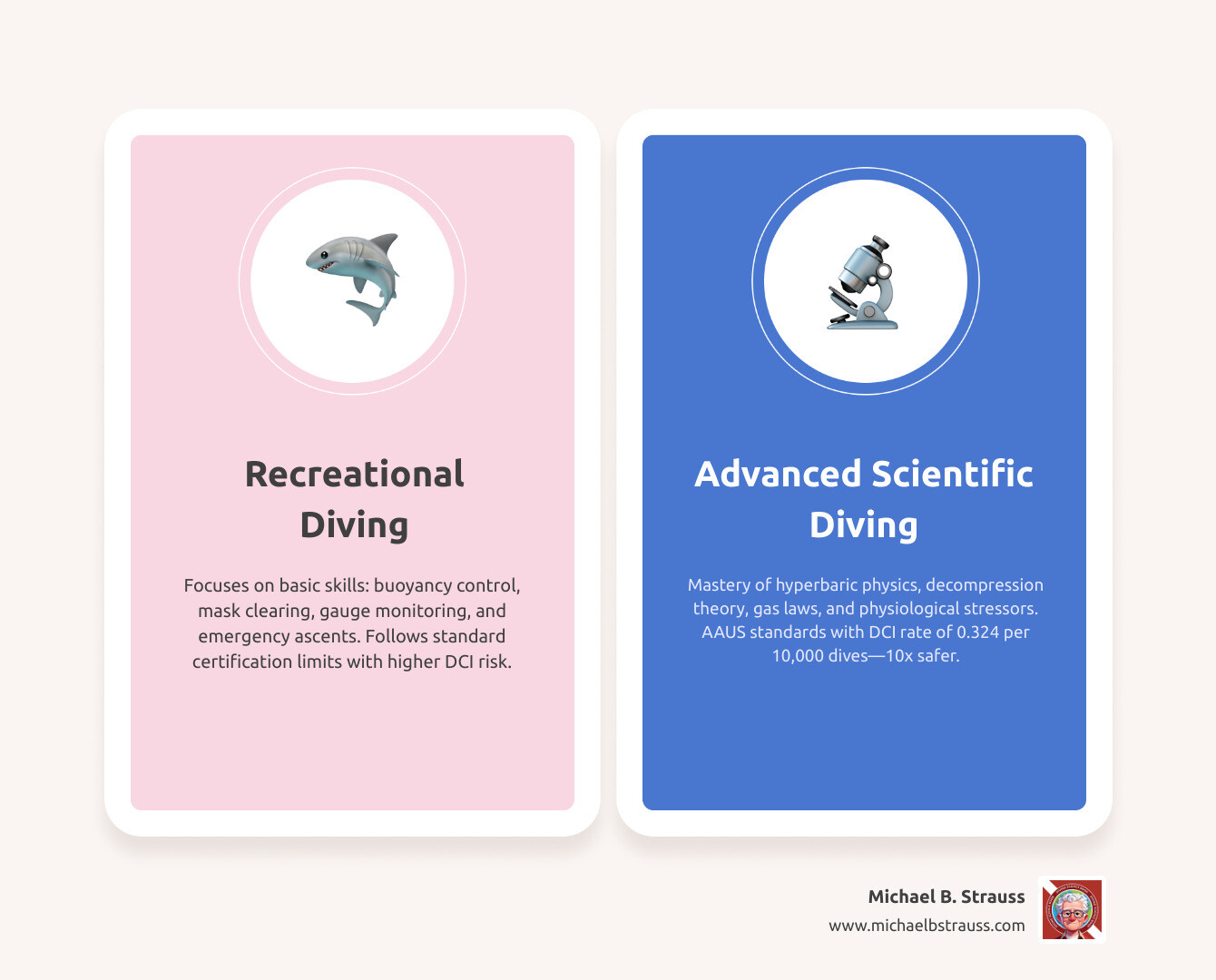
While recreational training focuses on "how" to dive—how to clear a mask, how to monitor a gauge—Advanced Diving Science focuses on "why" the body reacts the way it does. This distinction is codified in the legal and operational standards of the industry. In 1983, the American Academy of Underwater Sciences (AAUS) successfully lobbied for a scientific diving exemption from OSHA’s commercial diving standards. This exemption was granted because scientific diving programs utilize a consensual set of high-level standards, a Diving Safety Manual, and a Diving Control Board (DCB) to manage risk.
The Proprietary Insight: The Stimulus-Response Framework
At the heart of our approach to Advanced Diving Science is the Stimulus-Response Framework. In this model, every aspect of the underwater environment—increased partial pressures, thermal conductivity, gas density, and hydrostatic force—acts as a stimulus on the diver. The diver’s physiological and psychological reactions are the responses.
By understanding this framework, an instructor can predict how a student will react to nitrogen narcosis or cold-water stressors before the situation becomes critical. We do not just teach safety protocols; we teach how to manage the body's response to hyperbaric stimuli. This is the underlying principle for establishing the rigorous safety standards seen in professional organizations like the American Academy of Underwater Sciences.
Scientific Rationale vs. Recreational Rules
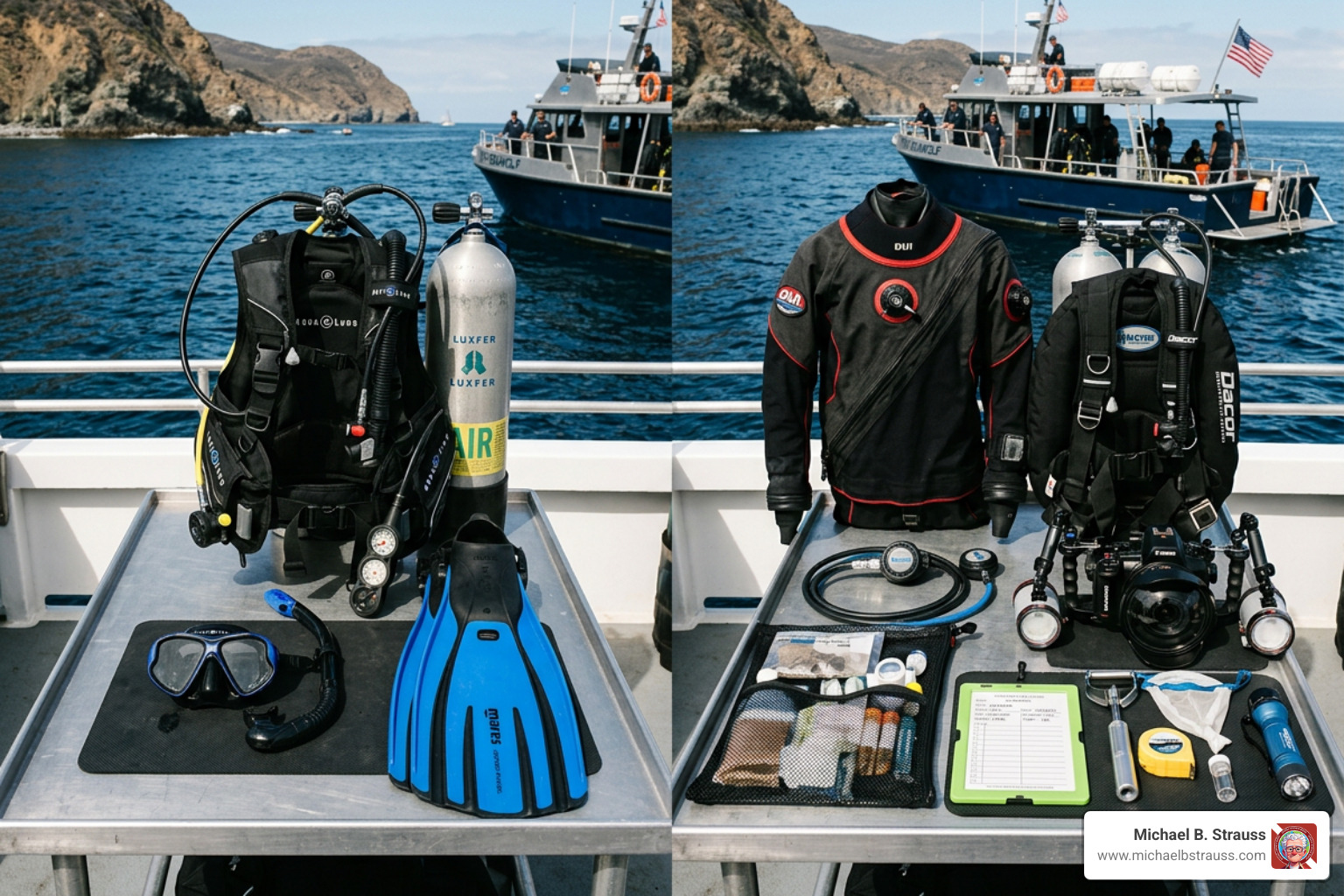
The following table illustrates why professional standards differ so significantly from recreational guidelines.
| Context | Depth Limit | Gas Management | Primary Goal |
|---|---|---|---|
| Recreational | 40m (130ft) | Single gas (Air/Nitrox) | Observation & Pleasure |
| Scientific (AAUS) | Variable (based on cert) | Redundant systems required | Data Collection/Research |
| Technical (TDI) | 100m+ (330ft+) | Hypoxic Trimix/Multiple stages | Exploration/Deep Tasking |
Scientific diving requires more than just being a "good diver." It requires the ability to use the scientific method while submerged. This means maintaining perfect buoyancy while performing complex tasks like core sampling, transect surveys, or utilizing full-face masks with communication systems.
Core Principles of Advanced Diving Science: Physics and Physiology
To master Advanced Diving Science, we must first master the physics that dictate our physiological limits. The primary gas laws—Boyle’s, Dalton’s, and Henry’s—are not just formulas to be memorized for an exam; they are the boundaries of human survival.
Hydrostatic Pressure and the Mammalian Diving Reflex
As we descend, hydrostatic pressure increases. This pressure affects every gas-filled space in the body. However, humans also possess a vestigial set of physiological responses known as the mammalian-divers reflex. This includes bradycardia (slowing of the heart rate) and peripheral vasoconstriction, which helps conserve oxygen. An advanced instructor understands how to leverage these natural responses to improve air consumption and diver calm.
Inert Gas Exchange and Oxygen Toxicity
We must also account for the absorption and elimination of inert gases (nitrogen or helium). As partial pressures increase (Dalton’s Law), these gases dissolve into the blood and tissues (Henry’s Law). If an instructor does not understand the nuances of gas solubility, they cannot effectively manage the risk of decompression sickness.
Furthermore, we must respect the limits of oxygen. At high partial pressures (typically above 1.4 or 1.6 ata), oxygen becomes toxic to the Central Nervous System (CNS), potentially causing seizures. In extreme deep diving, such as the TDI Advanced Trimix Diver level, we also encounter High Pressure Nervous Syndrome (HPNS), a condition caused by rapid compression that results in tremors and cognitive impairment.
Properly managing these risks requires an expert evaluation-and-management-of-pain-related-medical-problems-of-diving, ensuring that any physical symptom is accurately diagnosed as either a pressure-related injury or a musculoskeletal issue.
Mastering Decompression Theory within Advanced Diving Science
Decompression is perhaps the most misunderstood aspect of diving. It is not a simple "on-and-off" switch. It is a continuous process of gas tension management. To truly understand decompression-science, an instructor must look beyond the dive computer.
Bubble Mechanics and M-Values
Decompression sickness (DCS) occurs when the pressure reduces too quickly, causing dissolved gases to form bubbles in the tissues or bloodstream. But why-and-at-what-sites-decompression-sickness-can-occur is a matter of "M-values"—the maximum allowable tissue pressure for a specific tissue compartment.
Advanced instructors study these gradients to understand "silent bubbles"—microbubbles that form even during "no-decompression" dives. By understanding bubble mechanics, we can implement better safety stops and ascent rates that go beyond the minimum requirements of a standard PADI or SSI course.
Isobaric Counter Diffusion (ICD)
In advanced technical and scientific diving, we often switch gases. If a diver switches from a nitrogen-heavy gas to a helium-heavy gas at depth, the different diffusion rates of these gases can cause bubbles to form even without a change in ambient pressure. This is isobaric counter diffusion. Managing ICD is a hallmark of Advanced Diving Science and is critical for any instructor moving into the realm of TDI Advanced Trimix.
How Does Advanced Diving Science Inform Professional Standards and Training?
Professional standards are not arbitrary; they are the result of decades of incident data and hyperbaric research. Organizations like the AAUS maintain a DCI rate of 0.324 per 10,000 dives—a statistic that is roughly one-tenth that of the recreational diving world. This safety record is built on the foundation of the AAUS Standards For Scientific Diving.
Rigorous Training and Reciprocity
Unlike recreational certifications, which are often "one and done," professional scientific diving requires ongoing competency maintenance. For example, the Advanced Science Diving Program (ASDP) at FSU Panama City structures its curriculum around 8 credit hours of intensive training. Students earn certifications through IANTD and AAUS, but more importantly, they gain "reciprocity." This means an AAUS diver at one university can seamlessly join a research mission at another institution because their training meets a universal, high-level standard.
The Stimulus-Response Framework in Training Design
We use the stimulus-response framework to design training modules that prepare divers for "worst-case" scenarios. By intentionally introducing stressors—such as blacked-out masks to simulate silt-outs or complex task-loading—we train the diver’s response to be automatic and calm. This scientific approach to training reduces the likelihood of panic, which is the leading cause of diving fatalities.
What are the Career Paths and Safety Benefits of Advanced Diving Science?
Mastering Advanced Diving Science is more than a safety measure; it is a career accelerator. The field of scientific diving supports over $155 million in science funding every five years. This funding fuels a variety of professional paths that require high-level diving expertise.
Career Paths for Scientific Diving Graduates:
- Marine Biology & Ecology: Conducting surveys on coral reef health or invasive species.
- Underwater Archaeology: Mapping shipwrecks and recovering historical artifacts.
- Aquarium Diving: Managing large-scale habitats and animal health in facilities worldwide.
- Underwater Investigation: Working in maritime forensics or crime scene investigation.
- Governmental Research: Working with the NOAA Diving Program to support national oceanic missions.
- Environmental Consulting: Assessing the impact of coastal development on marine environments.
Programs like the ADAS Part 1 Restricted provide a streamlined pathway for those who want to work in onshore scientific diving or aquariums without the heavy construction elements of full commercial diving. This focus on "Scientific SCUBA" allows researchers to reach depths of 30m safely and efficiently.
Scholarship and Funding Opportunities for Aspiring Diving Scientists
The path to becoming a professional scientific diver can be demanding, but there is significant financial support available for those committed to the field. The AAUS Foundation alone has awarded over $210,000 in scholarships since 1996.
- AAUS Foundation Scholarships: Awarded to graduate students for research where diving is a primary tool.
- Zale Parry Scholarship: Specifically for candidates currently enrolled in a graduate program (Masters or Ph.D.).
- Women Divers Hall of Fame: Offers training grants (typically around $1,000) for underwater training and equipment.
- Our World Underwater Scholarship Society: Provides the prestigious Rolex North American Scholarship for hands-on introduction to underwater endeavors.
- PADI Foundation: Supports research and education related to aquatic environments.
- Bob Barth Underwater Research Scholarship: Available for students at FSU Panama City enrolled in diving courses.
Conclusion: Elevating Professional Standards with Dr. Michael B. Strauss
In the high-stakes world of professional diving, there is no substitute for scientific literacy. Advanced Diving Science is the barrier between a safe, productive mission and a hyperbaric accident. By moving beyond the basics of recreational training and embracing the complexities of physics, physiology, and decompression theory, instructors can provide their students with a level of safety that is statistically superior.
Dr. Michael B. Strauss has spent a lifetime bridging the gap between clinical medicine and the underwater world. His work on the stimulus-response framework and hyperbaric safety protocols has set a standard for how we understand the diver's interaction with the deep. Whether you are an aspiring scientific diver, a seasoned instructor, or a technical explorer, the principles of diving-science are your most important piece of equipment.
By prioritizing this knowledge, we do more than just follow rules; we honor the science that allows us to explore the final frontier of our planet.
Call to Action: To further your understanding of these critical concepts and to elevate your instructional capabilities, get your copy of the book Diving Science Revisited from this link: https://www.bestpub.com/view-all-products/product/diving-science-revisited/category_pathway-48.html. Equip yourself with the knowledge to lead, protect, and excel in every hyperbaric environment.
DISCLAIMER: Articles are for "EDUCATIONAL PURPOSES ONLY", not to be considered advice or recommendations.


