Read story

Why Divers Need More Than Standard Travel Insurance

Annual travel insurance including scuba diving provides year-round coverage for multiple diving trips, protecting you from dive-specific risks like decompression sickness, hyperbaric chamber costs, and equipment loss—risks that standard travel policies typically exclude.

What You Need to Know:

  • Coverage Duration: Unlimited trips over 12 months, with each trip typically limited to 30-90 days
  • Depth Limits: Most policies cover 30m independently, up to 40-50m with proper certification
  • Key Benefits: Emergency medical evacuation, hyperbaric treatment, gear protection, trip cancellation
  • Certification Required: You must be certified to the diving depth you're undertaking
  • Cost Advantage: More economical than buying separate policies if you dive twice or more per year

While diving offers unparalleled experiences, it carries inherent risks that demand specialized protection. Standard travel insurance policies often classify scuba diving as an "extreme sport," excluding it from basic coverage. This leaves divers exposed to catastrophic costs, as a single hyperbaric chamber treatment can exceed $10,000 and emergency evacuation can cost significantly more.

For frequent divers, an annual policy is a practical solution. It eliminates the need to buy new coverage for each trip, protecting you for both diving and non-diving travel all year. Beyond medical emergencies, these policies often cover lost equipment and trip cancellations, providing comprehensive peace of mind.
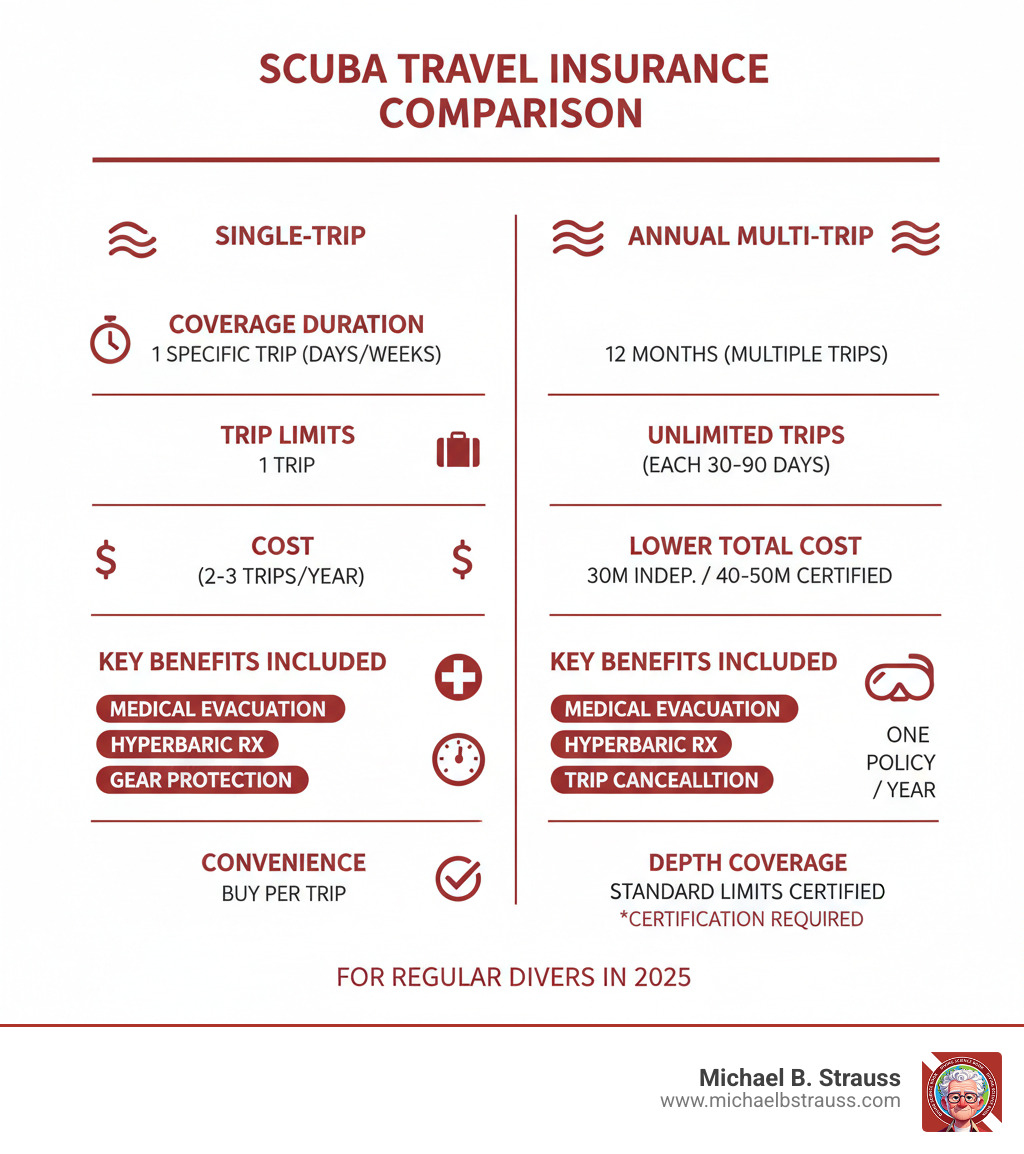
Infographic comparing single-trip versus annual multi-trip travel insurance for scuba divers, showing coverage duration, trip limits, cost comparison for 2-3 trips per year, included benefits like medical evacuation and hyperbaric treatment, depth coverage limits, and convenience factors - annual travel insurance including scuba diving infographic

Understanding Annual Travel Insurance Including Scuba Diving

Annual travel insurance including scuba diving is a specialized shield for divers, going far beyond standard coverage for missed flights or lost luggage.

image of a hyperbaric chamber - annual travel insurance including scuba diving

Unlike a single-trip policy that covers one journey, an annual policy protects you for unlimited trips over 12 months, though each trip has a duration limit (e.g., 30-90 days). For frequent divers, this means you're always covered, whether for a planned expedition or a spontaneous weekend dive. This convenience extends to all your travel throughout the year, including non-diving trips, all under one policy.

Why Standard Travel Insurance Isn't Enough for Divers

Most standard travel policies are inadequate for divers because they classify scuba diving as an adventurous activity, which is typically excluded from coverage. This leaves you unprotected against dive-specific risks.

Diving carries unique dangers like Decompression Sickness (DCS), which requires urgent treatment in a hyperbaric chamber—a service that can cost thousands of dollars per session. Furthermore, many prime dive spots are remote, and an emergency medical evacuation can run into the tens of thousands. Standard policies and national healthcare plans rarely cover these high costs, making specialized dive insurance essential.

To understand the science behind these risks, explore our resource on Decompression Science. This knowledge highlights why specialized coverage is a necessity, not a luxury.

Key Coverage Features in an annual travel insurance including scuba diving policy

When choosing a policy, focus on these essential dive-specific benefits:

  • Emergency Medical Evacuation: Covers transport from a remote dive site to an appropriate medical facility.
  • Hyperbaric Chamber Treatment: Specific coverage for recompression therapy to treat decompression sickness.
  • Diving Equipment Coverage: Protects your investment by covering lost, stolen, or damaged gear.
  • Lost Diving Days: Compensates you for prepaid dives you miss due to bad weather, boat issues, or a medical inability to dive.
  • Trip Cancellation and Interruption: Safeguards your financial investment if you have to cancel or cut your trip short.
  • Depth Limits: The policy specifies the maximum depth you are covered for, usually tied to your certification level (e.g., 30-50 meters).
  • Personal Liability: Protects you if you accidentally cause injury to another person or damage to property while diving.
  • Search and Rescue: Covers the costs of rescue operations in remote areas.

Most comprehensive dive insurance policies also include standard travel protections like coverage for non-diving medical issues, travel delays, and lost baggage.

Decoding Policy Details: What's Covered and What's Not?

Understanding your policy's fine print is crucial. Pay close attention to these key areas:

  • Certification and Depth Limits: Insurers require you to be certified for the depth you are diving to. Policies have specific depth limits (e.g., 18m, 40m, 50m). Always dive within your training and policy limits.
  • Common Exclusions: Be aware of what is not covered. Common exclusions include professional diving, diving against medical or government travel advice, diving under the influence, and often solo diving. Check your policy for specifics.
  • Pre-existing Medical Conditions: You must declare all pre-existing conditions to your insurer. Failure to do so can void your entire policy. For more on how diving affects the body, see our resource on Diving Science.

Always read your policy thoroughly and contact your insurer to clarify any questions before you travel.

The Cost Factor: What Influences Your Premium?

The cost of an annual travel insurance including scuba diving policy depends on several factors:

  • Age: Premiums are typically lower for younger travelers.
  • Destination: Coverage for regions with high medical costs, like the USA, is more expensive.
  • Trip Duration: Policies with longer per-trip limits (e.g., 90 days vs. 30 days) cost more.
  • Coverage Level: Higher tiers offer more generous benefit limits but come with a higher premium.
  • Add-ons: Including scuba diving often requires selecting an activity pack, which may define your depth limit.
  • Pre-existing Conditions: Declared medical conditions may increase the premium, but non-disclosure can void your policy.

Securing Your Year of Underwater Adventures

Proper planning for a year of diving requires solid protection. An annual travel insurance including scuba diving policy is the foundation for worry-free adventures, on land and underwater.

world map with popular dive sites marked - annual travel insurance including scuba diving

Whether you're exploring the historic wrecks of the Red Sea, the biodiversity of the Galapagos, or the cenotes of Mexico, each destination presents unique challenges. Comprehensive annual coverage allows you to explore these wonders with confidence, knowing that medical emergencies or travel disruptions are covered.

The Annual Advantage: Why an annual travel insurance including scuba diving policy makes sense

For anyone taking two or more dive trips a year, an annual travel insurance including scuba diving policy is the smartest choice. It offers significant advantages in cost, convenience, and flexibility.

  • Cost-Effective: An annual plan is almost always cheaper than buying multiple single-trip policies.
  • Convenient: It eliminates the hassle of arranging insurance for every trip. Your coverage is always active, ready for planned vacations or last-minute getaways.
  • Spontaneous: With insurance in place, you can take advantage of surprise travel deals without delay.
  • Versatile: These policies cover all your travel for the year, not just diving trips, adding to the overall value.

Modern travel requires planning for unexpected global events. Many annual travel insurance including scuba diving policies now include coverage for COVID-19 related issues, such as medical treatment or trip cancellation. However, benefits vary widely, so read your policy's specific terms.

Natural disasters can also disrupt dive trips. Check if your policy compensates for lost diving days due to severe weather. Most importantly, always monitor travel advisories from official sources like the World Health Organization and the U.S. Department of State. Traveling against a "Do Not Travel" advisory will likely void your insurance coverage.

Final Checklist Before You Travel

Before you depart, run through this final checklist to ensure your annual travel insurance including scuba diving is ready for your adventure.

diver checking their gear on a boat before a dive - annual travel insurance including scuba diving

  • Review Your Policy: Read the documents carefully. Confirm your coverage for depth limits, medical evacuation, hyperbaric treatment, and any declared pre-existing conditions.
  • Prepare Documents: Save your policy information and emergency contact numbers both digitally and in a physical waterproof bag. Know the 24/7 emergency hotline number.
  • Understand the Claims Process: Know what's required to file a claim, including necessary documentation and reporting deadlines. Have proof of insurance ready for dive operators.
  • Prioritize Safety Knowledge: Insurance is a safety net, not a replacement for safe diving practices. Improve your understanding of diving safety with the comprehensive diving books by Dr. Michael B. Strauss. These essential resources for scuba divers work hand-in-hand with your insurance to keep you protected. For more, explore our diving resources.

With this preparation, you can dive with confidence and peace of mind.

To enhance your diving safety and knowledge, get your copy of "Diving Science Revisited" here: https://www.bestpub.com/view-all-products/product/diving-science-revisited/category_pathway-48.html

DISCLAIMER: Articles are for "EDUCATIONAL PURPOSES ONLY", not to be considered advice or recommendations.

Download Full PDF
Tags:

Why Divers Need More Than Standard Travel Insurance

Annual travel insurance including scuba diving provides year-round coverage for multiple diving trips, protecting you from dive-specific risks like decompression sickness, hyperbaric chamber costs, and equipment loss—risks that standard travel policies typically exclude.

What You Need to Know:

  • Coverage Duration: Unlimited trips over 12 months, with each trip typically limited to 30-90 days
  • Depth Limits: Most policies cover 30m independently, up to 40-50m with proper certification
  • Key Benefits: Emergency medical evacuation, hyperbaric treatment, gear protection, trip cancellation
  • Certification Required: You must be certified to the diving depth you're undertaking
  • Cost Advantage: More economical than buying separate policies if you dive twice or more per year

While diving offers unparalleled experiences, it carries inherent risks that demand specialized protection. Standard travel insurance policies often classify scuba diving as an "extreme sport," excluding it from basic coverage. This leaves divers exposed to catastrophic costs, as a single hyperbaric chamber treatment can exceed $10,000 and emergency evacuation can cost significantly more.

For frequent divers, an annual policy is a practical solution. It eliminates the need to buy new coverage for each trip, protecting you for both diving and non-diving travel all year. Beyond medical emergencies, these policies often cover lost equipment and trip cancellations, providing comprehensive peace of mind.

Infographic comparing single-trip versus annual multi-trip travel insurance for scuba divers, showing coverage duration, trip limits, cost comparison for 2-3 trips per year, included benefits like medical evacuation and hyperbaric treatment, depth coverage limits, and convenience factors - annual travel insurance including scuba diving infographic

Understanding Annual Travel Insurance Including Scuba Diving

Annual travel insurance including scuba diving is a specialized shield for divers, going far beyond standard coverage for missed flights or lost luggage.

image of a hyperbaric chamber - annual travel insurance including scuba diving

Unlike a single-trip policy that covers one journey, an annual policy protects you for unlimited trips over 12 months, though each trip has a duration limit (e.g., 30-90 days). For frequent divers, this means you're always covered, whether for a planned expedition or a spontaneous weekend dive. This convenience extends to all your travel throughout the year, including non-diving trips, all under one policy.

Why Standard Travel Insurance Isn't Enough for Divers

Most standard travel policies are inadequate for divers because they classify scuba diving as an adventurous activity, which is typically excluded from coverage. This leaves you unprotected against dive-specific risks.

Diving carries unique dangers like Decompression Sickness (DCS), which requires urgent treatment in a hyperbaric chamber—a service that can cost thousands of dollars per session. Furthermore, many prime dive spots are remote, and an emergency medical evacuation can run into the tens of thousands. Standard policies and national healthcare plans rarely cover these high costs, making specialized dive insurance essential.

To understand the science behind these risks, explore our resource on Decompression Science. This knowledge highlights why specialized coverage is a necessity, not a luxury.

Key Coverage Features in an annual travel insurance including scuba diving policy

When choosing a policy, focus on these essential dive-specific benefits:

  • Emergency Medical Evacuation: Covers transport from a remote dive site to an appropriate medical facility.
  • Hyperbaric Chamber Treatment: Specific coverage for recompression therapy to treat decompression sickness.
  • Diving Equipment Coverage: Protects your investment by covering lost, stolen, or damaged gear.
  • Lost Diving Days: Compensates you for prepaid dives you miss due to bad weather, boat issues, or a medical inability to dive.
  • Trip Cancellation and Interruption: Safeguards your financial investment if you have to cancel or cut your trip short.
  • Depth Limits: The policy specifies the maximum depth you are covered for, usually tied to your certification level (e.g., 30-50 meters).
  • Personal Liability: Protects you if you accidentally cause injury to another person or damage to property while diving.
  • Search and Rescue: Covers the costs of rescue operations in remote areas.

Most comprehensive dive insurance policies also include standard travel protections like coverage for non-diving medical issues, travel delays, and lost baggage.

Decoding Policy Details: What's Covered and What's Not?

Understanding your policy's fine print is crucial. Pay close attention to these key areas:

  • Certification and Depth Limits: Insurers require you to be certified for the depth you are diving to. Policies have specific depth limits (e.g., 18m, 40m, 50m). Always dive within your training and policy limits.
  • Common Exclusions: Be aware of what is not covered. Common exclusions include professional diving, diving against medical or government travel advice, diving under the influence, and often solo diving. Check your policy for specifics.
  • Pre-existing Medical Conditions: You must declare all pre-existing conditions to your insurer. Failure to do so can void your entire policy. For more on how diving affects the body, see our resource on Diving Science.

Always read your policy thoroughly and contact your insurer to clarify any questions before you travel.

The Cost Factor: What Influences Your Premium?

The cost of an annual travel insurance including scuba diving policy depends on several factors:

  • Age: Premiums are typically lower for younger travelers.
  • Destination: Coverage for regions with high medical costs, like the USA, is more expensive.
  • Trip Duration: Policies with longer per-trip limits (e.g., 90 days vs. 30 days) cost more.
  • Coverage Level: Higher tiers offer more generous benefit limits but come with a higher premium.
  • Add-ons: Including scuba diving often requires selecting an activity pack, which may define your depth limit.
  • Pre-existing Conditions: Declared medical conditions may increase the premium, but non-disclosure can void your policy.

Securing Your Year of Underwater Adventures

Proper planning for a year of diving requires solid protection. An annual travel insurance including scuba diving policy is the foundation for worry-free adventures, on land and underwater.

world map with popular dive sites marked - annual travel insurance including scuba diving

Whether you're exploring the historic wrecks of the Red Sea, the biodiversity of the Galapagos, or the cenotes of Mexico, each destination presents unique challenges. Comprehensive annual coverage allows you to explore these wonders with confidence, knowing that medical emergencies or travel disruptions are covered.

The Annual Advantage: Why an annual travel insurance including scuba diving policy makes sense

For anyone taking two or more dive trips a year, an annual travel insurance including scuba diving policy is the smartest choice. It offers significant advantages in cost, convenience, and flexibility.

  • Cost-Effective: An annual plan is almost always cheaper than buying multiple single-trip policies.
  • Convenient: It eliminates the hassle of arranging insurance for every trip. Your coverage is always active, ready for planned vacations or last-minute getaways.
  • Spontaneous: With insurance in place, you can take advantage of surprise travel deals without delay.
  • Versatile: These policies cover all your travel for the year, not just diving trips, adding to the overall value.

Modern travel requires planning for unexpected global events. Many annual travel insurance including scuba diving policies now include coverage for COVID-19 related issues, such as medical treatment or trip cancellation. However, benefits vary widely, so read your policy's specific terms.

Natural disasters can also disrupt dive trips. Check if your policy compensates for lost diving days due to severe weather. Most importantly, always monitor travel advisories from official sources like the World Health Organization and the U.S. Department of State. Traveling against a "Do Not Travel" advisory will likely void your insurance coverage.

Final Checklist Before You Travel

Before you depart, run through this final checklist to ensure your annual travel insurance including scuba diving is ready for your adventure.

diver checking their gear on a boat before a dive - annual travel insurance including scuba diving

  • Review Your Policy: Read the documents carefully. Confirm your coverage for depth limits, medical evacuation, hyperbaric treatment, and any declared pre-existing conditions.
  • Prepare Documents: Save your policy information and emergency contact numbers both digitally and in a physical waterproof bag. Know the 24/7 emergency hotline number.
  • Understand the Claims Process: Know what's required to file a claim, including necessary documentation and reporting deadlines. Have proof of insurance ready for dive operators.
  • Prioritize Safety Knowledge: Insurance is a safety net, not a replacement for safe diving practices. Improve your understanding of diving safety with the comprehensive diving books by Dr. Michael B. Strauss. These essential resources for scuba divers work hand-in-hand with your insurance to keep you protected. For more, explore our diving resources.

With this preparation, you can dive with confidence and peace of mind.

To enhance your diving safety and knowledge, get your copy of "Diving Science Revisited" here: https://www.bestpub.com/view-all-products/product/diving-science-revisited/category_pathway-48.html

DISCLAIMER: Articles are for "EDUCATIONAL PURPOSES ONLY", not to be considered advice or recommendations.