Read story

Why the Right Reading Makes All the Difference for Galapagos Diving

galapagos diving - best diving books galapagos

The best diving books galapagos divers recommend include:

  • The Diving Guide: Galapagos Islands by Steve Rosenberg - 43 dive sites with detailed conditions and topography
  • Reef Fish Identification: Galapagos by Paul Humann - Essential for identifying marine species
  • Marine Life of the Galapagos by Pierre Constant - Comprehensive diver's guide to fishes, whales, dolphins, and invertebrates
  • Wildlife of the Galápagos by Julian Fitter - All-in-one guide covering marine and terrestrial life
  • Galápagos: The Islands That Changed the World by Paul D. Stewart - Natural history and conservation context

The Galapagos Islands sit at the intersection of three major ocean currents, creating one of the planet's most biodiverse marine protected areas. This unique convergence brings nutrient-rich waters that support everything from hammerhead shark schools to marine iguanas—the world's only aquatic lizards.

However, these conditions also create challenges. Visibility can be limited to 25-49 feet, water temperatures drop suddenly at thermoclines, and strong currents mean most dives are drift dives that require experience.

The right books transform your trip. They help you identify a mola mola, understand why you're seeing penguins at the equator, and prepare for the cold upwellings that bring Galapagos sharks from the depths.

Whether you're on a land-based trip from Santa Cruz or a liveaboard to the legendary Darwin and Wolf Islands, a good reading list is as crucial as your gear check. The books below cover dive sites, marine biology, and the evolutionary history that makes these islands so special.
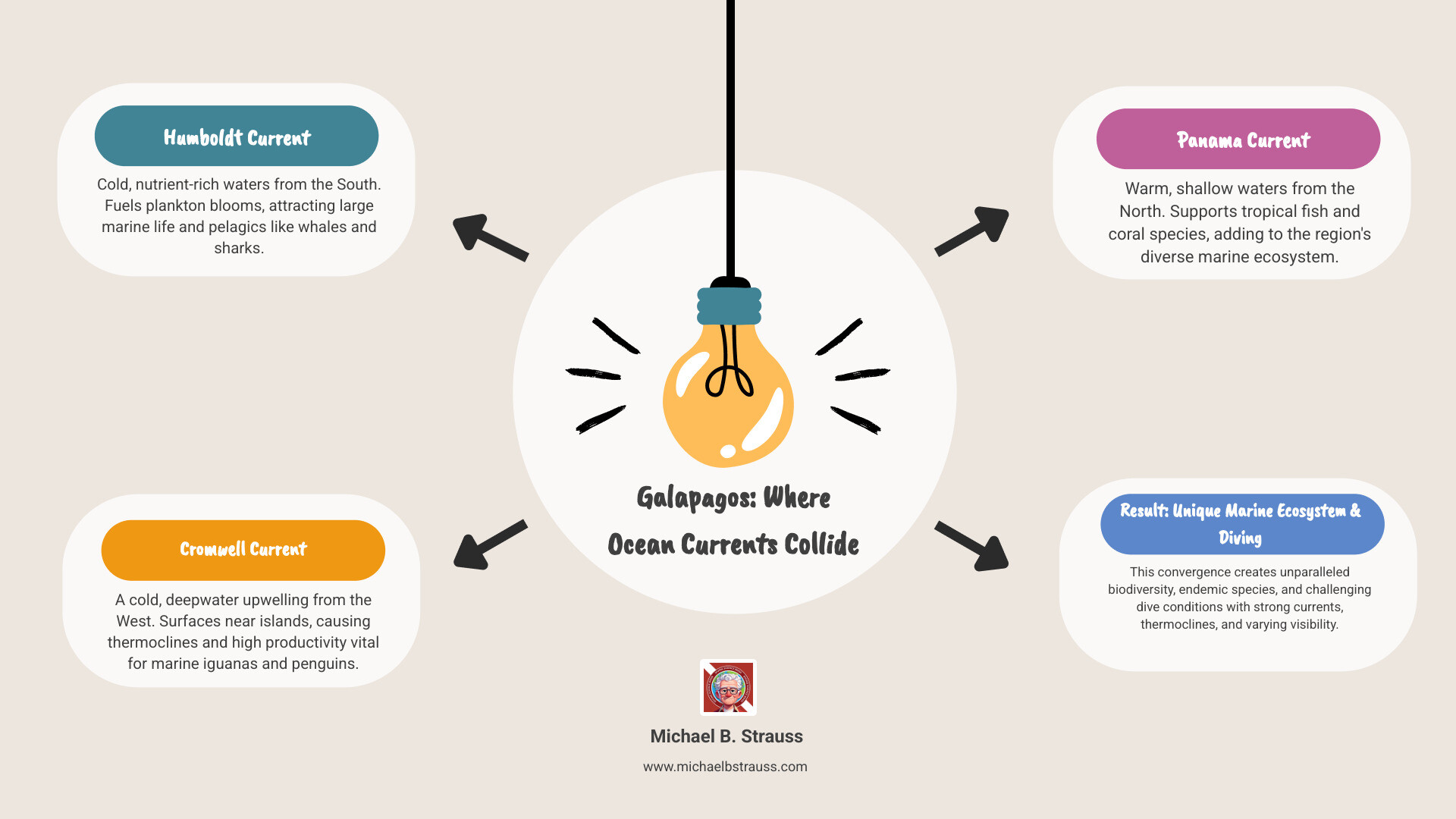
Infographic showing the Humboldt, Cromwell, and Panama currents converging at the Galapagos Islands, with labeled arrows indicating current flow patterns, water temperature zones, and key marine species found in each current system including hammerhead sharks, mola mola, and marine iguanas - best diving books galapagos infographic brainstorm-4-items

Basic best diving books galapagos vocab:

The Best Diving Books Galapagos Divers Swear By

A diving adventure in the Galapagos, the "Underwater Serengeti," is a dream for many. To safely steer these unique waters and fully appreciate the spectacle, preparation is key. We've curated a list of the best diving books Galapagos explorers should read, covering dive sites, species identification, and the islands' history to improve your encounters both above and below the surface.

Essential Guides to Galapagos Dive Sites & Travel

When planning a dive trip to a destination as unique as the Galapagos, comprehensive guides are invaluable. They offer practical advice, detailed maps, and critical insights into the local environment, from navigating dive sites to making the most of your time on land.

  • The Diving Guide: Galapagos Islands by Steve Rosenberg and Ellen I. SarboneThis cornerstone guide offers an exhaustive look at the archipelago's underwater world, with in-depth descriptions of 43 dive sites. It provides comprehensive details on conditions, depths, topography, and marine life for each location, from the currents of Wolf and Darwin to the hammerhead schools of Seymour Channel. The book also includes land tour descriptions and advice on the best times to dive, making it an essential resource.

  • Galápagos (Mostly Underwater Books Travel Guide) by Josef LittThis guide combines practical travel advice with rich anecdotal content and over 300 stunning photographs. It offers divers insights into both the underwater experience and broader travel logistics, immersing you in the spirit of the islands before you arrive.

  • The Rough Guide to Ecuador & the Galápagos by Rough GuidesWhile not a dedicated diving book, this guide is an excellent resource for planning your entire trip. It offers practical information and expert recommendations on travel, accommodations, and land-based activities, helping you combine your underwater adventures with the rich terrestrial experiences the Galapagos offers.

The Best Diving Books for Galapagos Marine Life Identification

The Galapagos Marine Reserve is a wonderland of biodiversity. Identifying the incredible creatures you encounter is a huge part of the diving experience. These identification guides are indispensable tools for divers and snorkelers alike.

  • Reef Fish Identification: Galapagos by Paul Humann (edited by Ned Deloach)Paul Humann's guides are legendary in the diving community. This Galapagos edition is an essential companion for identifying the region's diverse fish, featuring numerous color photographs and detailed descriptions. It's perfect for both novices and experienced divers wanting to confidently identify the unique marine life.

  • Marine Life of the Galapagos: A Diver’s Guide to the Fishes, Whales, Dolphins and Marine Invertebrates by Pierre ConstantThis guide goes beyond fish to cover whales, dolphins, and marine invertebrates. With 288 color photographs, it's an excellent tool for understanding the broader marine ecosystem, from tiny nudibranchs to colossal whale sharks. Its detailed coverage also makes it great for snorkelers.

  • Galapagos Marine Life (submersible field-guide) by Ceslo MontalvoFor quick identification on the boat, this waterproof, pocket-sized accordion-style guide is ideal. It features vibrant photos and straightforward information on commonly observed marine life, making it a practical tool for immediate reference after a dive.

  • Wildlife of the Galápagos by Julian Fitter, Daniel Fitter, and David HoskingThis all-in-one compact guide covers both marine and terrestrial life. With over 650 color photographs, it provides an overview of the islands' history, climate, and geology, along with visitor site maps. It's a superbly illustrated guide that links the underwater world with iconic land species, offering a complete picture of the Galapagos ecosystem.

These identification guides ensure that every encounter becomes a moment of informed wonder.
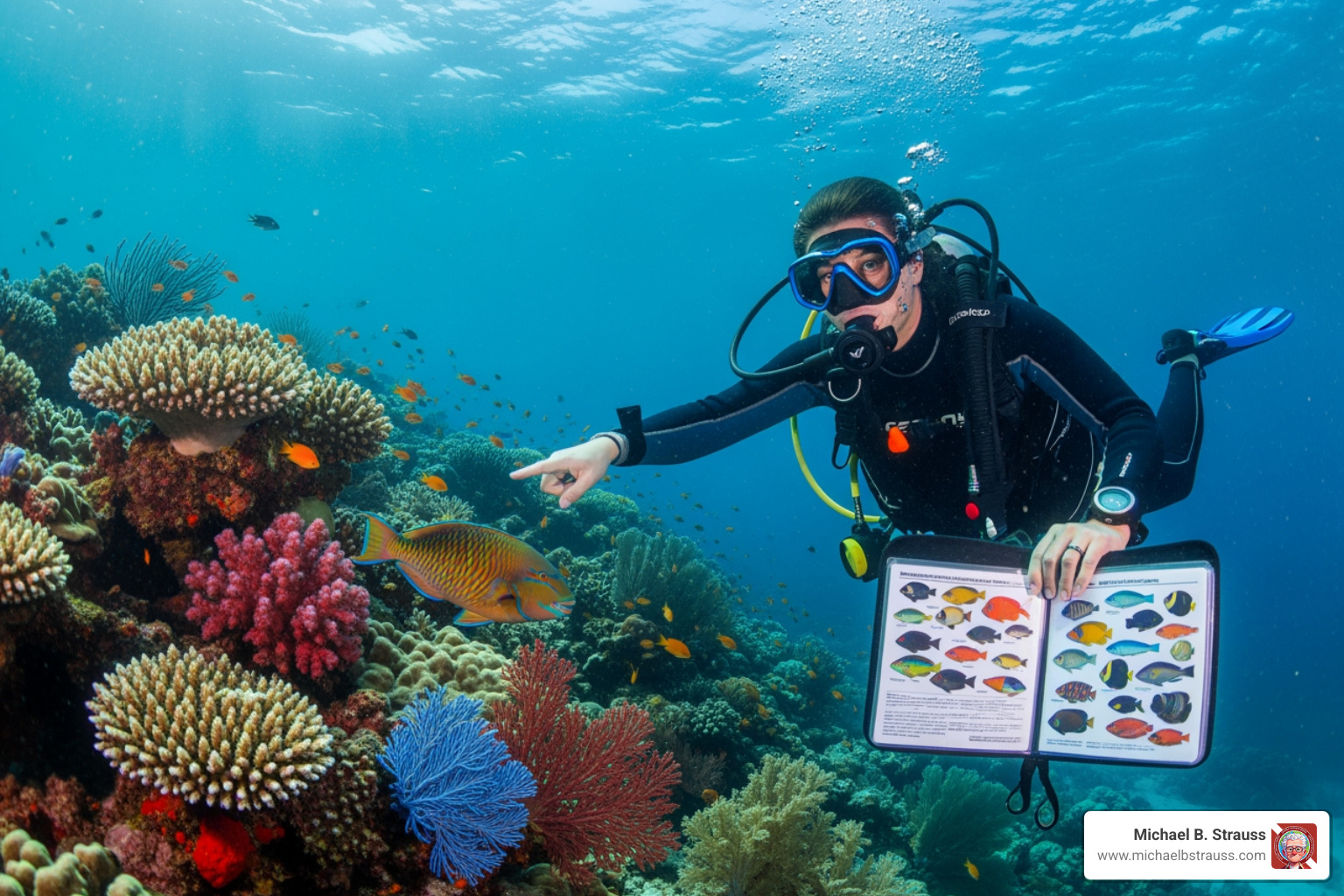
A diver pointing at a colorful reef fish, with a submersible identification guide in their other hand - best diving books galapagos

The Best Diving Books for Galapagos Science and History

Understanding the scientific and historical context of the Galapagos deepens our appreciation for the unique environment. These books offer insights that make the diving experience more meaningful.

  • Voyage of the Beagle by Charles DarwinDarwin's classic account of his five-year voyage is essential for understanding the historical and scientific significance of the Galapagos. First published in 1839, it remains a marvelous introduction to the wildlife and nature that shaped his world-changing ideas on evolution.

  • The Beak of the Finch by Jonathan WeinerThis Pulitzer Prize-winning book offers an accessible look at evolution in action. It chronicles the decades-long research of Peter and Rosemary Grant, who proved Darwin's theory was even stronger than he knew. The book highlights the islands' role as a living laboratory for evolutionary biology.

  • Galápagos: The Islands That Changed the World by Paul D. StewartThis is a complete guide to the environment, wildlife, and human history of the islands. It covers geology, flora, fauna, and their role in scientific thought, particularly Darwin's theories. The book also includes a gazetteer of endemic species and practical travel advice, making it an indispensable reference.

  • Understanding the Unique Physiology of Mammalian DiversFor those intrigued by the adaptations of marine life, delving into the science behind mammalian divers like Galapagos sea lions is fascinating. Dr. Michael B. Strauss, a renowned expert in diving safety, offers invaluable insights into the physiology of these creatures. His work helps us appreciate the biological marvels that allow animals to thrive underwater, from managing pressure changes to optimizing oxygen use. Understanding these adaptations enriches our perspective on the marine mammals we encounter. Read more.

These books provide a robust understanding of the Galapagos's significance, turning a dive trip into an educational and enriching journey.

A Galapagos sea lion gracefully swimming underwater, showcasing its natural adaptations for diving - best diving books galapagos

Complementary Reading for a Full Galapagos Experience

While our focus is on the best diving books Galapagos has to offer, the islands' magic extends far beyond the reef. These additional resources provide a richer context for your diving adventures.

  • Galapagos Wildlife by David Horwell and Pete OxfordThis compact photographic guide is excellent for identifying the birds, reptiles, and marine life you'll encounter. With chapters on visitor sites, history, and conservation, it's a perfect companion for land excursions, bridging the gap between underwater and terrestrial observations.

  • Ecuador and the Galapagos Islands (Guide to Wildlife) by David Pearson and Les BeletskyThis beautifully illustrated book covers the magnificent animal life of both mainland Ecuador and the Galapagos. Its broad scope is great for travelers exploring the wider region, placing the islands in a larger ecological context.

  • Birds, Mammals, and Reptiles of the Galápagos Islands: An Identification Guide by Andy Swach and Rob StillThis is the first comprehensive identification guide focused specifically on the unique birds, mammals, and reptiles of the Galapagos. Its simple-to-use format is invaluable for divers who also enjoy observing the islands' famous land animals, from blue-footed boobies to giant tortoises.

  • Galapagos National Geographic Adventure Map by National Geographic MapsIn a remote location like the Galapagos, a physical map is invaluable. This waterproof and tear-resistant map provides an overview of the island chain and details on each major island's endemic species. It's useful for tracking routes and learning about the environment where digital access is limited.

  • Floreana, A Woman’s Pilgrimage to the Galapagos by Margaret WittmerFor a taste of human history, this is a captivating first-hand account from Margaret Wittmer, who settled on Floreana Island in 1932. It includes her story of the infamous 'Galapagos Affair,' a real-life murder mystery. This book adds another layer to your appreciation of these remote islands.

These complementary readings ensure your journey is a holistic exploration of one of the world's most extraordinary natural and historical treasures.

Final Thoughts: Dive Deeper and Safer

A diver gliding through a school of hammerhead sharks is an iconic Galapagos moment. This “Underwater Serengeti” is a bucket-list destination, where unique currents create a haven for endemic species like marine iguanas and Galapagos sea lions. The right pre-dive reading improves your experience, aids wildlife identification, and prepares you for the region’s challenging conditions.

We've explored the best diving books Galapagos enthusiasts can find, from dive site guides to scientific accounts. These resources provide the tools to appreciate the Galapagos on a deeper level, turning a vacation into an enriching expedition.

However, knowledge is only part of the equation. The Galapagos presents challenges like strong currents and thermoclines that demand a focus on safety. As diving safety expert Dr. Michael B. Strauss emphasizes, prioritizing safety is key. Understanding principles like Decompression Science is crucial for the advanced profiles common in the Galapagos. Dr. Strauss's comprehensive diving books are essential reads for gaining invaluable insights into safe diving practices.

We encourage you to explore these books to understand the delicate balance of this incredible ecosystem and its history. For more expert insights to ensure every dive is a safe one, and to continue your journey of learning about the underwater world, get your copy of Diving Science Revisited here: https://www.bestpub.com/view-all-products/product/diving-science-revisited/category_pathway-48.html

DISCLAIMER: Articles are for "EDUCATIONAL PURPOSES ONLY", not to be considered advice or recommendations.

Download Full PDF
Tags:

Why the Right Reading Makes All the Difference for Galapagos Diving

galapagos diving - best diving books galapagos

The best diving books galapagos divers recommend include:

  • The Diving Guide: Galapagos Islands by Steve Rosenberg - 43 dive sites with detailed conditions and topography
  • Reef Fish Identification: Galapagos by Paul Humann - Essential for identifying marine species
  • Marine Life of the Galapagos by Pierre Constant - Comprehensive diver's guide to fishes, whales, dolphins, and invertebrates
  • Wildlife of the Galápagos by Julian Fitter - All-in-one guide covering marine and terrestrial life
  • Galápagos: The Islands That Changed the World by Paul D. Stewart - Natural history and conservation context

The Galapagos Islands sit at the intersection of three major ocean currents, creating one of the planet's most biodiverse marine protected areas. This unique convergence brings nutrient-rich waters that support everything from hammerhead shark schools to marine iguanas—the world's only aquatic lizards.

However, these conditions also create challenges. Visibility can be limited to 25-49 feet, water temperatures drop suddenly at thermoclines, and strong currents mean most dives are drift dives that require experience.

The right books transform your trip. They help you identify a mola mola, understand why you're seeing penguins at the equator, and prepare for the cold upwellings that bring Galapagos sharks from the depths.

Whether you're on a land-based trip from Santa Cruz or a liveaboard to the legendary Darwin and Wolf Islands, a good reading list is as crucial as your gear check. The books below cover dive sites, marine biology, and the evolutionary history that makes these islands so special.

Infographic showing the Humboldt, Cromwell, and Panama currents converging at the Galapagos Islands, with labeled arrows indicating current flow patterns, water temperature zones, and key marine species found in each current system including hammerhead sharks, mola mola, and marine iguanas - best diving books galapagos infographic brainstorm-4-items

Basic best diving books galapagos vocab:

The Best Diving Books Galapagos Divers Swear By

A diving adventure in the Galapagos, the "Underwater Serengeti," is a dream for many. To safely steer these unique waters and fully appreciate the spectacle, preparation is key. We've curated a list of the best diving books Galapagos explorers should read, covering dive sites, species identification, and the islands' history to improve your encounters both above and below the surface.

Essential Guides to Galapagos Dive Sites & Travel

When planning a dive trip to a destination as unique as the Galapagos, comprehensive guides are invaluable. They offer practical advice, detailed maps, and critical insights into the local environment, from navigating dive sites to making the most of your time on land.

  • The Diving Guide: Galapagos Islands by Steve Rosenberg and Ellen I. SarboneThis cornerstone guide offers an exhaustive look at the archipelago's underwater world, with in-depth descriptions of 43 dive sites. It provides comprehensive details on conditions, depths, topography, and marine life for each location, from the currents of Wolf and Darwin to the hammerhead schools of Seymour Channel. The book also includes land tour descriptions and advice on the best times to dive, making it an essential resource.

  • Galápagos (Mostly Underwater Books Travel Guide) by Josef LittThis guide combines practical travel advice with rich anecdotal content and over 300 stunning photographs. It offers divers insights into both the underwater experience and broader travel logistics, immersing you in the spirit of the islands before you arrive.

  • The Rough Guide to Ecuador & the Galápagos by Rough GuidesWhile not a dedicated diving book, this guide is an excellent resource for planning your entire trip. It offers practical information and expert recommendations on travel, accommodations, and land-based activities, helping you combine your underwater adventures with the rich terrestrial experiences the Galapagos offers.

The Best Diving Books for Galapagos Marine Life Identification

The Galapagos Marine Reserve is a wonderland of biodiversity. Identifying the incredible creatures you encounter is a huge part of the diving experience. These identification guides are indispensable tools for divers and snorkelers alike.

  • Reef Fish Identification: Galapagos by Paul Humann (edited by Ned Deloach)Paul Humann's guides are legendary in the diving community. This Galapagos edition is an essential companion for identifying the region's diverse fish, featuring numerous color photographs and detailed descriptions. It's perfect for both novices and experienced divers wanting to confidently identify the unique marine life.

  • Marine Life of the Galapagos: A Diver’s Guide to the Fishes, Whales, Dolphins and Marine Invertebrates by Pierre ConstantThis guide goes beyond fish to cover whales, dolphins, and marine invertebrates. With 288 color photographs, it's an excellent tool for understanding the broader marine ecosystem, from tiny nudibranchs to colossal whale sharks. Its detailed coverage also makes it great for snorkelers.

  • Galapagos Marine Life (submersible field-guide) by Ceslo MontalvoFor quick identification on the boat, this waterproof, pocket-sized accordion-style guide is ideal. It features vibrant photos and straightforward information on commonly observed marine life, making it a practical tool for immediate reference after a dive.

  • Wildlife of the Galápagos by Julian Fitter, Daniel Fitter, and David HoskingThis all-in-one compact guide covers both marine and terrestrial life. With over 650 color photographs, it provides an overview of the islands' history, climate, and geology, along with visitor site maps. It's a superbly illustrated guide that links the underwater world with iconic land species, offering a complete picture of the Galapagos ecosystem.

These identification guides ensure that every encounter becomes a moment of informed wonder.

A diver pointing at a colorful reef fish, with a submersible identification guide in their other hand - best diving books galapagos

The Best Diving Books for Galapagos Science and History

Understanding the scientific and historical context of the Galapagos deepens our appreciation for the unique environment. These books offer insights that make the diving experience more meaningful.

  • Voyage of the Beagle by Charles DarwinDarwin's classic account of his five-year voyage is essential for understanding the historical and scientific significance of the Galapagos. First published in 1839, it remains a marvelous introduction to the wildlife and nature that shaped his world-changing ideas on evolution.

  • The Beak of the Finch by Jonathan WeinerThis Pulitzer Prize-winning book offers an accessible look at evolution in action. It chronicles the decades-long research of Peter and Rosemary Grant, who proved Darwin's theory was even stronger than he knew. The book highlights the islands' role as a living laboratory for evolutionary biology.

  • Galápagos: The Islands That Changed the World by Paul D. StewartThis is a complete guide to the environment, wildlife, and human history of the islands. It covers geology, flora, fauna, and their role in scientific thought, particularly Darwin's theories. The book also includes a gazetteer of endemic species and practical travel advice, making it an indispensable reference.

  • Understanding the Unique Physiology of Mammalian DiversFor those intrigued by the adaptations of marine life, delving into the science behind mammalian divers like Galapagos sea lions is fascinating. Dr. Michael B. Strauss, a renowned expert in diving safety, offers invaluable insights into the physiology of these creatures. His work helps us appreciate the biological marvels that allow animals to thrive underwater, from managing pressure changes to optimizing oxygen use. Understanding these adaptations enriches our perspective on the marine mammals we encounter. Read more.

These books provide a robust understanding of the Galapagos's significance, turning a dive trip into an educational and enriching journey.

A Galapagos sea lion gracefully swimming underwater, showcasing its natural adaptations for diving - best diving books galapagos

Complementary Reading for a Full Galapagos Experience

While our focus is on the best diving books Galapagos has to offer, the islands' magic extends far beyond the reef. These additional resources provide a richer context for your diving adventures.

  • Galapagos Wildlife by David Horwell and Pete OxfordThis compact photographic guide is excellent for identifying the birds, reptiles, and marine life you'll encounter. With chapters on visitor sites, history, and conservation, it's a perfect companion for land excursions, bridging the gap between underwater and terrestrial observations.

  • Ecuador and the Galapagos Islands (Guide to Wildlife) by David Pearson and Les BeletskyThis beautifully illustrated book covers the magnificent animal life of both mainland Ecuador and the Galapagos. Its broad scope is great for travelers exploring the wider region, placing the islands in a larger ecological context.

  • Birds, Mammals, and Reptiles of the Galápagos Islands: An Identification Guide by Andy Swach and Rob StillThis is the first comprehensive identification guide focused specifically on the unique birds, mammals, and reptiles of the Galapagos. Its simple-to-use format is invaluable for divers who also enjoy observing the islands' famous land animals, from blue-footed boobies to giant tortoises.

  • Galapagos National Geographic Adventure Map by National Geographic MapsIn a remote location like the Galapagos, a physical map is invaluable. This waterproof and tear-resistant map provides an overview of the island chain and details on each major island's endemic species. It's useful for tracking routes and learning about the environment where digital access is limited.

  • Floreana, A Woman’s Pilgrimage to the Galapagos by Margaret WittmerFor a taste of human history, this is a captivating first-hand account from Margaret Wittmer, who settled on Floreana Island in 1932. It includes her story of the infamous 'Galapagos Affair,' a real-life murder mystery. This book adds another layer to your appreciation of these remote islands.

These complementary readings ensure your journey is a holistic exploration of one of the world's most extraordinary natural and historical treasures.

Final Thoughts: Dive Deeper and Safer

A diver gliding through a school of hammerhead sharks is an iconic Galapagos moment. This “Underwater Serengeti” is a bucket-list destination, where unique currents create a haven for endemic species like marine iguanas and Galapagos sea lions. The right pre-dive reading improves your experience, aids wildlife identification, and prepares you for the region’s challenging conditions.

We've explored the best diving books Galapagos enthusiasts can find, from dive site guides to scientific accounts. These resources provide the tools to appreciate the Galapagos on a deeper level, turning a vacation into an enriching expedition.

However, knowledge is only part of the equation. The Galapagos presents challenges like strong currents and thermoclines that demand a focus on safety. As diving safety expert Dr. Michael B. Strauss emphasizes, prioritizing safety is key. Understanding principles like Decompression Science is crucial for the advanced profiles common in the Galapagos. Dr. Strauss's comprehensive diving books are essential reads for gaining invaluable insights into safe diving practices.

We encourage you to explore these books to understand the delicate balance of this incredible ecosystem and its history. For more expert insights to ensure every dive is a safe one, and to continue your journey of learning about the underwater world, get your copy of Diving Science Revisited here: https://www.bestpub.com/view-all-products/product/diving-science-revisited/category_pathway-48.html

DISCLAIMER: Articles are for "EDUCATIONAL PURPOSES ONLY", not to be considered advice or recommendations.