What Is Bühlmann GF Implementation and Why It Matters for Safe Ascent Planning
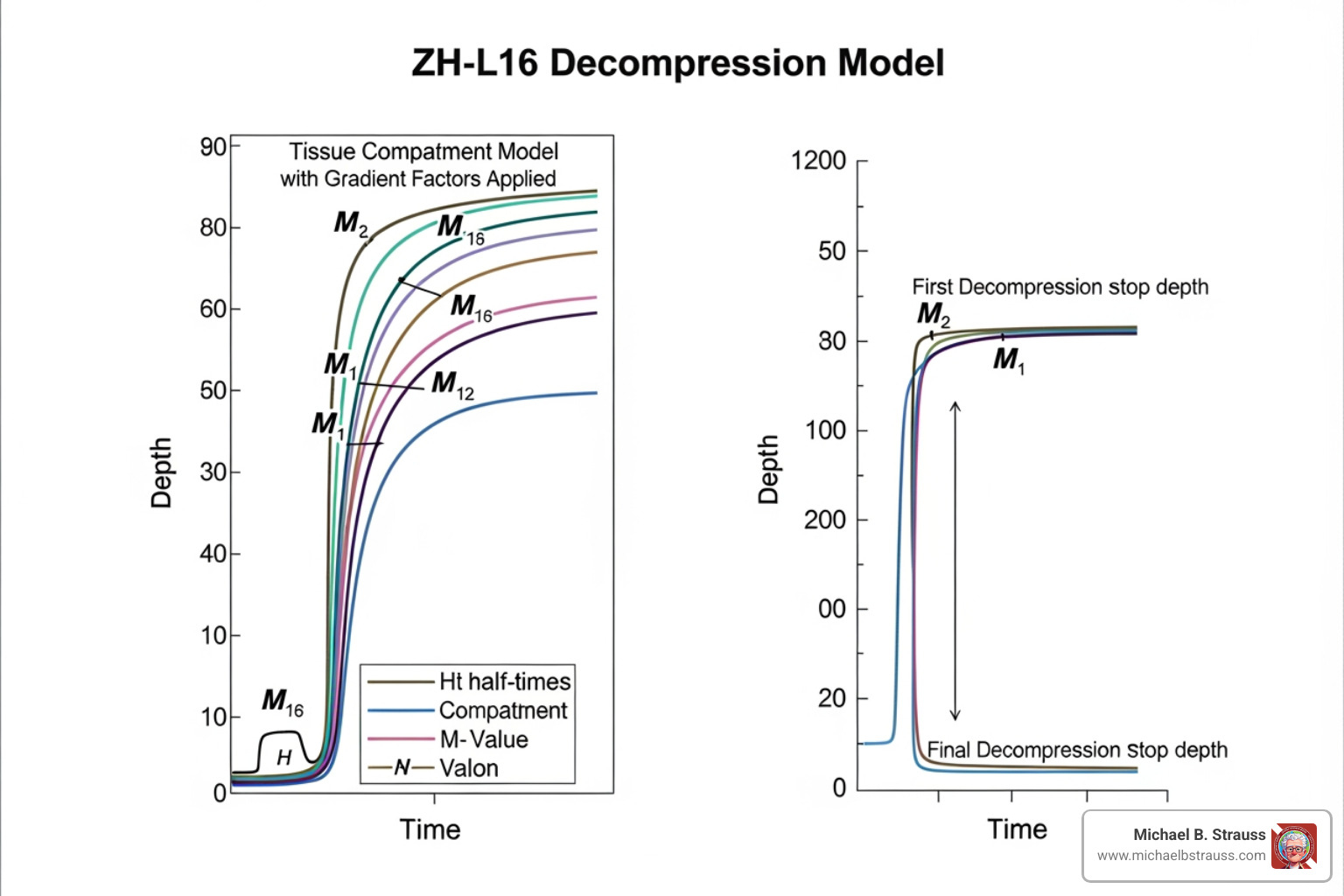
Bühlmann GF implementation is the process of applying Gradient Factors (GF) to the Bühlmann ZH-L16 decompression algorithm to control how close your tissue gas pressures get to their maximum safe limits (M-values) during ascent.
Here is a quick summary of how it works:
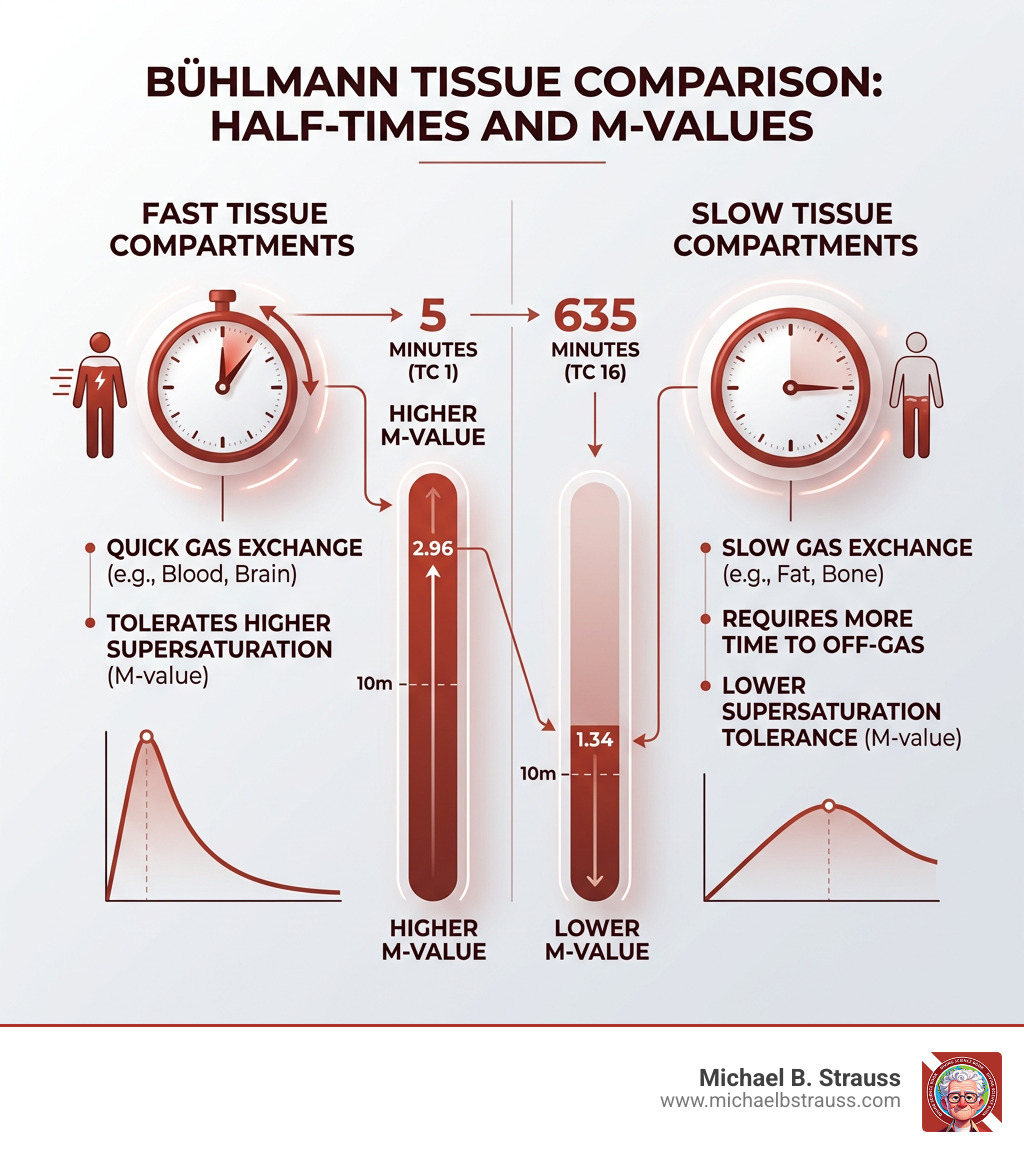
- The Bühlmann model tracks inert gas loading across 16 tissue compartments with half-times ranging from 5 to 635 minutes.
- M-values define the maximum allowable inert gas pressure in each compartment at any given depth.
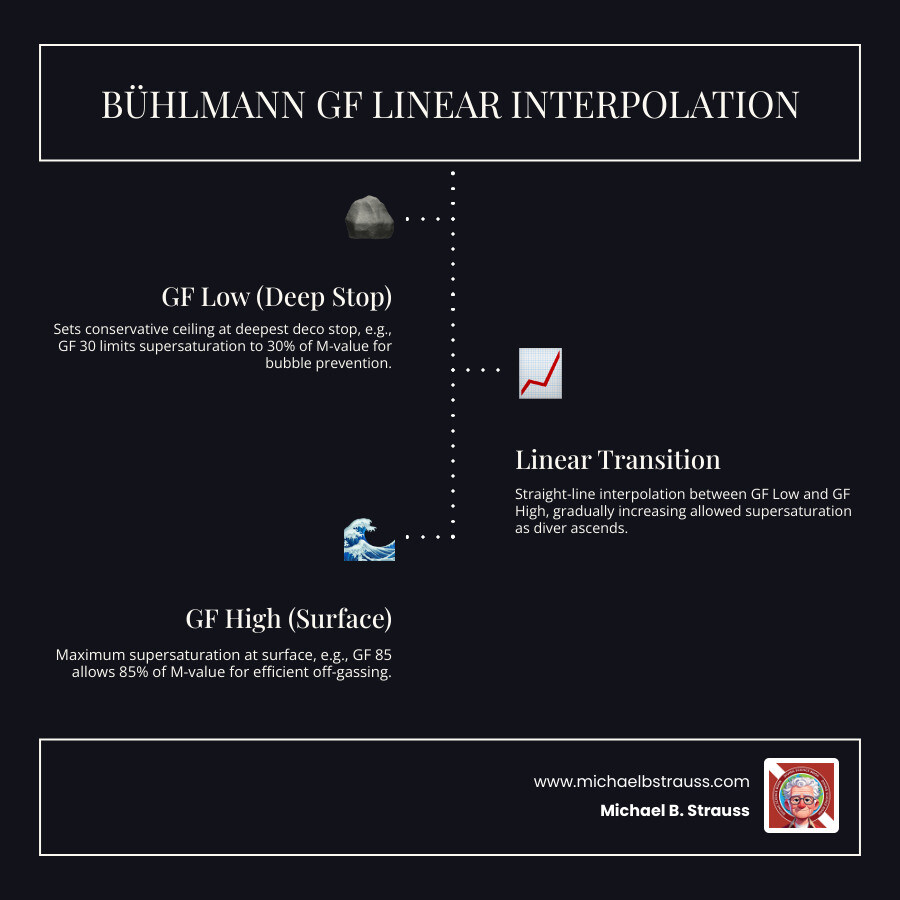
- GF Low (GF1) sets a conservative ceiling for your first (deepest) deco stop — for example, 30% of the way to the M-value.
- GF High (GF2) sets the maximum supersaturation allowed at the surface — for example, 85% of the M-value.
- Between those two points, the algorithm interpolates a straight line, gradually allowing more supersaturation as you ascend.
The core formula driving this:
GF = (Tissue Pressure − Ambient Pressure) ÷ (M-value − Ambient Pressure)
A GF of 1.0 means you are exactly at Bühlmann's M-value limit. A GF of 0.0 means tissue pressure equals ambient — fully off-gassed. Most divers operate somewhere in between, using settings like 30/85 or 70/85 depending on the dive type.
This matters because no decompression model can guarantee a DCS-free dive — the algorithm is theoretical and does not monitor your actual body. Choosing the right GF settings is one of the most important decisions a diver makes before entering the water.
Introduction to Buhlmann GF Implementation
When we talk about diving safety, we are standing on the shoulders of giants. The story of Buhlmann GF implementation begins with Dr. Albert A. Bühlmann, a Swiss physician who began researching decompression theory in 1959. His work culminated in the ZH-L16 model (Zurich-Limits, 16 compartments), which remains the gold standard for most modern dive computers.
Bühlmann’s model is "Neo-Haldanian," meaning it builds on the early 20th-century work of John Scott Haldane. While Haldane used five tissue compartments, Bühlmann expanded this to 16 hypothetical tissue compartments (TCs). These aren't specific organs like your liver or lungs; instead, they represent a range of tissues with different "half-times"—the time it takes for a tissue to become half-saturated with an inert gas like nitrogen or helium. These half-times range from a lightning-fast 5 minutes to a sluggish 635 minutes.
However, the original Bühlmann model was quite aggressive. It calculated the absolute maximum pressure (the M-value) a tissue could withstand before the risk of decompression sickness (DCS) became unacceptable. This is where Erik Baker enters the picture. In the 1990s, Baker introduced Gradient Factors as a way to "dial back" the model's aggression. By using a Buhlmann GF implementation, we can create a safety buffer, ensuring we never actually hit that 100% M-value limit.
Think of the M-value as the "red line" on a car's tachometer. You can drive there, but it’s risky. Gradient Factors allow us to decide that we’d rather shift gears when we hit 80% or 85% of that red line, giving our bodies more time to off-gas safely.
Step-by-Step Buhlmann GF Implementation for Ascent Planning
Implementing Gradient Factors isn't just about picking two numbers and hoping for the best. It’s a systematic way to manage how bubbles form and grow in our blood and tissues. When we plan an ascent, we have to consider two critical points: where we start our decompression (the first stop) and where we end it (the surface).
Calculating the First Stop with GF Low
The first stop is dictated by GF Low (often called GF1). This value determines how deep your first decompression stop will be. If you set a low GF Low, such as 30, you are telling your computer that you want your first stop to occur when your most saturated tissue compartment reaches only 30% of the way between ambient pressure and the M-value.
Historically, technical divers used very low GF Low values (like 10 or 20) to force "deep stops." The theory was that stopping deep would prevent micro-bubbles from expanding early. However, modern research, including studies on the Prevention of compressed air illness, suggests that staying too deep for too long can actually cause your slower tissues to continue on-gassing while your fast tissues are off-gassing.
| Feature | GF 30/85 (Deep Bias) | GF 70/85 (Shallow Bias) |
|---|---|---|
| First Stop Depth | Deeper (e.g., 21m) | Shallower (e.g., 12m) |
| Total Deco Time | Often Longer | Often Shorter |
| Slow Tissue Loading | Higher | Lower |
| Primary Goal | Bubble Control | Efficient Gas Exchange |
To calculate your first stop depth, the algorithm checks every one of the 16 compartments. It looks for the depth where the tissue pressure ($P_{tissue}$) exceeds the "effective M-value" created by your GF Low. If your GF Low is 30%, your effective M-value ($M_{eff}$) at that depth is:$M_{eff} = P_{amb} + [GF_{low} \times (M - P_{amb})]$
Determining the Final Stop and Surfacing with GF High
While GF Low gets the deco party started, GF High (GF2) determines when it’s safe to head home to the surface. GF High defines the level of supersaturation allowed when you finally reach the surface. A common setting is 85, meaning you surface with your tissues at 85% of the Bühlmann M-value limit.
As we move from our first stop toward the surface, the computer doesn't just jump from 30% to 85%. It creates a "slope" or a linear interpolation. Every foot you ascend, the allowable gradient increases slightly. This ensures a smooth transition and prevents sudden "shocks" to the system.
If you’re interested in the deeper mechanics of this, you can find More info about decompression science on our blog. The final stop, usually at 3 or 6 meters, is where you spend the most time because the pressure change relative to the surface is the greatest. This is where the "off-gassing" is most efficient, provided you haven't overloaded your slow tissues by staying too deep for too long.
Mathematical Formulas for Buhlmann GF Implementation
For those who love the "crunchy" side of dive math, the Buhlmann GF implementation relies on the ZH-L16 parameters, specifically the 'a' and 'b' values. These values are used to calculate the M-value for each compartment at a specific ambient pressure ($P_{amb}$):$M = (a / b) + P_{amb}$
However, the version most commonly used in dive computers is ZH-L16C. This version was specifically modified with more conservative 'a' values for middle-range compartments to better suit the real-time processing of dive computers. The parameters were refined through extensive Scientific research on Zurich research principles.
The "Gradient Factor" itself is a ratio. To find the current GF of a tissue at any depth:$Current\ GF = (P_{tissue} - P_{amb}) / (M - P_{amb})$
To calculate the allowable tissue pressure at any point during the ascent, we use the slope ($S$) between $GF_{low}$ and $GF_{high}$:$GF_{at_depth} = GF_{high} - [(GF_{high} - GF_{low}) / (First\ Stop\ Depth)] \times Current\ Depth$
This math ensures that as you get shallower, the "safety ceiling" moves in a predictable, linear fashion.
Optimizing Safety and Conservatism in Your Dive Profile
Selecting the right numbers for your Buhlmann GF implementation isn't just a math exercise; it’s a personal safety choice. We always recommend being more conservative if you are tired, cold, or performing a strenuous dive.
Choosing Gradient Factors for Air vs. Technical Diving
One of the biggest mistakes divers make is using "technical" GF settings for "recreational" air dives. For a standard air or Nitrox dive, many experts now recommend symmetrical Gradient Factors, such as 80/80 or 85/85. This avoids forcing unnecessary deep stops on a dive where you haven't accumulated a massive gas load.
In contrast, technical diving involving helium (Trimix) often uses asymmetrical settings like 50/80 or 30/70. Helium enters and leaves tissues much faster than nitrogen, and it is more prone to forming bubbles. Therefore, a lower GF Low is often used to keep those fast-moving helium bubbles under control.
We must also understand Why and at What Sites Decompression Sickness Can Occur to realize that no setting is "bulletproof." Factors like dehydration, age, and patent foramen ovale (PFO) can change how your body handles the gas load that the computer is merely guessing at.
Real-Time Monitoring with SurfGF and GF99
Modern dive computers have given us incredible tools for situational awareness during a dive. Two of the most useful are SurfGF and GF99.
- GF99: This shows you the current gradient factor of your leading tissue compartment right now, at your current depth. If your GF99 is 60, it means your most loaded tissue is currently at 60% of its M-value.
- SurfGF: This is a "what if" calculation. It tells you what your gradient factor would be if you swam directly to the surface right this second.
Imagine you’re at 20 meters and your SurfGF is 110%. That’s a giant red flag! It means if you surfaced now, you would exceed the Bühlmann M-value by 10%, putting you at high risk for DCS. By watching SurfGF, we can make informed decisions. If an emergency occurs, knowing your SurfGF helps you weigh the risk of a missed deco stop against the risk of staying underwater.
Best Practices for Buhlmann GF Implementation and Safety
Dr. Michael B. Strauss has spent a lifetime studying these variables to keep us safe. In his essential diving books, he emphasizes that the computer is a tool, not a god. We must use our brains to supplement the algorithm.
Here are our top best practices for Buhlmann GF implementation:
- Match your buddy: Ensure your team is using similar GF settings. If you’re on 30/70 and your buddy is on 85/85, you will have vastly different deco schedules, which can lead to separation or confusion.
- Don't "chase" the GF: If your computer says you can ascend, do so slowly. The 10 meters per minute ascent rate is just as important as the deco stops themselves.
- Account for personal factors: If you’re diving in cold water or doing heavy work (like swimming against a current), increase your conservatism (lower your GF High).
- Understand your computer's version: Know if your device uses ZH-L16B (often for tables) or ZH-L16C (for computers).
- Stay hydrated: Decompression is a physiological process, not just a physical one. Your blood needs to be "thin" enough to transport gas efficiently.
For more deep dives into the mechanics of safety, check out More info about diving science.
In conclusion, Buhlmann GF implementation is about balance. It’s the balance between the efficiency of shallow off-gassing and the bubble-control of deeper stops. By understanding the 16 tissue compartments, the math of M-values, and the flexibility of Gradient Factors, we can tailor our dives to be as safe and enjoyable as possible. The goal isn't just to get out of the water; it's to get out of the water feeling great and ready for the next adventure. Stay safe, dive smart, and always keep learning!
To further your knowledge on diving safety and decompression theory, you can buy the book Diving Science Revisited from this link: https://www.bestpub.com/view-all-products/product/diving-science-revisited/category_pathway-48.html
DISCLAIMER: Articles are for "EDUCATIONAL PURPOSES ONLY", not to be considered advice or recommendations.


