Read story

Why Dive Safety Equipment Matters

scuba diver with safety equipment underwater - dive safety equipment

Dive safety equipment is the foundation for exploring the underwater world with confidence. While every dive has inherent risks, proper gear transforms them into manageable challenges.

Essential dive safety equipment every diver should carry includes:

  1. Dive Computer - Real-time depth, time, and decompression tracking
  2. Delayed Surface Marker Buoy (DSMB) - Surface signaling and emergency location
  3. Cutting Tool - Quick release from mess (line, kelp, nets)
  4. Dive Light - Visibility, communication, and emergency signaling
  5. Whistle and Mirror - Surface detection and rescue signaling
  6. Submersible Pressure Gauge (SPG) - Gas supply monitoring
  7. Alternative Air Source - Emergency breathing backup
  8. Compass - Underwater navigation

While standard scuba gear lets you breathe and move underwater, safety gear specifically protects you when things don't go as planned.

The right equipment can be the difference between a minor issue and a serious emergency. A dive computer offers more accurate decompression data than tables, a DSMB ensures you're seen by the boat, and a cutting tool can free you from mess in seconds.

Some gear is essential, while other items are recommended based on your dive environment, type, and experience level. This guide breaks down the essential safety equipment, explains why each piece matters, and helps you build a kit with purpose.
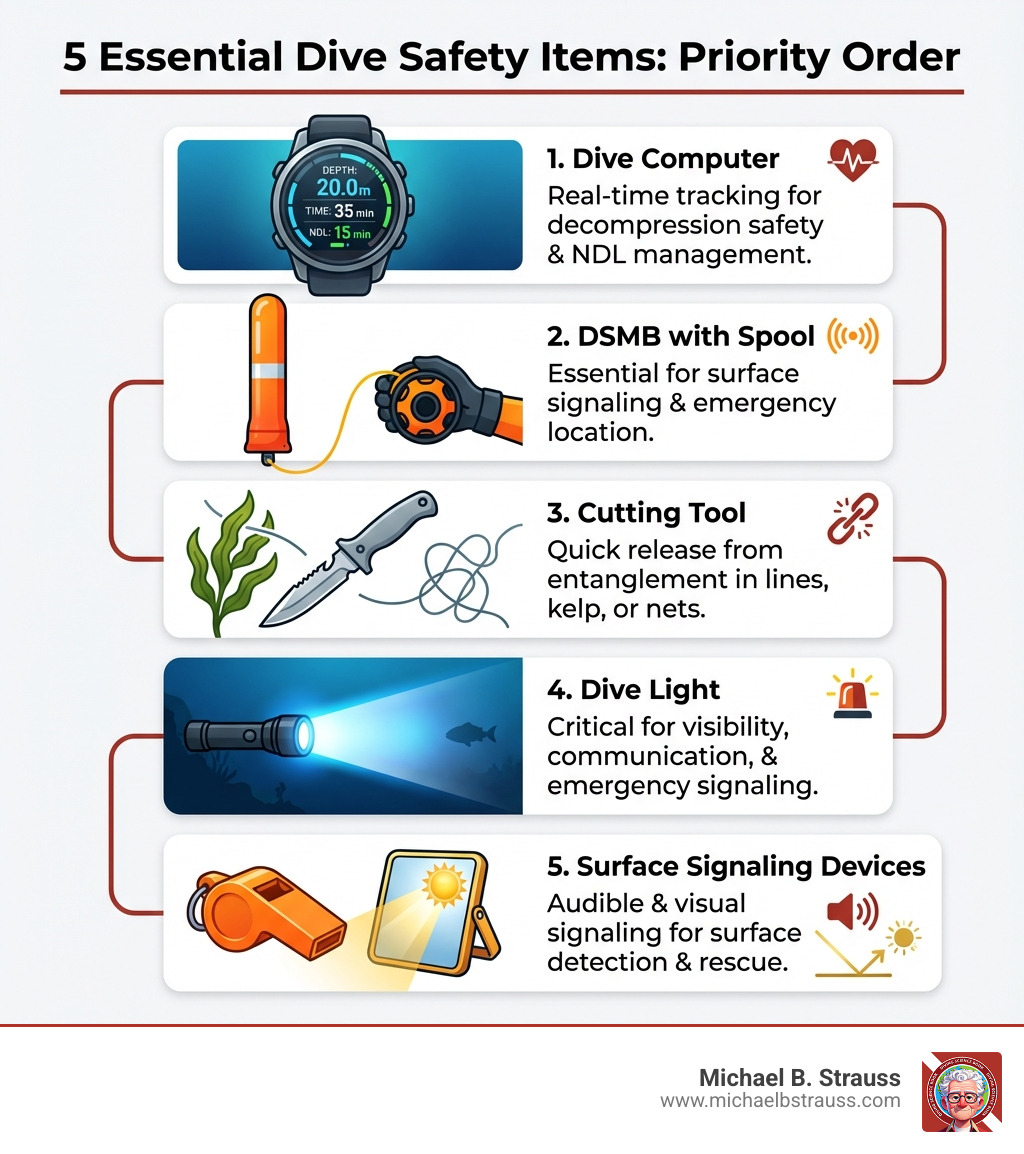
Infographic showing 5 essential dive safety items arranged in priority order: 1. Dive Computer (with icon of wrist computer showing depth/time/NDL data), 2. DSMB with spool (orange inflatable marker buoy), 3. Cutting tool (dive knife or line cutter), 4. Dive light (compact torch), 5. Surface signaling devices (whistle and mirror). Each item includes a brief one-line benefit statement about emergency use or safety function. - dive safety equipment infographic

Basic dive safety equipment vocab:

Core Safety Systems and Essential Gear
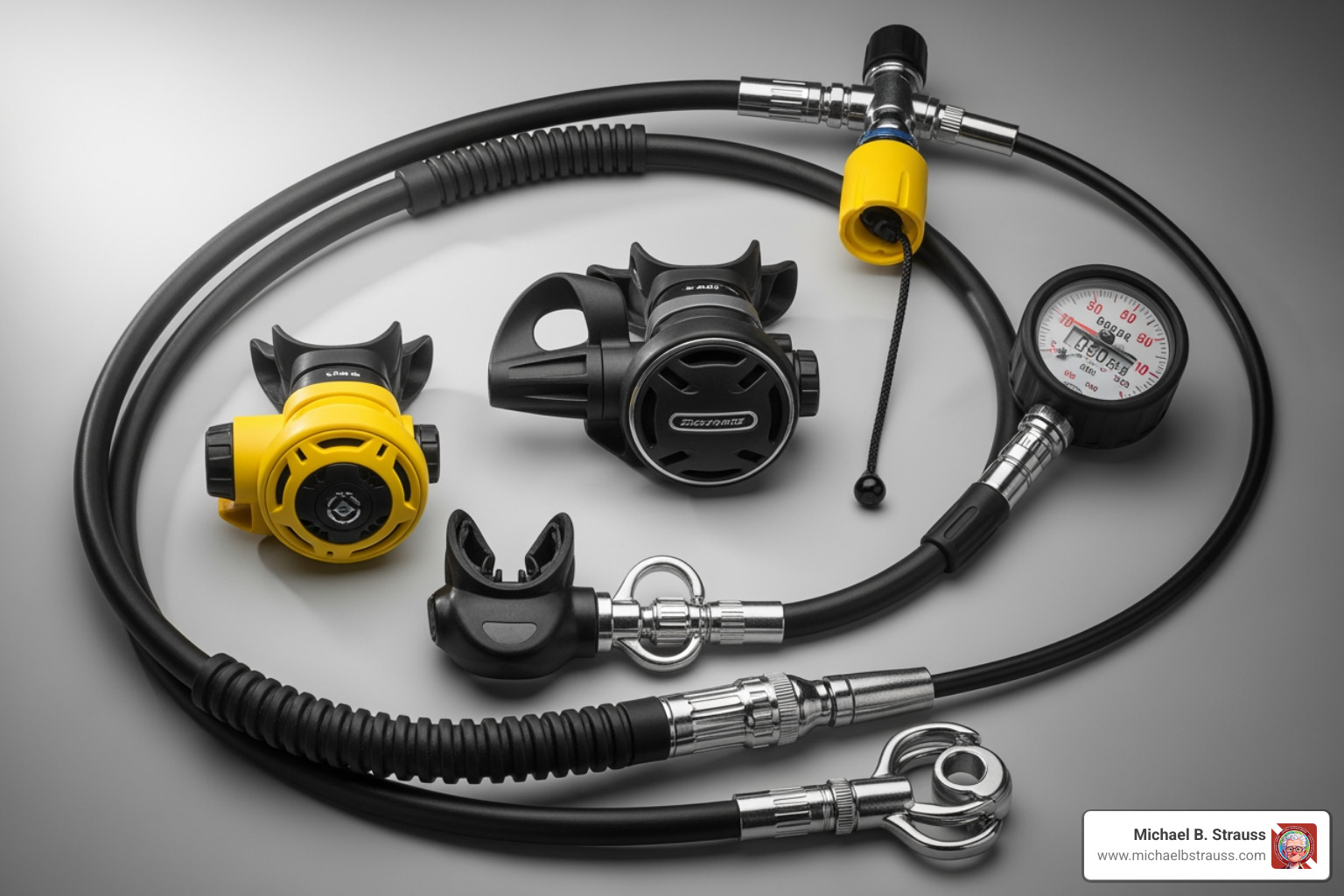
modern regulator set with an octopus and submersible pressure gauge (SPG) - dive safety equipment

This section covers the foundational dive safety equipment that forms the backbone of any responsible diver's kit, focusing on breathing apparatus and navigational aids. These are the pieces of gear that literally keep us alive and oriented underwater.

Life Support and Buoyancy Control

At the heart of our underwater adventures are the systems that allow us to breathe and control our position in the water. These are not just comfort items; they are essential life support.

The Buoyancy Control Device (BCD) is our underwater life vest, allowing us to achieve neutral buoyancy, ascend, and descend with control. When choosing a BCD, fit and comfort are paramount. For maintenance, always rinse your BCD with fresh water after each dive and store it partially inflated. Regular checks for leaks and functionality of dump valves are crucial.

Our Regulator is the device that delivers air from our scuba tank, allowing us to breathe naturally underwater. A reliable regulator is non-negotiable. When selecting one, consider ease of breathing and performance. Regular professional servicing, adhering to the manufacturer's recommendations, is vital. Always perform a pre-dive check to ensure it breathes freely.

The Submersible Pressure Gauge (SPG) is our lifeline, displaying how much air remains in our tank. This critical instrument lets us know when it's time to end our dive safely. We must check our SPG frequently throughout the dive to manage our gas supply effectively.

Perhaps one of the most critical pieces of dive safety equipment is our Alternative Air Source (AS). This is our backup plan for sharing air with a buddy in an out-of-air emergency. This can be an octopus regulator (an additional second-stage regulator) or an independent pony bottle (a small, separate cylinder). For dives below 30m, an independent supply is strongly recommended by many diving experts. A pony cylinder should have a capacity of at least three litres. Regulators conforming to the EN250 standard are designed to provide enough gas for two divers in an emergency. Brief your buddy on its use before every dive and practice regularly in a controlled environment.

For more in-depth knowledge on the principles behind our equipment, we can explore More info about diving science.

The Critical Role of the Dive Computer

Our dive computer is arguably the single most important piece of personal dive safety equipment we own. It's our underwater brain, continuously calculating and displaying vital information like depth and time in real-time, applying it to a decompression model to track dissolved nitrogen.

This technology contributes to diver safety by providing:

  • Real-time data: Instantaneous depth, time, and no-stop limits.
  • Continuous decompression calculations: Far easier and safer than relying on dive tables.
  • Ascent rate warnings: Alerting us if we're ascending too quickly.
  • Advanced features: Many computers offer nitrox, mixed gas, and air integration.

While dive computers are smart, they cannot account for individual susceptibility to decompression illness, so never push them to their absolute limits. Learning to use the planning function on your computer before every dive is a best practice. Advanced computers may use Gradient Factors (GF) to customize decompression profiles, but this requires additional training. Maintain your computer by rinsing it in fresh water, protecting it from damage, and changing the battery as needed.

For a deeper dive into the science behind decompression, Dr. Michael B. Strauss's books offer comprehensive insights. We can also explore Scientific research on Decompression Science.

Essential Personal Dive Safety Equipment

Beyond our core life support, several pieces of personal dive safety equipment are crucial for signaling, navigation, and mitigating common problems.
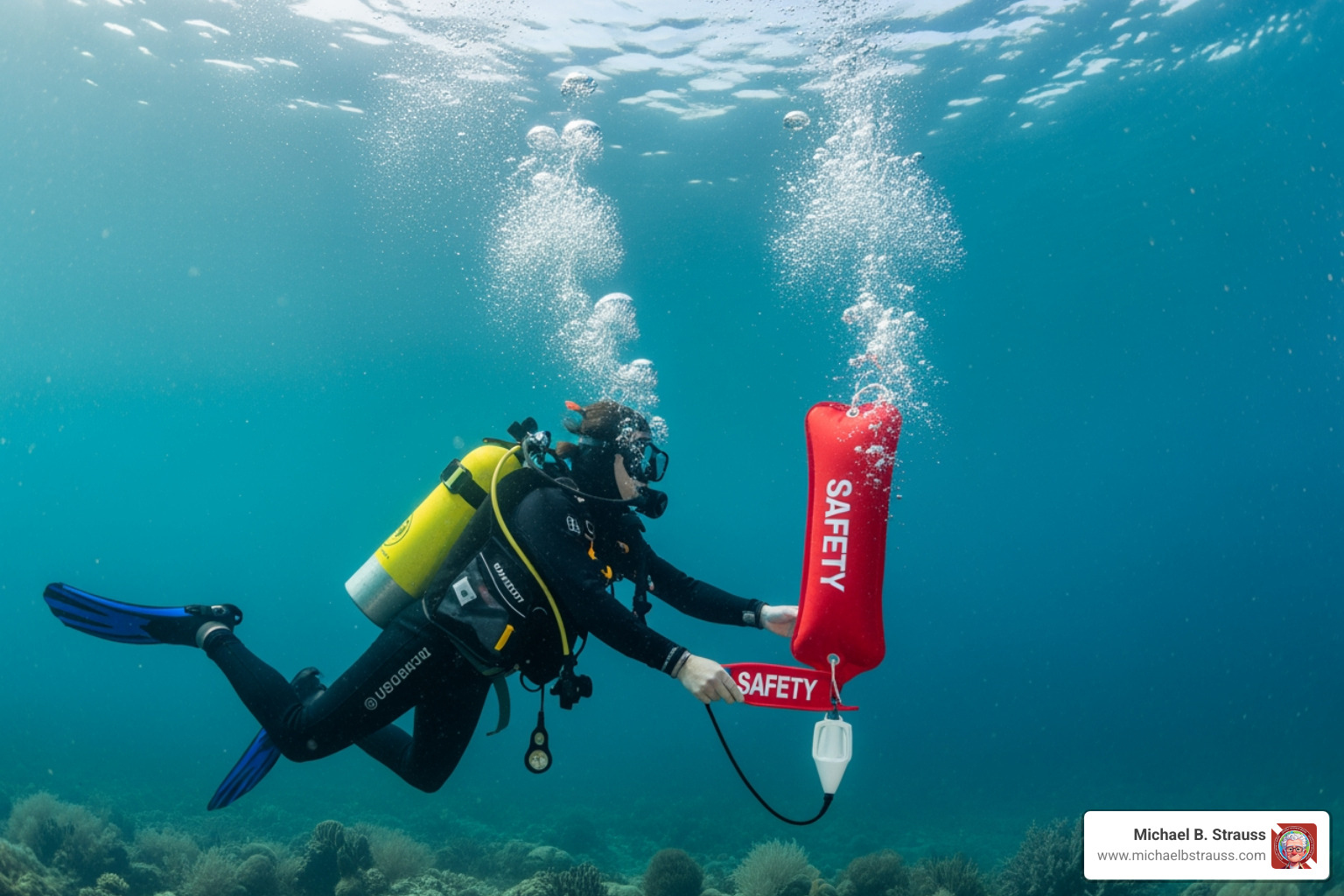
diver deploying a DSMB during a safety stop - dive safety equipment

The Delayed Surface Marker Buoy (DSMB) is our signal to the surface, letting boats see us. It's vital during safety stops or if drifting. Practice deploying your DSMB, as it's a common point of failure. Never attach the reel or spool to your gear so it can be jettisoned if needed. A spool is often safer than a reel for managing the line.

A Cutting Tool is an absolute must for mess risks like fishing line or nets. A sharp, accessible dive knife or line cutter is needed to free yourself or a teammate quickly. Ensure it's reachable with either hand.

A Dive Light is essential, even on day dives, to see into crevices, communicate with a buddy, and for emergency signaling.

A Compass is crucial for navigation, allowing you to return to your exit point without guesswork and building confidence.

For surface emergencies, a Whistle and Signal Mirror are invaluable for attracting attention from boats or shore.

Gas Management and Proper Weighting for Safety

Effective gas management and precise weighting are fundamental to our safety. They allow for controlled descents, comfortable buoyancy, and safe ascents.

Cylinder pressure management begins before the dive. Check your pressure before and at regular intervals during the dive. A critical safety rule is the one-third reserve rule, which recommends surfacing with at least one-third of your cylinder's capacity left as a reserve (e.g., 75 bar for a 232 bar cylinder). This reserve is for you and for assisting a buddy.

Proper Cylinder labeling is paramount, especially when diving with nitrox. Your cylinder should be clearly marked with the mix and the Maximum Operating Depth (MOD). If using multiple cylinders, employ a system to prevent confusion, as breathing the wrong gas at depth can have serious consequences.

Proper weighting profoundly impacts safety and enjoyment. Correct weighting helps conserve gas and makes dives safer. You should be weighted to hold a safety stop with near-empty cylinders. Perform a weight check with any new equipment and know how to release your weights in an emergency.

Understanding the principles of gas management and buoyancy control also ties into understanding decompression illness. For more on this, we can dig into Why and at What Sites Decompression Sickness Can Occur.

Advanced and Environmental Safety Considerations

As we gain experience and venture into more challenging dive environments, our dive safety equipment and protocols must evolve. Specialized diving requires specific gear and procedures to manage unique risks.

Specialized Dive Safety Equipment for Unique Environments

Different underwater worlds demand different gear. For cold water diving (cooler than 15°C/60°F), a drysuit or thick wetsuit is critical for warmth and protection.

Technical diving and rebreather diving introduce complexities that require redundant systems and specialized training.

Rebreathers (CCR and SCR) reuse exhaled gas, allowing for longer, bubble-free dives. However, they introduce complex risks like hypoxia and CO2 buildup, requiring formal qualification and strict adherence to pre-dive checklists and maintenance schedules. Key safety considerations include buddy procedures for emergencies, scrubber management, and regular replacement of oxygen cells.

When using Diver Propulsion Vehicles (DPVs), or scooters, training is essential. DPVs make covering distance easy but add complexity to buoyancy control. Always plan for potential failure and carry a lifting bag to recover a flooded, negatively buoyant scooter.

Lifting bags are also invaluable for safely bringing objects from the seabed to the surface. Always use a lifting bag instead of your BCD or drysuit to lift heavy objects to avoid uncontrolled ascents. Ensure no divers are underneath when sending an object to the surface.

For further guidance on specialized diving equipment and techniques, we can consult Safe diving equipment guidance.

Pre-Dive Preparation and Emergency Kits

Thorough preparation is our first line of defense. This includes meticulous pre-dive checks and having a "Save-a-Dive Kit" at the ready.

Checklists are vital for ensuring all equipment is functional before a dive, preventing oversights that can lead to incidents. For rebreather divers, detailed checklists are non-negotiable.

Despite our best efforts, minor equipment malfunctions can occur. A 'Save-a-Dive Kit' can fix common issues and prevent a dive from being cut short. Your kit should include:

  • O-rings: For tank valves, regulators, and hoses.
  • Zip ties: For versatile temporary repairs.
  • Mask strap: A broken strap can ruin a dive.
  • Fin strap: Essential for propulsion.
  • Mouthpiece: A spare for a torn mouthpiece.
  • Small tools: Hex wrenches, screwdrivers, and pliers.

Having these components allows for quick repairs, making it a small investment with a big payoff.

For further in-depth knowledge, the comprehensive diving books by Dr. Michael B. Strauss, a renowned expert in diving safety, are an invaluable resource for every diver. They cover critical topics like the Evaluation and Management of Pain-Related Medical Problems of Diving. To explore these topics and more, get your copy of Diving Science, Revisited today.

DISCLAIMER: Articles are for "EDUCATIONAL PURPOSES ONLY", not to be considered advice or recommendations.

Download Full PDF
Tags:

Why Dive Safety Equipment Matters

scuba diver with safety equipment underwater - dive safety equipment

Dive safety equipment is the foundation for exploring the underwater world with confidence. While every dive has inherent risks, proper gear transforms them into manageable challenges.

Essential dive safety equipment every diver should carry includes:

  1. Dive Computer - Real-time depth, time, and decompression tracking
  2. Delayed Surface Marker Buoy (DSMB) - Surface signaling and emergency location
  3. Cutting Tool - Quick release from mess (line, kelp, nets)
  4. Dive Light - Visibility, communication, and emergency signaling
  5. Whistle and Mirror - Surface detection and rescue signaling
  6. Submersible Pressure Gauge (SPG) - Gas supply monitoring
  7. Alternative Air Source - Emergency breathing backup
  8. Compass - Underwater navigation

While standard scuba gear lets you breathe and move underwater, safety gear specifically protects you when things don't go as planned.

The right equipment can be the difference between a minor issue and a serious emergency. A dive computer offers more accurate decompression data than tables, a DSMB ensures you're seen by the boat, and a cutting tool can free you from mess in seconds.

Some gear is essential, while other items are recommended based on your dive environment, type, and experience level. This guide breaks down the essential safety equipment, explains why each piece matters, and helps you build a kit with purpose.

Infographic showing 5 essential dive safety items arranged in priority order: 1. Dive Computer (with icon of wrist computer showing depth/time/NDL data), 2. DSMB with spool (orange inflatable marker buoy), 3. Cutting tool (dive knife or line cutter), 4. Dive light (compact torch), 5. Surface signaling devices (whistle and mirror). Each item includes a brief one-line benefit statement about emergency use or safety function. - dive safety equipment infographic

Basic dive safety equipment vocab:

Core Safety Systems and Essential Gear

modern regulator set with an octopus and submersible pressure gauge (SPG) - dive safety equipment

This section covers the foundational dive safety equipment that forms the backbone of any responsible diver's kit, focusing on breathing apparatus and navigational aids. These are the pieces of gear that literally keep us alive and oriented underwater.

Life Support and Buoyancy Control

At the heart of our underwater adventures are the systems that allow us to breathe and control our position in the water. These are not just comfort items; they are essential life support.

The Buoyancy Control Device (BCD) is our underwater life vest, allowing us to achieve neutral buoyancy, ascend, and descend with control. When choosing a BCD, fit and comfort are paramount. For maintenance, always rinse your BCD with fresh water after each dive and store it partially inflated. Regular checks for leaks and functionality of dump valves are crucial.

Our Regulator is the device that delivers air from our scuba tank, allowing us to breathe naturally underwater. A reliable regulator is non-negotiable. When selecting one, consider ease of breathing and performance. Regular professional servicing, adhering to the manufacturer's recommendations, is vital. Always perform a pre-dive check to ensure it breathes freely.

The Submersible Pressure Gauge (SPG) is our lifeline, displaying how much air remains in our tank. This critical instrument lets us know when it's time to end our dive safely. We must check our SPG frequently throughout the dive to manage our gas supply effectively.

Perhaps one of the most critical pieces of dive safety equipment is our Alternative Air Source (AS). This is our backup plan for sharing air with a buddy in an out-of-air emergency. This can be an octopus regulator (an additional second-stage regulator) or an independent pony bottle (a small, separate cylinder). For dives below 30m, an independent supply is strongly recommended by many diving experts. A pony cylinder should have a capacity of at least three litres. Regulators conforming to the EN250 standard are designed to provide enough gas for two divers in an emergency. Brief your buddy on its use before every dive and practice regularly in a controlled environment.

For more in-depth knowledge on the principles behind our equipment, we can explore More info about diving science.

The Critical Role of the Dive Computer

Our dive computer is arguably the single most important piece of personal dive safety equipment we own. It's our underwater brain, continuously calculating and displaying vital information like depth and time in real-time, applying it to a decompression model to track dissolved nitrogen.

This technology contributes to diver safety by providing:

  • Real-time data: Instantaneous depth, time, and no-stop limits.
  • Continuous decompression calculations: Far easier and safer than relying on dive tables.
  • Ascent rate warnings: Alerting us if we're ascending too quickly.
  • Advanced features: Many computers offer nitrox, mixed gas, and air integration.

While dive computers are smart, they cannot account for individual susceptibility to decompression illness, so never push them to their absolute limits. Learning to use the planning function on your computer before every dive is a best practice. Advanced computers may use Gradient Factors (GF) to customize decompression profiles, but this requires additional training. Maintain your computer by rinsing it in fresh water, protecting it from damage, and changing the battery as needed.

For a deeper dive into the science behind decompression, Dr. Michael B. Strauss's books offer comprehensive insights. We can also explore Scientific research on Decompression Science.

Essential Personal Dive Safety Equipment

Beyond our core life support, several pieces of personal dive safety equipment are crucial for signaling, navigation, and mitigating common problems.

diver deploying a DSMB during a safety stop - dive safety equipment

The Delayed Surface Marker Buoy (DSMB) is our signal to the surface, letting boats see us. It's vital during safety stops or if drifting. Practice deploying your DSMB, as it's a common point of failure. Never attach the reel or spool to your gear so it can be jettisoned if needed. A spool is often safer than a reel for managing the line.

A Cutting Tool is an absolute must for mess risks like fishing line or nets. A sharp, accessible dive knife or line cutter is needed to free yourself or a teammate quickly. Ensure it's reachable with either hand.

A Dive Light is essential, even on day dives, to see into crevices, communicate with a buddy, and for emergency signaling.

A Compass is crucial for navigation, allowing you to return to your exit point without guesswork and building confidence.

For surface emergencies, a Whistle and Signal Mirror are invaluable for attracting attention from boats or shore.

Gas Management and Proper Weighting for Safety

Effective gas management and precise weighting are fundamental to our safety. They allow for controlled descents, comfortable buoyancy, and safe ascents.

Cylinder pressure management begins before the dive. Check your pressure before and at regular intervals during the dive. A critical safety rule is the one-third reserve rule, which recommends surfacing with at least one-third of your cylinder's capacity left as a reserve (e.g., 75 bar for a 232 bar cylinder). This reserve is for you and for assisting a buddy.

Proper Cylinder labeling is paramount, especially when diving with nitrox. Your cylinder should be clearly marked with the mix and the Maximum Operating Depth (MOD). If using multiple cylinders, employ a system to prevent confusion, as breathing the wrong gas at depth can have serious consequences.

Proper weighting profoundly impacts safety and enjoyment. Correct weighting helps conserve gas and makes dives safer. You should be weighted to hold a safety stop with near-empty cylinders. Perform a weight check with any new equipment and know how to release your weights in an emergency.

Understanding the principles of gas management and buoyancy control also ties into understanding decompression illness. For more on this, we can dig into Why and at What Sites Decompression Sickness Can Occur.

Advanced and Environmental Safety Considerations

As we gain experience and venture into more challenging dive environments, our dive safety equipment and protocols must evolve. Specialized diving requires specific gear and procedures to manage unique risks.

Specialized Dive Safety Equipment for Unique Environments

Different underwater worlds demand different gear. For cold water diving (cooler than 15°C/60°F), a drysuit or thick wetsuit is critical for warmth and protection.

Technical diving and rebreather diving introduce complexities that require redundant systems and specialized training.

Rebreathers (CCR and SCR) reuse exhaled gas, allowing for longer, bubble-free dives. However, they introduce complex risks like hypoxia and CO2 buildup, requiring formal qualification and strict adherence to pre-dive checklists and maintenance schedules. Key safety considerations include buddy procedures for emergencies, scrubber management, and regular replacement of oxygen cells.

When using Diver Propulsion Vehicles (DPVs), or scooters, training is essential. DPVs make covering distance easy but add complexity to buoyancy control. Always plan for potential failure and carry a lifting bag to recover a flooded, negatively buoyant scooter.

Lifting bags are also invaluable for safely bringing objects from the seabed to the surface. Always use a lifting bag instead of your BCD or drysuit to lift heavy objects to avoid uncontrolled ascents. Ensure no divers are underneath when sending an object to the surface.

For further guidance on specialized diving equipment and techniques, we can consult Safe diving equipment guidance.

Pre-Dive Preparation and Emergency Kits

Thorough preparation is our first line of defense. This includes meticulous pre-dive checks and having a "Save-a-Dive Kit" at the ready.

Checklists are vital for ensuring all equipment is functional before a dive, preventing oversights that can lead to incidents. For rebreather divers, detailed checklists are non-negotiable.

Despite our best efforts, minor equipment malfunctions can occur. A 'Save-a-Dive Kit' can fix common issues and prevent a dive from being cut short. Your kit should include:

  • O-rings: For tank valves, regulators, and hoses.
  • Zip ties: For versatile temporary repairs.
  • Mask strap: A broken strap can ruin a dive.
  • Fin strap: Essential for propulsion.
  • Mouthpiece: A spare for a torn mouthpiece.
  • Small tools: Hex wrenches, screwdrivers, and pliers.

Having these components allows for quick repairs, making it a small investment with a big payoff.

For further in-depth knowledge, the comprehensive diving books by Dr. Michael B. Strauss, a renowned expert in diving safety, are an invaluable resource for every diver. They cover critical topics like the Evaluation and Management of Pain-Related Medical Problems of Diving. To explore these topics and more, get your copy of Diving Science, Revisited today.

DISCLAIMER: Articles are for "EDUCATIONAL PURPOSES ONLY", not to be considered advice or recommendations.