Read story

Why Every Diver Needs a Dive Safety Sausage
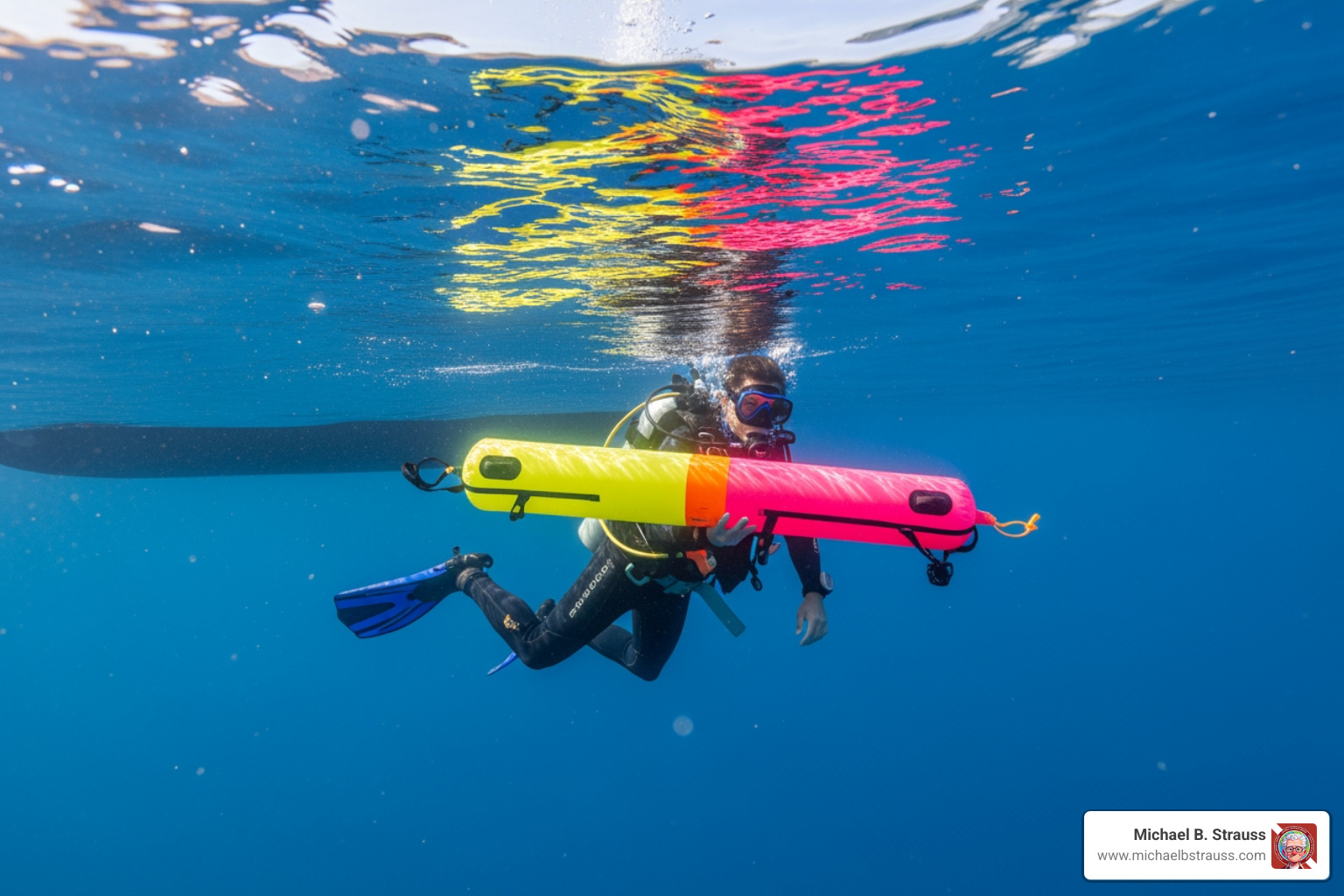
dive safety sausage

A dive safety sausage — also called a surface marker buoy (SMB) or DSMB — is an inflatable signal tube that makes you visible to boats and rescue crews when you surface after a dive.

Here's what you need to know at a glance:

  • What it is: A bright, inflatable tube (typically 3–6 feet long) carried by scuba divers to signal their position on the surface
  • Who needs one: Any diver doing ocean dives, drift dives, or diving in areas with boat traffic
  • When to use it: Deploy before or during your ascent, especially at your safety stop
  • SMB vs. DSMB: An SMB is inflated at the surface; a DSMB (Delayed SMB) is deployed underwater and rises to the surface ahead of you
  • Key features to look for: Bright orange or yellow color, reflective strips, over-pressure relief valve, closed-circuit design
  • What to pair it with: A finger spool with at least 1.5x your dive depth in line, plus a whistle or strobe

Open water hides divers well. Waves, sun glare, and engine noise make it easy for a boat to miss a diver on the surface. A 6-foot safety sausage standing upright cuts through all of that — giving rescue crews and boat operators a clear, visible target.

Think of it as your personal flag above the water. Small to carry. Critical when it counts.
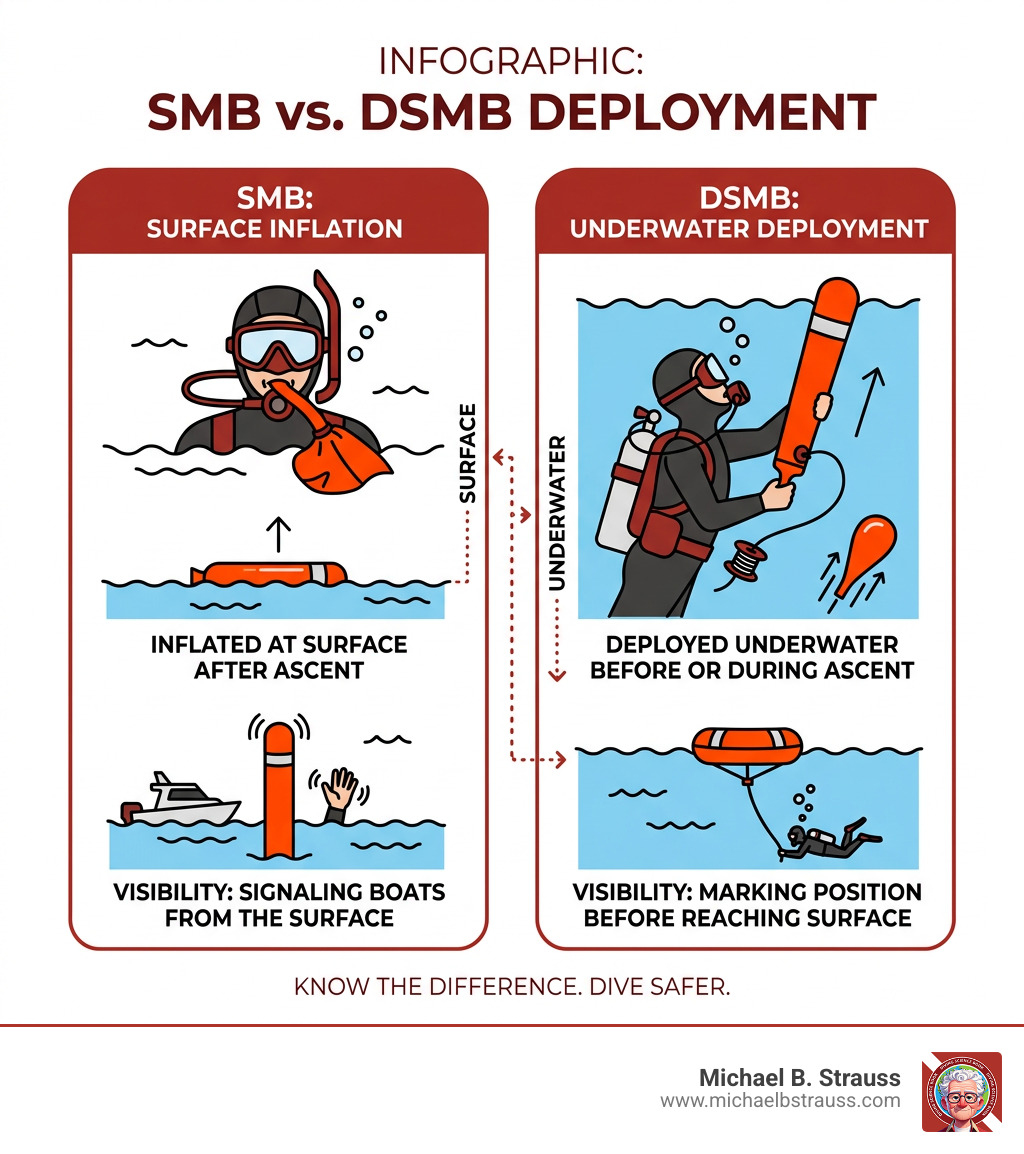
Infographic showing the difference between SMB surface inflation and DSMB underwater deployment - dive safety sausage

Dive safety sausage terms explained:

Choosing and Using Your dive safety sausage
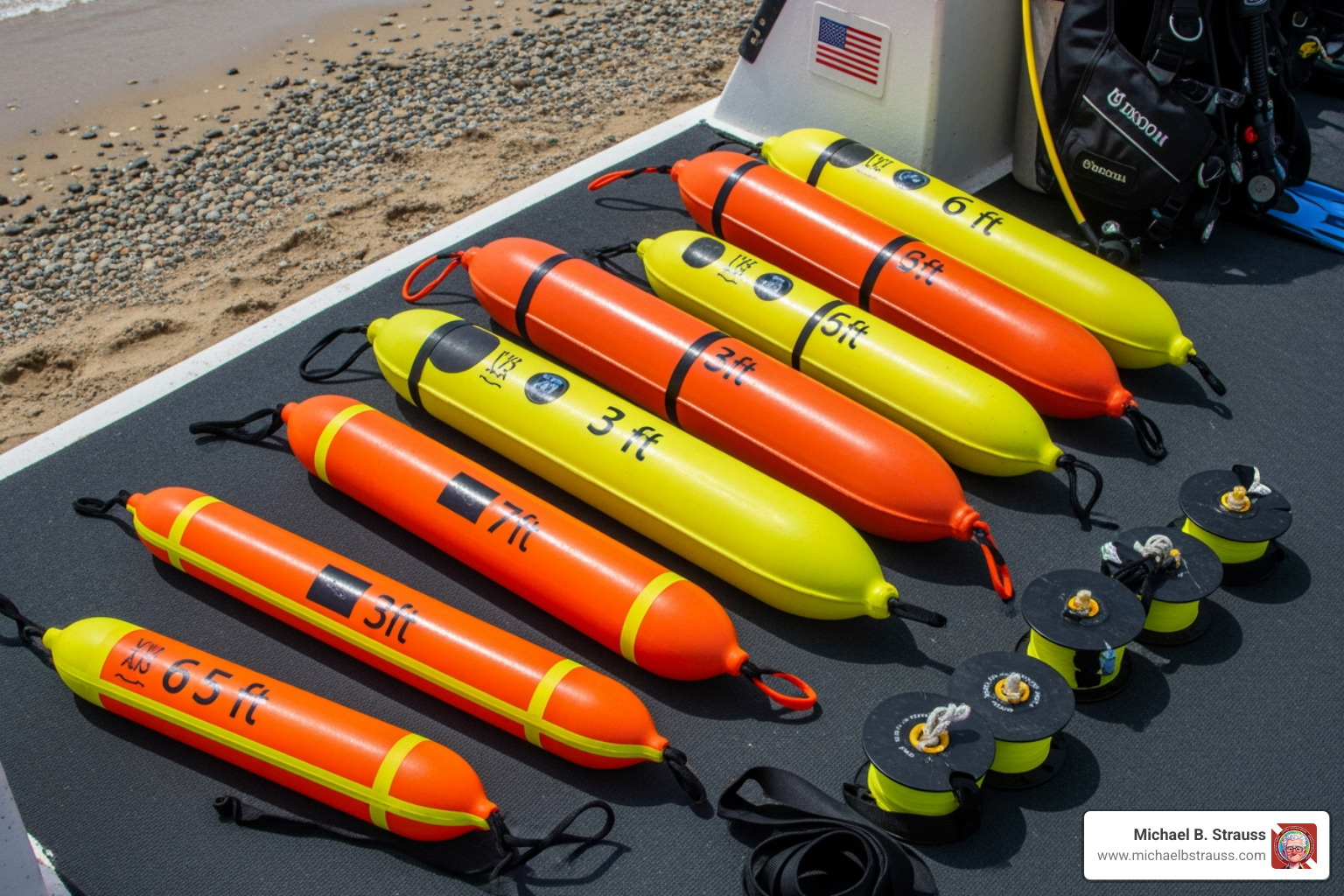
Various safety sausage sizes from 3 to 6 feet - dive safety sausage

When we talk about choosing the right dive safety sausage, we aren't just talking about picking a favorite color. This piece of gear is a literal lifesaver. In diving safety, visibility is the name of the game. Dr. Michael B. Strauss often emphasizes in his diving books that being prepared for the unexpected is what separates a successful dive from a dangerous one.

The first thing to consider is the environment. If you are diving in a calm, inland lake, a 3-foot tube might suffice. However, if you are in the open ocean with rolling swells, that 3-foot tube will disappear in the trough of a wave. This is why 6-foot models are the gold standard for serious divers. A 6-foot marker provides better visibility in choppy water and can even offer significant lift—some models provide over 40 lbs of lifting capacity, which can help a tired diver stay buoyant at the surface.

Material durability is another factor we can't ignore. You want something "beefy." Look for high-denier nylon (like 210 or even 400 denier) with a urethane backing. This ensures the sausage won't puncture easily if it brushes against a boat hull or a bit of reef. Reflective tape or strips at the top are also vital; they catch the light of a search boat's spotlight or the sun, making you stand out like a beacon.

FeatureRecreational DivingDrift / Technical Diving
Typical Length3 to 4 feet6 feet or taller
Inflation MethodOral (Surface only)Oral, LP Hose, or Reg Purge
Bottom StyleOpen or ClosedClosed with Over-Pressure Valve
VisibilityLow to MediumHigh (Reflective/Radar strips)
Primary UseMarking surface positionSignaling ascent/Decompression

Key Features of a Reliable dive safety sausage

Not all sausages are created equal. We recommend looking for a "closed-circuit" design. This means that once the air is inside the tube, it stays there. Some cheaper models are "open-bottom," which are fine for surface use but can be tricky if you want to deploy them from depth. If an open-bottom marker tips over on the surface, the air can burp out, leaving you with a "limp" sausage that provides zero visibility.

A reliable dive safety sausage should feature:

  • Over-Pressure Valve (OPV): This is critical for DSMBs. As the air inside the tube expands during its trip to the surface (thanks to Boyle's Law), the OPV allows excess pressure to vent so the tube doesn't burst.
  • Duck Valves (Flapper Valves): Located at the bottom of the tube, these allow air in but prevent it from escaping, keeping the marker rigid even if it's tossed around by waves.
  • Oral/Power Inflation: The ability to inflate via a dedicated oral valve or by connecting a low-pressure (LP) inflator hose gives you options in different scenarios.
  • Attachment Points: A sturdy D-ring or "hard point" at the bottom to attach your spool or reel is non-negotiable for underwater deployment.

For more technical details on how these devices function in various conditions, you can check out this Scientific research on safety sausages.

How to Deploy a dive safety sausage from Depth

Deploying a dive safety sausage from depth—specifically during a safety stop or decompression—is a skill every diver should master. We call this a "Delayed SMB" (DSMB) deployment. It tells the boat exactly where you are before you even break the surface.

Here is our step-by-step guide to doing it safely:

  1. Get Neutrally Buoyant: Before you reach for your gear, ensure you are stable and neutrally buoyant. You don't want to be fighting your depth while trying to manage a spool and a tube.
  2. Look Up: Always check above you for boat traffic or other divers. You are about to send a rocket to the surface; make sure the path is clear.
  3. Prepare the Gear: Unfurl the sausage and unclip your spool. Hold the spool in one hand and the sausage in the other. Never, under any circumstances, clip the spool to yourself or your BCD during deployment. If the line tangles, you could be dragged to the surface.
  4. Inflate Gradually: If you are at depth (say, 60 feet), you only need to put a small amount of air into the tube. Gas expansion is your friend here. A tube filled 1/3 full at 66 feet will be fully inflated by the time it hits the surface. You can use your secondary regulator (octopus) to purge a bit of air into the bottom opening or use the oral inflator.
  5. Release and Tension: Let the sausage go and watch it fly. Keep a slight amount of tension on the line as it reels out. This ensures the sausage stays upright on the surface rather than lying flat.
  6. Ascend and Wind: As you begin your ascent, wind the line back onto the spool. This keeps the line taut and prevents entanglement.

For a deeper dive into the mechanics of this process, see this guide on How to deploy a safety sausage.

Mastering Deployment and Maintenance for Maximum Safety

Safety isn't just about the gear you have; it's about how you manage it. Dr. Michael B. Strauss emphasizes that "diving science" involves understanding the physical laws of the underwater world and how they affect our equipment. When we deploy a dive safety sausage, we are managing buoyancy, line tension, and visibility all at once.

One of the most important aspects of safety is "stowage." Your SMB should be easily accessible—usually tucked into a thigh pocket or clipped to a rear D-ring where it won't snag. If you can't reach it with one hand, it's not in the right place. To further explore the intersection of gear and safety, visit More info about diving science.

Line Management and Spool Essentials

The spool is the unsung hero of the dive safety sausage setup. Without enough line, your marker is useless. The general rule of thumb is the 1.5x depth rule. If you plan to deploy your marker from a 20-meter safety stop, you should have at least 30 meters of line. This extra length accounts for currents that might pull the line at an angle.

  • Finger Spools: These are compact and have no moving parts to fail. They are the favorite of recreational and technical divers alike.
  • Bolt Snaps: Use a double-ended stainless steel bolt snap to secure the spool when not in use.
  • Jam Prevention: Always wind your line neatly. A "birds-nest" of tangled line at 50 feet is a recipe for a buoyancy accident.

Avoiding Common Deployment Mistakes

Even experienced divers make mistakes. Here are the "don'ts" of the dive safety sausage world:

  • Don't Over-inflate at Depth: If your sausage doesn't have an Over-Pressure Valve (OPV), filling it completely at 30 feet will cause it to explode before it reaches the surface.
  • Don't Get Tangled: Keep the line away from your body, your regulator, and your computer. If the line loops around your arm, you're going for a ride.
  • Don't Be "Limp": A wrinkly, flaccid sausage is hard to see. Ensure there is enough air to keep it rigid and upright. If you're on the surface and it's looking a bit sad, give it a few more puffs through the oral inflator.
  • Don't Just Let It Sit: On the surface, if you see a boat but they haven't seen you, wave the sausage! Some divers use a "bobbing" motion—pulling the string down and letting it pop back up—to create a vertical movement that catches the eye.

Maintenance and Expert Safety Insights

A dive safety sausage is a piece of life-support equipment, and it should be treated as such. Saltwater is corrosive, and the sun's UV rays are the enemy of nylon and plastic.

Our Recommended Maintenance Routine:

  1. Freshwater Rinse: After every dive day, rinse the outside and the inside of the tube. Salt crystals can form inside the valves, causing them to leak.
  2. Valve Inspection: Periodically check the OPV and oral inflation valves. Make sure they operate smoothly and don't stick.
  3. Dry in the Shade: Never leave your gear in direct sunlight to dry. UV rays break down the urethane coating and fade the high-visibility colors.
  4. Pre-Dive Checks: Before you get on the boat, unroll your sausage and give it a quick oral inflation. Make sure it holds air. There is nothing worse than needing your "sausage" in an emergency only to find it has a leak.

Pre-Dive Safety Checklist:

  • [ ] Sausage is tightly rolled and secured.
  • [ ] Spool line is free of knots and tangles.
  • [ ] Bolt snap is functional and not corroded.
  • [ ] Whistle or signaling mirror is attached and reachable.
  • [ ] Reflective tape is intact.

By following these steps and prioritizing your visibility, you ensure that every dive ends with a safe and easy pickup. As we always say, the best dive is the one where everyone gets back on the boat with a great story to tell. Stay safe, stay visible, and keep exploring!

To further enhance your knowledge of diving safety and the science behind it, you can purchase the book Diving Science Revisited at this link: https://www.bestpub.com/view-all-products/product/diving-science-revisited/category_pathway-48.html

DISCLAIMER: Articles are for "EDUCATIONAL PURPOSES ONLY", not to be considered advice or recommendations.

Download Full PDF
Tags:

Why Every Diver Needs a Dive Safety Sausage

dive safety sausage

A dive safety sausage — also called a surface marker buoy (SMB) or DSMB — is an inflatable signal tube that makes you visible to boats and rescue crews when you surface after a dive.

Here's what you need to know at a glance:

  • What it is: A bright, inflatable tube (typically 3–6 feet long) carried by scuba divers to signal their position on the surface
  • Who needs one: Any diver doing ocean dives, drift dives, or diving in areas with boat traffic
  • When to use it: Deploy before or during your ascent, especially at your safety stop
  • SMB vs. DSMB: An SMB is inflated at the surface; a DSMB (Delayed SMB) is deployed underwater and rises to the surface ahead of you
  • Key features to look for: Bright orange or yellow color, reflective strips, over-pressure relief valve, closed-circuit design
  • What to pair it with: A finger spool with at least 1.5x your dive depth in line, plus a whistle or strobe

Open water hides divers well. Waves, sun glare, and engine noise make it easy for a boat to miss a diver on the surface. A 6-foot safety sausage standing upright cuts through all of that — giving rescue crews and boat operators a clear, visible target.

Think of it as your personal flag above the water. Small to carry. Critical when it counts.

Infographic showing the difference between SMB surface inflation and DSMB underwater deployment - dive safety sausage

Dive safety sausage terms explained:

Choosing and Using Your dive safety sausage

Various safety sausage sizes from 3 to 6 feet - dive safety sausage

When we talk about choosing the right dive safety sausage, we aren't just talking about picking a favorite color. This piece of gear is a literal lifesaver. In diving safety, visibility is the name of the game. Dr. Michael B. Strauss often emphasizes in his diving books that being prepared for the unexpected is what separates a successful dive from a dangerous one.

The first thing to consider is the environment. If you are diving in a calm, inland lake, a 3-foot tube might suffice. However, if you are in the open ocean with rolling swells, that 3-foot tube will disappear in the trough of a wave. This is why 6-foot models are the gold standard for serious divers. A 6-foot marker provides better visibility in choppy water and can even offer significant lift—some models provide over 40 lbs of lifting capacity, which can help a tired diver stay buoyant at the surface.

Material durability is another factor we can't ignore. You want something "beefy." Look for high-denier nylon (like 210 or even 400 denier) with a urethane backing. This ensures the sausage won't puncture easily if it brushes against a boat hull or a bit of reef. Reflective tape or strips at the top are also vital; they catch the light of a search boat's spotlight or the sun, making you stand out like a beacon.

FeatureRecreational DivingDrift / Technical Diving
Typical Length3 to 4 feet6 feet or taller
Inflation MethodOral (Surface only)Oral, LP Hose, or Reg Purge
Bottom StyleOpen or ClosedClosed with Over-Pressure Valve
VisibilityLow to MediumHigh (Reflective/Radar strips)
Primary UseMarking surface positionSignaling ascent/Decompression

Key Features of a Reliable dive safety sausage

Not all sausages are created equal. We recommend looking for a "closed-circuit" design. This means that once the air is inside the tube, it stays there. Some cheaper models are "open-bottom," which are fine for surface use but can be tricky if you want to deploy them from depth. If an open-bottom marker tips over on the surface, the air can burp out, leaving you with a "limp" sausage that provides zero visibility.

A reliable dive safety sausage should feature:

  • Over-Pressure Valve (OPV): This is critical for DSMBs. As the air inside the tube expands during its trip to the surface (thanks to Boyle's Law), the OPV allows excess pressure to vent so the tube doesn't burst.
  • Duck Valves (Flapper Valves): Located at the bottom of the tube, these allow air in but prevent it from escaping, keeping the marker rigid even if it's tossed around by waves.
  • Oral/Power Inflation: The ability to inflate via a dedicated oral valve or by connecting a low-pressure (LP) inflator hose gives you options in different scenarios.
  • Attachment Points: A sturdy D-ring or "hard point" at the bottom to attach your spool or reel is non-negotiable for underwater deployment.

For more technical details on how these devices function in various conditions, you can check out this Scientific research on safety sausages.

How to Deploy a dive safety sausage from Depth

Deploying a dive safety sausage from depth—specifically during a safety stop or decompression—is a skill every diver should master. We call this a "Delayed SMB" (DSMB) deployment. It tells the boat exactly where you are before you even break the surface.

Here is our step-by-step guide to doing it safely:

  1. Get Neutrally Buoyant: Before you reach for your gear, ensure you are stable and neutrally buoyant. You don't want to be fighting your depth while trying to manage a spool and a tube.
  2. Look Up: Always check above you for boat traffic or other divers. You are about to send a rocket to the surface; make sure the path is clear.
  3. Prepare the Gear: Unfurl the sausage and unclip your spool. Hold the spool in one hand and the sausage in the other. Never, under any circumstances, clip the spool to yourself or your BCD during deployment. If the line tangles, you could be dragged to the surface.
  4. Inflate Gradually: If you are at depth (say, 60 feet), you only need to put a small amount of air into the tube. Gas expansion is your friend here. A tube filled 1/3 full at 66 feet will be fully inflated by the time it hits the surface. You can use your secondary regulator (octopus) to purge a bit of air into the bottom opening or use the oral inflator.
  5. Release and Tension: Let the sausage go and watch it fly. Keep a slight amount of tension on the line as it reels out. This ensures the sausage stays upright on the surface rather than lying flat.
  6. Ascend and Wind: As you begin your ascent, wind the line back onto the spool. This keeps the line taut and prevents entanglement.

For a deeper dive into the mechanics of this process, see this guide on How to deploy a safety sausage.

Mastering Deployment and Maintenance for Maximum Safety

Safety isn't just about the gear you have; it's about how you manage it. Dr. Michael B. Strauss emphasizes that "diving science" involves understanding the physical laws of the underwater world and how they affect our equipment. When we deploy a dive safety sausage, we are managing buoyancy, line tension, and visibility all at once.

One of the most important aspects of safety is "stowage." Your SMB should be easily accessible—usually tucked into a thigh pocket or clipped to a rear D-ring where it won't snag. If you can't reach it with one hand, it's not in the right place. To further explore the intersection of gear and safety, visit More info about diving science.

Line Management and Spool Essentials

The spool is the unsung hero of the dive safety sausage setup. Without enough line, your marker is useless. The general rule of thumb is the 1.5x depth rule. If you plan to deploy your marker from a 20-meter safety stop, you should have at least 30 meters of line. This extra length accounts for currents that might pull the line at an angle.

  • Finger Spools: These are compact and have no moving parts to fail. They are the favorite of recreational and technical divers alike.
  • Bolt Snaps: Use a double-ended stainless steel bolt snap to secure the spool when not in use.
  • Jam Prevention: Always wind your line neatly. A "birds-nest" of tangled line at 50 feet is a recipe for a buoyancy accident.

Avoiding Common Deployment Mistakes

Even experienced divers make mistakes. Here are the "don'ts" of the dive safety sausage world:

  • Don't Over-inflate at Depth: If your sausage doesn't have an Over-Pressure Valve (OPV), filling it completely at 30 feet will cause it to explode before it reaches the surface.
  • Don't Get Tangled: Keep the line away from your body, your regulator, and your computer. If the line loops around your arm, you're going for a ride.
  • Don't Be "Limp": A wrinkly, flaccid sausage is hard to see. Ensure there is enough air to keep it rigid and upright. If you're on the surface and it's looking a bit sad, give it a few more puffs through the oral inflator.
  • Don't Just Let It Sit: On the surface, if you see a boat but they haven't seen you, wave the sausage! Some divers use a "bobbing" motion—pulling the string down and letting it pop back up—to create a vertical movement that catches the eye.

Maintenance and Expert Safety Insights

A dive safety sausage is a piece of life-support equipment, and it should be treated as such. Saltwater is corrosive, and the sun's UV rays are the enemy of nylon and plastic.

Our Recommended Maintenance Routine:

  1. Freshwater Rinse: After every dive day, rinse the outside and the inside of the tube. Salt crystals can form inside the valves, causing them to leak.
  2. Valve Inspection: Periodically check the OPV and oral inflation valves. Make sure they operate smoothly and don't stick.
  3. Dry in the Shade: Never leave your gear in direct sunlight to dry. UV rays break down the urethane coating and fade the high-visibility colors.
  4. Pre-Dive Checks: Before you get on the boat, unroll your sausage and give it a quick oral inflation. Make sure it holds air. There is nothing worse than needing your "sausage" in an emergency only to find it has a leak.

Pre-Dive Safety Checklist:

  • [ ] Sausage is tightly rolled and secured.
  • [ ] Spool line is free of knots and tangles.
  • [ ] Bolt snap is functional and not corroded.
  • [ ] Whistle or signaling mirror is attached and reachable.
  • [ ] Reflective tape is intact.

By following these steps and prioritizing your visibility, you ensure that every dive ends with a safe and easy pickup. As we always say, the best dive is the one where everyone gets back on the boat with a great story to tell. Stay safe, stay visible, and keep exploring!

To further enhance your knowledge of diving safety and the science behind it, you can purchase the book Diving Science Revisited at this link: https://www.bestpub.com/view-all-products/product/diving-science-revisited/category_pathway-48.html

DISCLAIMER: Articles are for "EDUCATIONAL PURPOSES ONLY", not to be considered advice or recommendations.