Read story

Understanding Emergency Ascent Procedures: Your Essential Safety Framework
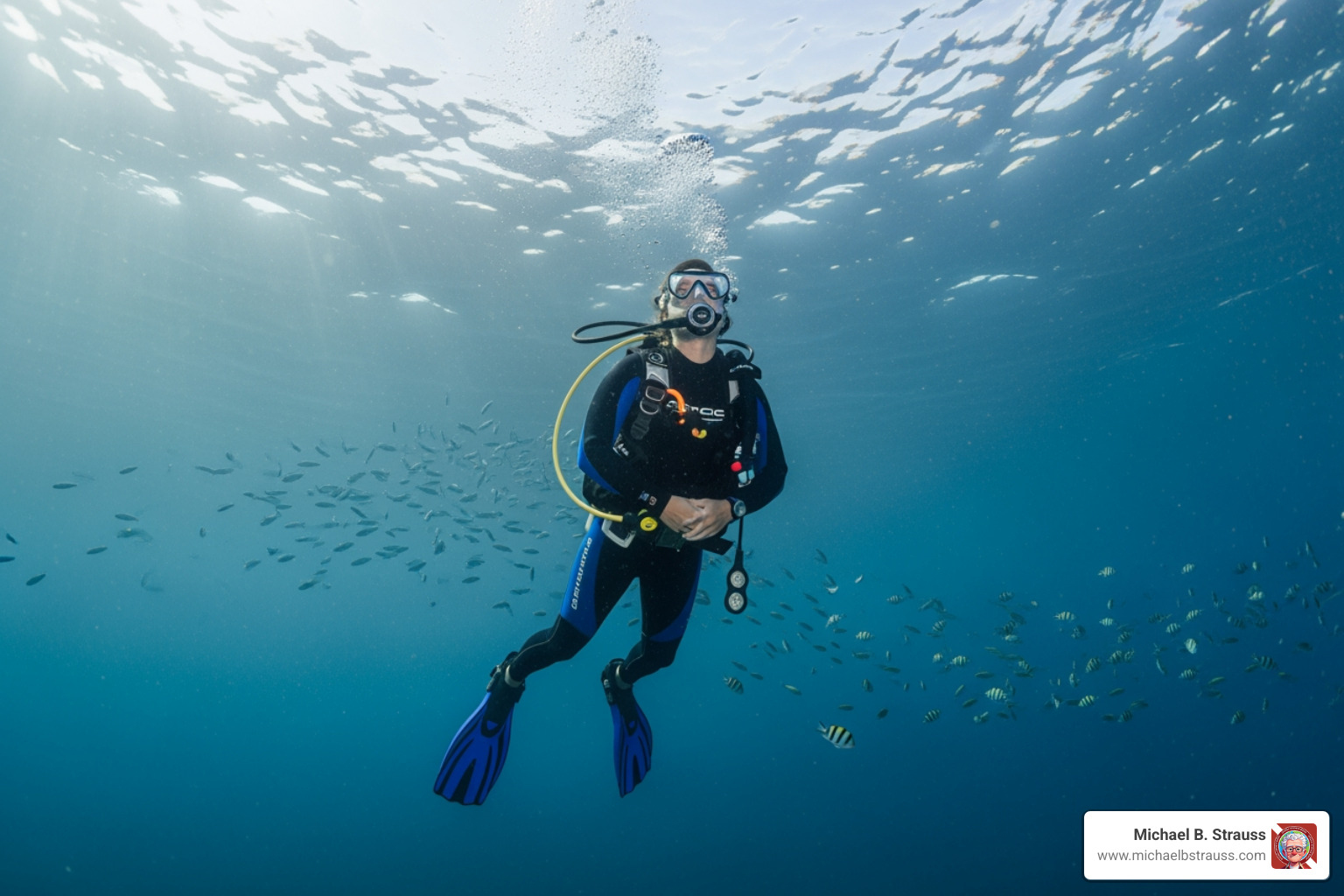
A scuba diver ascending calmly while looking up towards the surface, demonstrating composure and control during an ascent. - emergency ascent procedures

Emergency ascent procedures are life-saving protocols every diver must master. These techniques are for reaching the surface safely when a normal ascent isn't possible, such as during an out-of-air emergency or equipment failure.

Quick Reference: The Four Emergency Ascent Procedures (in order of priority)

  1. Normal Ascent - When you're low on air but still have enough to ascend normally
  2. Alternate Air Source Ascent - Breathing from your buddy's backup regulator while ascending together
  3. Controlled Emergency Swimming Ascent (CESA) - Swimming to the surface while exhaling continuously, when no air source is available
  4. Buoyant Ascent - Dropping weights and ascending rapidly (last resort only, highest risk)

While emergencies are rare—some studies track roughly 16 free ascents per 10,000 dives—they do happen. Your response in those critical seconds determines the outcome.

The most dangerous element of an emergency ascent is not the lack of air, but panic. A panicked diver makes poor decisions, ascends too quickly, and forgets basic safety rules. The difference between a manageable incident and a life-threatening one often comes down to training, equipment knowledge, and staying calm. An uncontrolled ascent can cause lung overexpansion injuries, decompression sickness, or loss of consciousness, all of which are preventable with proper technique.

Understanding these procedures provides the foundation for safer diving, whether you're a recreational diver, a technical diver, or a medical professional treating diving injuries.
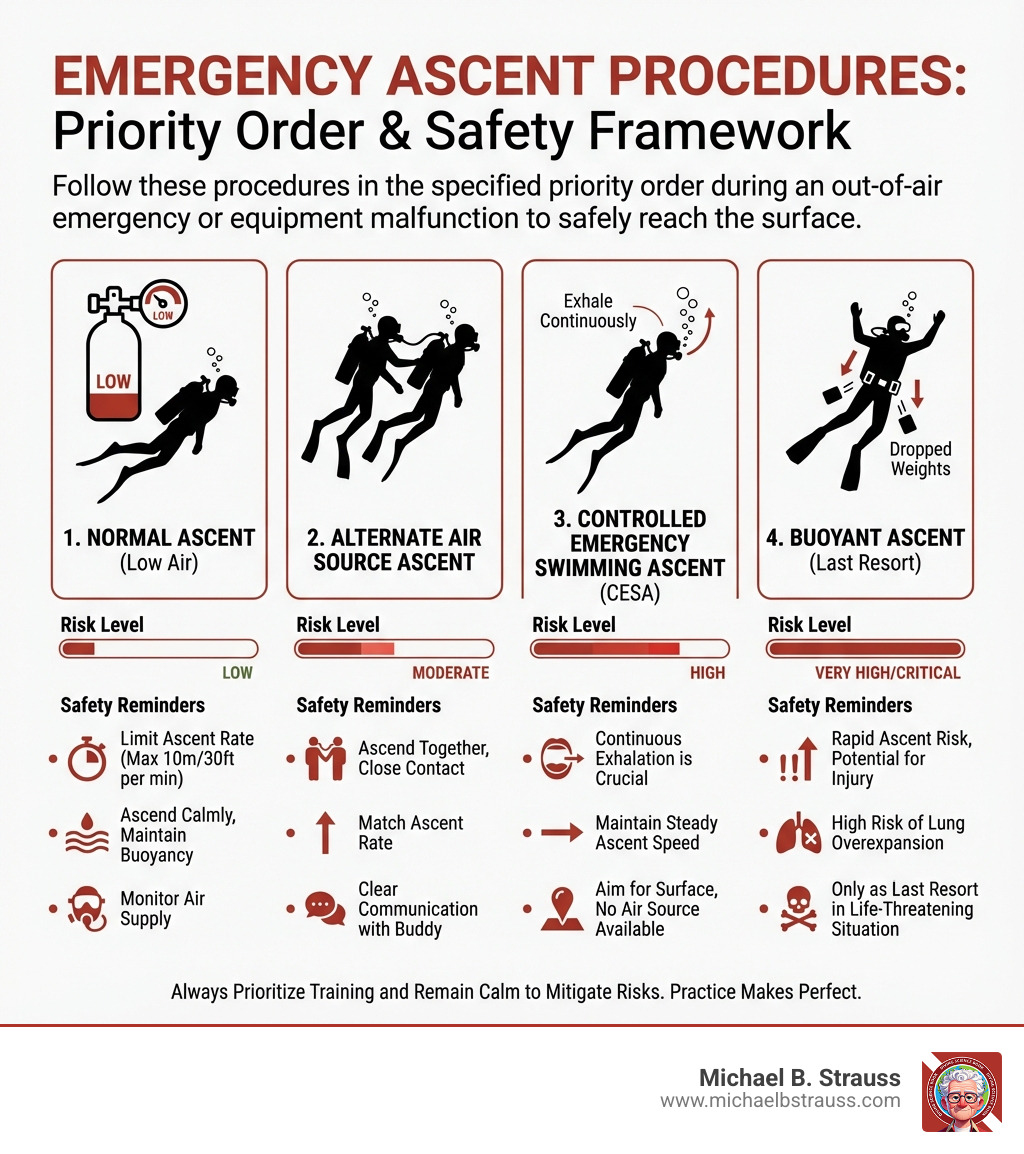
Infographic showing the four emergency ascent procedures in priority order: 1. Normal Ascent with low air tank icon, 2. Alternate Air Source Ascent with two divers sharing air, 3. Controlled Emergency Swimming Ascent with single diver ascending while exhaling, and 4. Buoyant Ascent with dropped weights. Each procedure includes risk level indicators and key safety reminders like ascent rate limits and continuous exhalation requirements. - emergency ascent procedures infographic

Easy emergency ascent procedures glossary:

A Diver's Guide to Emergency Ascent Procedures

When underwater, every ascent needs to be controlled. But what happens when things go wrong? Knowing our emergency ascent procedures is a life-saving skill. We must distinguish between different types of ascents, understand diver training standards, and rely on our buddy system and buoyancy control. For more information about diving safety and decompression science, visit Diving Science by Dr. Michael B. Strauss.

Independent vs. Dependent Ascents: Knowing Your Options

An emergency ascent is either independent or dependent.

  • Independent Emergency Ascent: You manage the ascent yourself without breathing assistance from another diver. This is a self-rescue scenario, such as a Controlled Emergency Swimming Ascent (CESA) or a Buoyant Ascent.
  • Dependent Emergency Ascent: This involves assistance from your buddy. The most common example is an Alternate Air Source Ascent, where you breathe from your buddy's secondary regulator. Historically, buddy breathing (sharing one regulator) was taught, but it has been largely phased out due to its risks.

Choosing the right procedure depends on the situation. If you are out of air with a buddy nearby, it's a dependent ascent. If your buddy is not in sight, it's an independent ascent. Training helps us make this critical decision quickly.

Dive training agencies have a clear order of priority for emergency ascent procedures in low-on-air or out-of-air situations to minimize risk.

Here's the preferred order:

  1. Normal Ascent (when low on air): The best option. If you're low on air but not out, signal your buddy and make a controlled ascent together at a safe rate. This is a preventative measure to avoid an out-of-air emergency.
  2. Alternate Air Source Ascent: The most desirable option for an out-of-air emergency. Signal your buddy, secure their alternate air source, and ascend together. This allows for normal breathing, a safe ascent rate, and reduces panic.
  3. Controlled Emergency Swimming Ascent (CESA): The primary independent option when you're out of air and a buddy cannot assist. You swim to the surface while exhaling continuously and managing your buoyancy.
  4. Buoyant Ascent: The absolute last resort. If you are out of air, too deep for a CESA, and unable to contact your buddy, you drop your weights. This causes a rapid, uncontrolled ascent and carries the highest risk of serious injury.

Buddy breathing is not on this list because it is no longer recommended by most agencies. Sharing a single regulator back and forth is complex, stressful, and increases the risk of water inhalation and loss of control for both divers. The widespread use of alternate air sources has made this risky procedure unnecessary.

Mastering the Controlled Emergency Swimming Ascent (CESA)

The CESA is a core skill taught in every Open Water Diver course. It's your go-to independent emergency ascent procedure if you are out of air and cannot get help from a buddy.

Here’s a step-by-step guide to performing a CESA:

  1. Don't Panic: Stay calm and remember your training.
  2. Signal: Signal "Out of Air" to your buddy. If they don't respond or you're alone, proceed with CESA.
  3. Look Up and Ascend: Orient yourself toward the surface, check for obstructions, and begin kicking upward.
  4. Continuously Exhale: This is the most crucial step. To prevent lung overexpansion injury (barotrauma), you must exhale continuously by making a steady "ahhhh" sound. Do not hold your breath!
  5. Keep Regulator In: Keep the regulator in your mouth to protect your airway from water.
  6. Protect Your Head: Extend one hand over your head to protect it from overhead obstructions.
  7. Manage Buoyancy: Use your other hand on the BCD inflator to release small bursts of expanding air, controlling your ascent rate.
  8. Control Ascent Rate: Aim for a speed no faster than 18 meters (60 feet) per minute. Slow and steady is key.
  9. Drop Weights Only at the Surface: Never drop weights during the ascent. Only do so at the surface if you struggle to stay buoyant.
  10. At the Surface: Once you break the surface, orally inflate your BCD for positive buoyancy and signal for help.
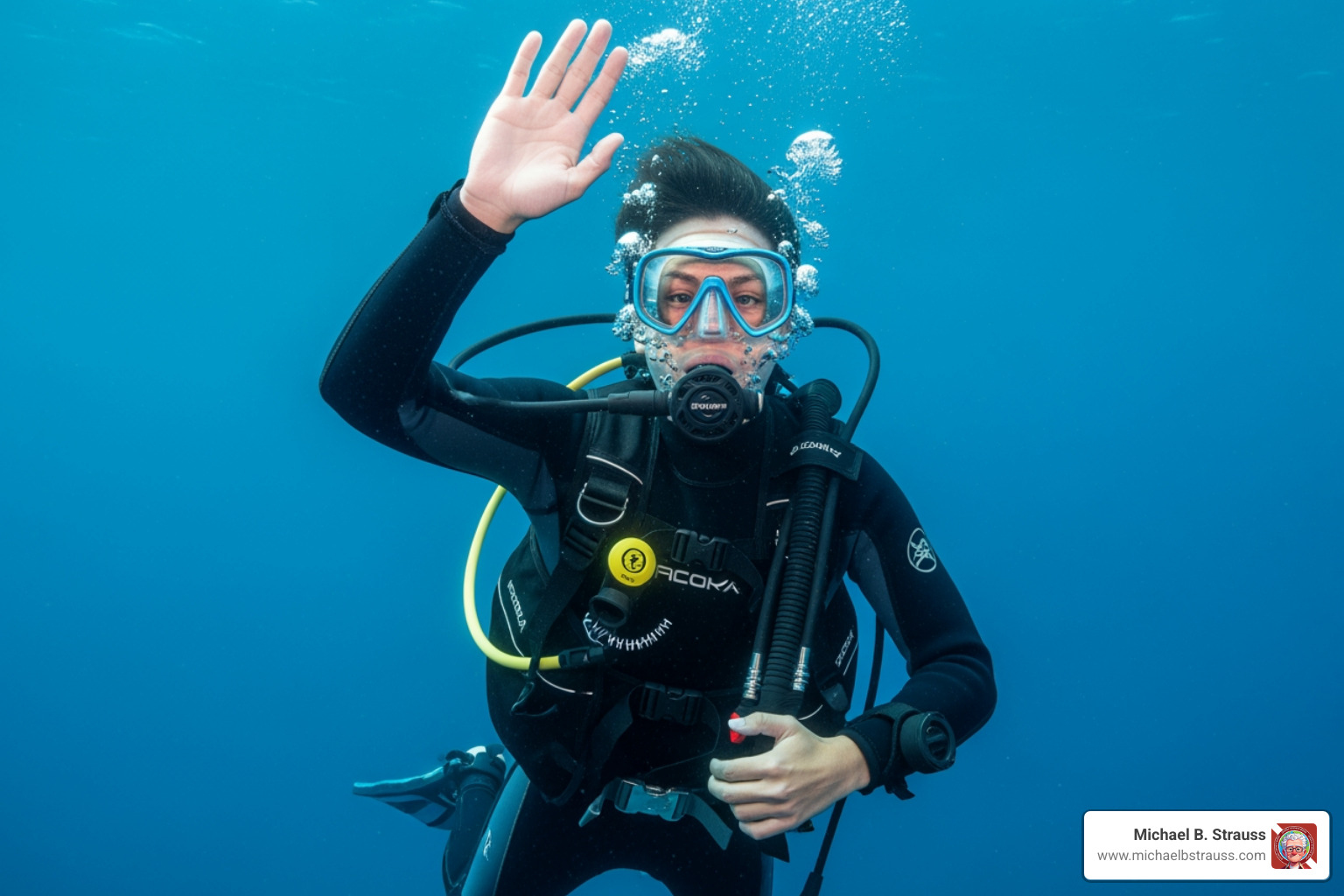
Illustration of the CESA technique, with one hand up protecting the head and the other on the BCD inflator hose, while the diver exhales with an 'ahhhh' sound. - emergency ascent procedures

Practicing CESA with an instructor builds the muscle memory and confidence needed for a real emergency.

Mitigating Risks and Mastering Your Skills

Understanding emergency ascent procedures is half the battle; the other is mitigating the risks through training, equipment knowledge, and composure. For scientific research on emergency ascent training, see Emergency Ascent Science.

The Dangers of a Rapid Ascent: Barotrauma, DCS, and Hypoxia

A rapid, uncontrolled ascent is dangerous due to the physiological effects of changing pressure.

  • Lung Overpressure Injury (Pulmonary Barotrauma): The most immediate risk of a rapid ascent, especially if you hold your breath. As pressure decreases, air in the lungs expands (Boyle’s Law!). Without continuous exhalation, this can rupture lung tissue, causing a collapsed lung or an arterial gas embolism (air bubbles in the bloodstream). Continuously exhaling is your protection.
  • Decompression Sickness (DCS): Known as "the bends," DCS occurs when nitrogen absorbed under pressure forms bubbles in body tissues during a too-rapid ascent. The body needs time to off-gas this nitrogen safely. Ascending too quickly can lead to symptoms from joint pain to paralysis. Maintain a slow ascent rate—no faster than 18 meters (60 feet) per minute—and make a safety stop if possible. Learn more about why DCS can occur.
  • Hypoxia: Lack of oxygen (hypoxia) can occur if you run out of air and overexert yourself during an ascent, leading to confusion or loss of consciousness. This underscores the importance of staying calm and conserving energy.

Modern dive computers provide warnings if you ascend too quickly. Heeding these and adjusting your buoyancy can prevent serious injury. Dropping weights should only be a last resort at the surface if you struggle to stay afloat, as it causes an uncontrolled ascent.
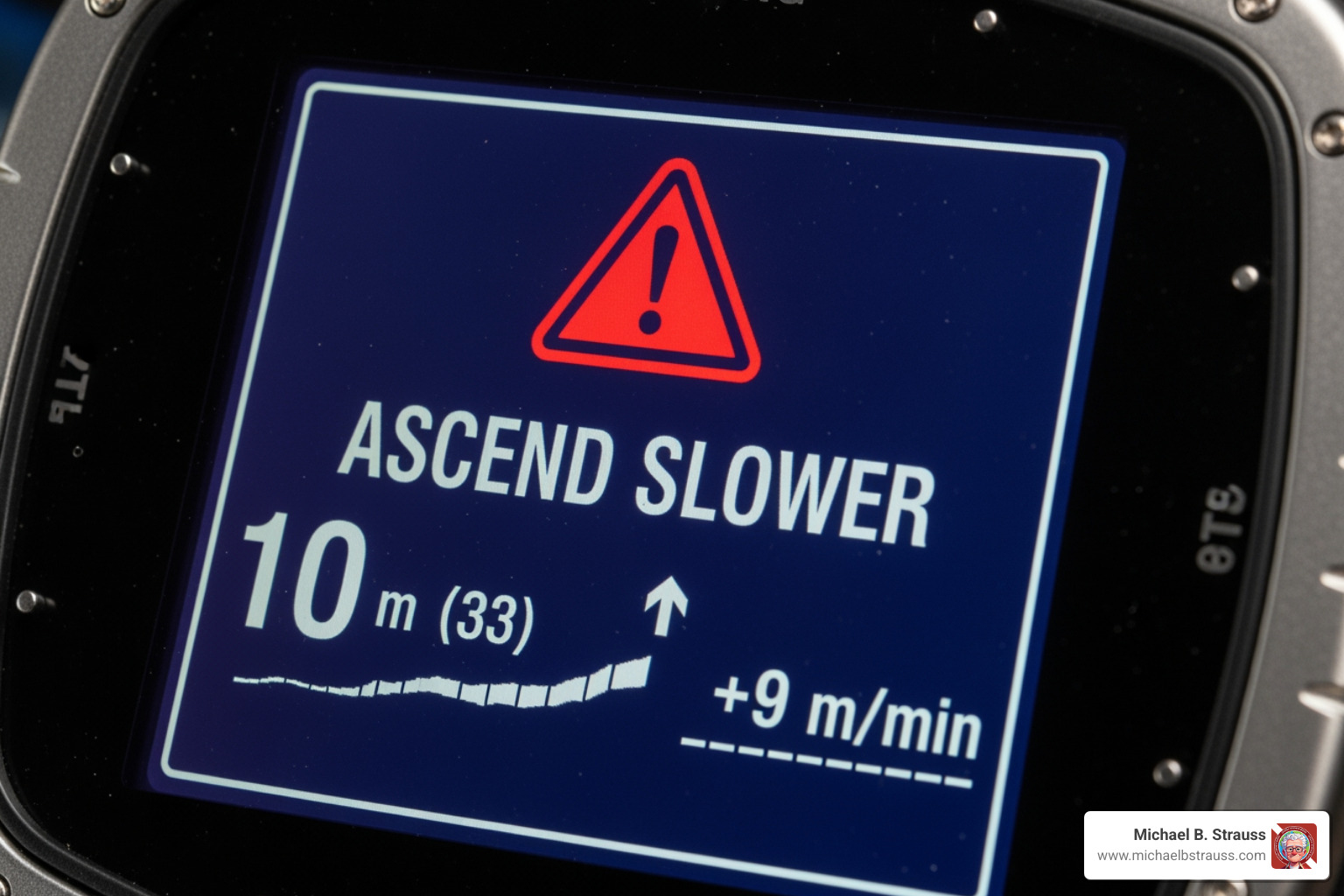
Dive computer displaying a rapid ascent warning, with a red icon and text indicating 'ASCEND SLOWER'. - emergency ascent procedures

The Buddy's Role and Alternate Air Source Ascents

Your dive buddy is your most important safety system. The buddy system is designed for situations like an out-of-air emergency. A buddy's role is to be vigilant, responsive, and ready to donate their alternate air source.

An Alternate Air Source Ascent is the preferred dependent emergency ascent procedure. The out-of-air diver signals their buddy, who provides their alternate regulator. The diver secures and breathes from the alternate source while the buddy maintains physical contact. Both divers then ascend slowly together, controlling their buoyancy and ascent rate. This procedure significantly reduces panic because the diver can breathe normally, and it keeps the team together for better control.

Preparation is Prevention: Training, Equipment, and Staying Calm

The best way to handle an emergency is to prevent it through preparation.

Staying calm is crucial, as panic is the single greatest threat in a diving emergency. Diving safety organizations report panic as a leading cause of accidents. Panic leads to rapid breathing, poor decisions, and forgetting your training. A calm diver can assess the situation and act methodically.

Thorough equipment knowledge is also paramount. Familiarity with your BCD, weight system, and alternate air source allows for quick, confident action. Always perform pre-dive safety checks on your own and your buddy's gear to prevent issues like a partially open tank valve.

Finally, preparation means continuous training. Beyond your Open Water course, advanced courses and regular practice drills (like CESA and alternate air source ascents) build muscle memory. Pre-dive discussions with your buddy about emergency plans are also essential.

By consistently training, understanding our gear, and cultivating a calm mindset, we transform potential emergencies into manageable situations, ensuring many more safe and exhilarating dives ahead. For a comprehensive guide to diving safety and science from renowned expert Dr. Michael B. Strauss, get your copy of Diving Science Revisited.

DISCLAIMER: Articles are for "EDUCATIONAL PURPOSES ONLY", not to be considered advice or recommendations.

Download Full PDF
Tags:

Understanding Emergency Ascent Procedures: Your Essential Safety Framework

A scuba diver ascending calmly while looking up towards the surface, demonstrating composure and control during an ascent. - emergency ascent procedures

Emergency ascent procedures are life-saving protocols every diver must master. These techniques are for reaching the surface safely when a normal ascent isn't possible, such as during an out-of-air emergency or equipment failure.

Quick Reference: The Four Emergency Ascent Procedures (in order of priority)

  1. Normal Ascent - When you're low on air but still have enough to ascend normally
  2. Alternate Air Source Ascent - Breathing from your buddy's backup regulator while ascending together
  3. Controlled Emergency Swimming Ascent (CESA) - Swimming to the surface while exhaling continuously, when no air source is available
  4. Buoyant Ascent - Dropping weights and ascending rapidly (last resort only, highest risk)

While emergencies are rare—some studies track roughly 16 free ascents per 10,000 dives—they do happen. Your response in those critical seconds determines the outcome.

The most dangerous element of an emergency ascent is not the lack of air, but panic. A panicked diver makes poor decisions, ascends too quickly, and forgets basic safety rules. The difference between a manageable incident and a life-threatening one often comes down to training, equipment knowledge, and staying calm. An uncontrolled ascent can cause lung overexpansion injuries, decompression sickness, or loss of consciousness, all of which are preventable with proper technique.

Understanding these procedures provides the foundation for safer diving, whether you're a recreational diver, a technical diver, or a medical professional treating diving injuries.

Infographic showing the four emergency ascent procedures in priority order: 1. Normal Ascent with low air tank icon, 2. Alternate Air Source Ascent with two divers sharing air, 3. Controlled Emergency Swimming Ascent with single diver ascending while exhaling, and 4. Buoyant Ascent with dropped weights. Each procedure includes risk level indicators and key safety reminders like ascent rate limits and continuous exhalation requirements. - emergency ascent procedures infographic

Easy emergency ascent procedures glossary:

A Diver's Guide to Emergency Ascent Procedures

When underwater, every ascent needs to be controlled. But what happens when things go wrong? Knowing our emergency ascent procedures is a life-saving skill. We must distinguish between different types of ascents, understand diver training standards, and rely on our buddy system and buoyancy control. For more information about diving safety and decompression science, visit Diving Science by Dr. Michael B. Strauss.

Independent vs. Dependent Ascents: Knowing Your Options

An emergency ascent is either independent or dependent.

  • Independent Emergency Ascent: You manage the ascent yourself without breathing assistance from another diver. This is a self-rescue scenario, such as a Controlled Emergency Swimming Ascent (CESA) or a Buoyant Ascent.
  • Dependent Emergency Ascent: This involves assistance from your buddy. The most common example is an Alternate Air Source Ascent, where you breathe from your buddy's secondary regulator. Historically, buddy breathing (sharing one regulator) was taught, but it has been largely phased out due to its risks.

Choosing the right procedure depends on the situation. If you are out of air with a buddy nearby, it's a dependent ascent. If your buddy is not in sight, it's an independent ascent. Training helps us make this critical decision quickly.

Dive training agencies have a clear order of priority for emergency ascent procedures in low-on-air or out-of-air situations to minimize risk.

Here's the preferred order:

  1. Normal Ascent (when low on air): The best option. If you're low on air but not out, signal your buddy and make a controlled ascent together at a safe rate. This is a preventative measure to avoid an out-of-air emergency.
  2. Alternate Air Source Ascent: The most desirable option for an out-of-air emergency. Signal your buddy, secure their alternate air source, and ascend together. This allows for normal breathing, a safe ascent rate, and reduces panic.
  3. Controlled Emergency Swimming Ascent (CESA): The primary independent option when you're out of air and a buddy cannot assist. You swim to the surface while exhaling continuously and managing your buoyancy.
  4. Buoyant Ascent: The absolute last resort. If you are out of air, too deep for a CESA, and unable to contact your buddy, you drop your weights. This causes a rapid, uncontrolled ascent and carries the highest risk of serious injury.

Buddy breathing is not on this list because it is no longer recommended by most agencies. Sharing a single regulator back and forth is complex, stressful, and increases the risk of water inhalation and loss of control for both divers. The widespread use of alternate air sources has made this risky procedure unnecessary.

Mastering the Controlled Emergency Swimming Ascent (CESA)

The CESA is a core skill taught in every Open Water Diver course. It's your go-to independent emergency ascent procedure if you are out of air and cannot get help from a buddy.

Here’s a step-by-step guide to performing a CESA:

  1. Don't Panic: Stay calm and remember your training.
  2. Signal: Signal "Out of Air" to your buddy. If they don't respond or you're alone, proceed with CESA.
  3. Look Up and Ascend: Orient yourself toward the surface, check for obstructions, and begin kicking upward.
  4. Continuously Exhale: This is the most crucial step. To prevent lung overexpansion injury (barotrauma), you must exhale continuously by making a steady "ahhhh" sound. Do not hold your breath!
  5. Keep Regulator In: Keep the regulator in your mouth to protect your airway from water.
  6. Protect Your Head: Extend one hand over your head to protect it from overhead obstructions.
  7. Manage Buoyancy: Use your other hand on the BCD inflator to release small bursts of expanding air, controlling your ascent rate.
  8. Control Ascent Rate: Aim for a speed no faster than 18 meters (60 feet) per minute. Slow and steady is key.
  9. Drop Weights Only at the Surface: Never drop weights during the ascent. Only do so at the surface if you struggle to stay buoyant.
  10. At the Surface: Once you break the surface, orally inflate your BCD for positive buoyancy and signal for help.

Illustration of the CESA technique, with one hand up protecting the head and the other on the BCD inflator hose, while the diver exhales with an 'ahhhh' sound. - emergency ascent procedures

Practicing CESA with an instructor builds the muscle memory and confidence needed for a real emergency.

Mitigating Risks and Mastering Your Skills

Understanding emergency ascent procedures is half the battle; the other is mitigating the risks through training, equipment knowledge, and composure. For scientific research on emergency ascent training, see Emergency Ascent Science.

The Dangers of a Rapid Ascent: Barotrauma, DCS, and Hypoxia

A rapid, uncontrolled ascent is dangerous due to the physiological effects of changing pressure.

  • Lung Overpressure Injury (Pulmonary Barotrauma): The most immediate risk of a rapid ascent, especially if you hold your breath. As pressure decreases, air in the lungs expands (Boyle’s Law!). Without continuous exhalation, this can rupture lung tissue, causing a collapsed lung or an arterial gas embolism (air bubbles in the bloodstream). Continuously exhaling is your protection.
  • Decompression Sickness (DCS): Known as "the bends," DCS occurs when nitrogen absorbed under pressure forms bubbles in body tissues during a too-rapid ascent. The body needs time to off-gas this nitrogen safely. Ascending too quickly can lead to symptoms from joint pain to paralysis. Maintain a slow ascent rate—no faster than 18 meters (60 feet) per minute—and make a safety stop if possible. Learn more about why DCS can occur.
  • Hypoxia: Lack of oxygen (hypoxia) can occur if you run out of air and overexert yourself during an ascent, leading to confusion or loss of consciousness. This underscores the importance of staying calm and conserving energy.

Modern dive computers provide warnings if you ascend too quickly. Heeding these and adjusting your buoyancy can prevent serious injury. Dropping weights should only be a last resort at the surface if you struggle to stay afloat, as it causes an uncontrolled ascent.

Dive computer displaying a rapid ascent warning, with a red icon and text indicating 'ASCEND SLOWER'. - emergency ascent procedures

The Buddy's Role and Alternate Air Source Ascents

Your dive buddy is your most important safety system. The buddy system is designed for situations like an out-of-air emergency. A buddy's role is to be vigilant, responsive, and ready to donate their alternate air source.

An Alternate Air Source Ascent is the preferred dependent emergency ascent procedure. The out-of-air diver signals their buddy, who provides their alternate regulator. The diver secures and breathes from the alternate source while the buddy maintains physical contact. Both divers then ascend slowly together, controlling their buoyancy and ascent rate. This procedure significantly reduces panic because the diver can breathe normally, and it keeps the team together for better control.

Preparation is Prevention: Training, Equipment, and Staying Calm

The best way to handle an emergency is to prevent it through preparation.

Staying calm is crucial, as panic is the single greatest threat in a diving emergency. Diving safety organizations report panic as a leading cause of accidents. Panic leads to rapid breathing, poor decisions, and forgetting your training. A calm diver can assess the situation and act methodically.

Thorough equipment knowledge is also paramount. Familiarity with your BCD, weight system, and alternate air source allows for quick, confident action. Always perform pre-dive safety checks on your own and your buddy's gear to prevent issues like a partially open tank valve.

Finally, preparation means continuous training. Beyond your Open Water course, advanced courses and regular practice drills (like CESA and alternate air source ascents) build muscle memory. Pre-dive discussions with your buddy about emergency plans are also essential.

By consistently training, understanding our gear, and cultivating a calm mindset, we transform potential emergencies into manageable situations, ensuring many more safe and exhilarating dives ahead. For a comprehensive guide to diving safety and science from renowned expert Dr. Michael B. Strauss, get your copy of Diving Science Revisited.

DISCLAIMER: Articles are for "EDUCATIONAL PURPOSES ONLY", not to be considered advice or recommendations.