Read story

Why Understanding Scuba Diving Coverage Matters Before Your Next Trip

Is scuba diving covered by travel insurance? The answer is rarely a simple yes. Most standard travel insurance policies exclude scuba diving or only cover it under strict conditions. To be properly insured, you will likely need to purchase an adventure sports add-on or a specialized plan.

Quick Facts on Scuba Diving Insurance:

  • Standard Travel Insurance: Often excludes scuba diving or requires an add-on.
  • Recreational Diving: Coverage is typically for depths up to 30m with a specialized policy.
  • Certification: PADI, SSI, BSAC, or an equivalent certification is required.
  • Key Exclusions: Technical diving, diving under the influence, and undeclared medical conditions are not covered.
  • What's Covered: Emergency medical care, hyperbaric treatment, medical evacuation, and equipment loss.
  • What's Not Covered: Search and rescue, diving beyond depth limits, and commercial diving.

Scuba diving offers unparalleled thrills, but it comes with inherent risks like decompression sickness (DCS) and equipment failure. Standard travel insurance, which covers trip cancellations and general medical issues, is often insufficient. Dive accident insurance, on the other hand, focuses specifically on underwater emergencies. Neither policy alone provides complete protection.

This guide explains what's covered, what's excluded, and how to choose the right protection for your dive adventure.
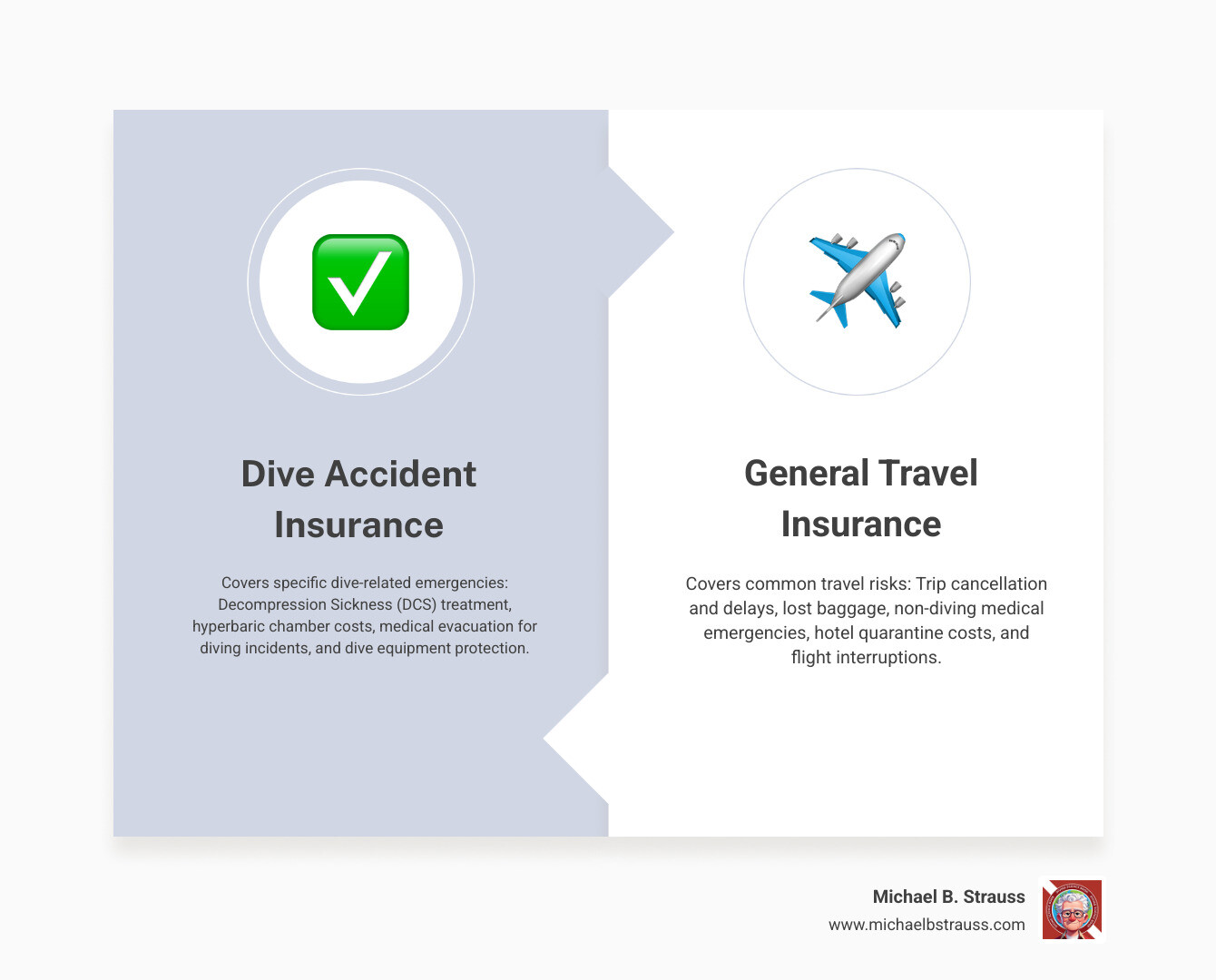
infographic comparing dive accident insurance coverage (decompression sickness treatment, hyperbaric chamber costs, dive-related medical evacuation, dive equipment protection) versus general travel insurance coverage (trip cancellation and delays, lost baggage and personal items, non-diving medical emergencies, hotel quarantine costs, flight interruptions) - is scuba diving covered by travel insurance infographic comparison-2-items-formal

Simple is scuba diving covered by travel insurance glossary:

Is Scuba Diving Covered by Travel Insurance? A Deep Dive into Your Policy

When planning a dive trip, a critical question is, "is scuba diving covered by travel insurance?" The answer is often complex. Standard travel insurance policies frequently list scuba diving as a high-risk exclusion. While your plan might cover a sprained ankle from a city tour, it likely won't cover decompression sickness (DCS) from a dive. To be protected, you must examine policy details and understand the specific coverage and exclusions. Securing adequate protection usually requires an adventure sports add-on or a specialized plan.
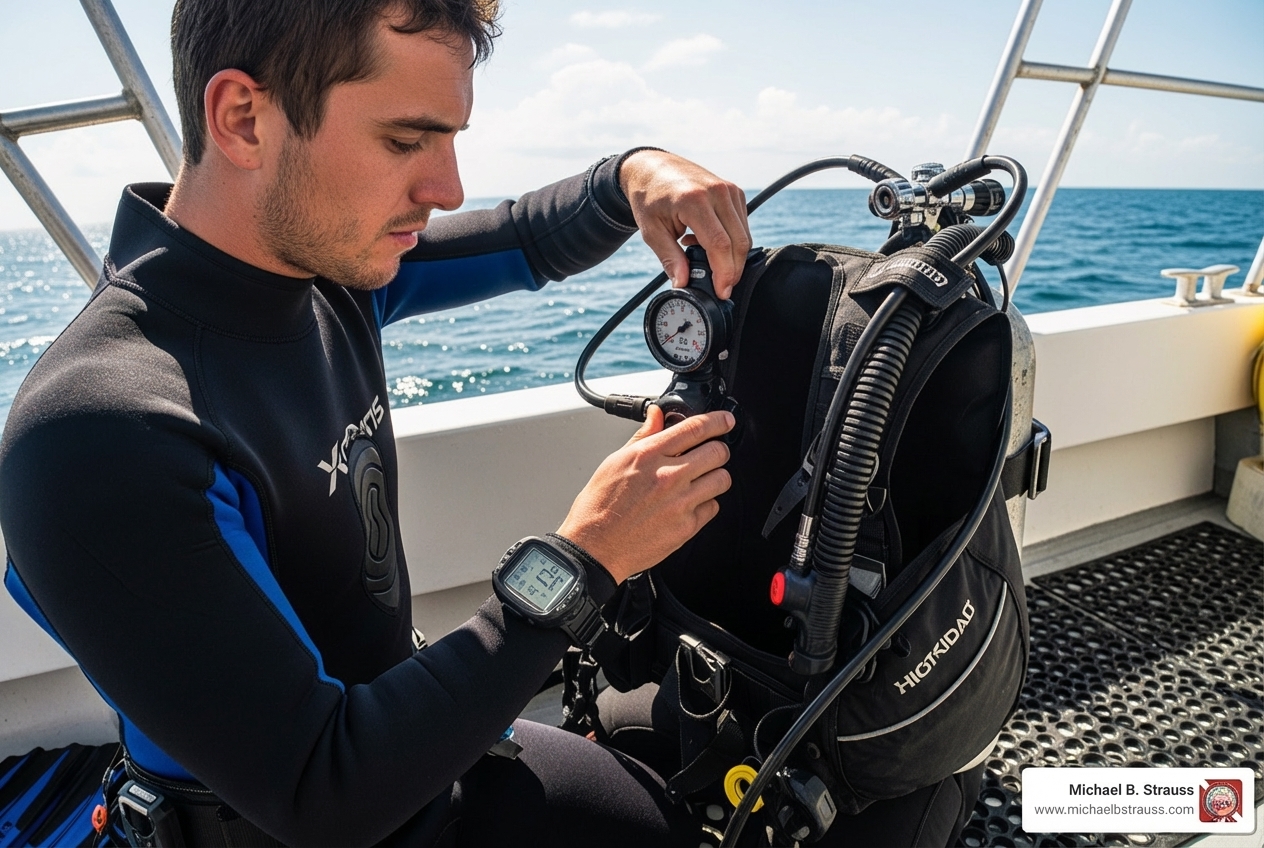
a diver carefully checking their BCD and regulator before a dive - is scuba diving covered by travel insurance

Standard vs. Specialized Policies: Is Scuba Diving Covered by Travel Insurance by Default?

Standard travel insurance policies typically do not cover scuba diving by default, categorizing it as a high-risk "adventure sport." To get proper protection, you have three main options:

  1. Adventure Sport Add-ons: Many general insurers offer an add-on to extend coverage to scuba diving, usually with depth and certification limits (e.g., up to 30 or 40 meters) and requiring proper certification (PADI, SSI, etc.).
  2. Specialized Dive Accident Insurance: This insurance is designed specifically for divers, covering in-water emergencies like DCS, arterial gas embolism, and the costs of hyperbaric chambers and medical evacuations. Organizations specializing in dive safety are well-known providers.
  3. Specialized Travel Insurance for Divers: Some providers offer plans that combine general travel benefits with comprehensive dive accident coverage.

Understanding the difference is key. Dive insurance handles diving-specific medical events, while travel insurance covers broader issues like trip cancellations, lost baggage, and non-diving medical problems. For complete protection, most divers need both. Many liveaboards and international destinations require proof of both types of insurance.

Here is a quick comparison:

FeatureDive Accident InsuranceGeneral Travel Insurance
Primary FocusDiving-related medical emergencies (DCS, barotrauma)Non-diving medical emergencies, trip disruptions
Medical TreatmentHyperbaric chamber, specialized dive doctors, evacuationGeneral hospital care, doctor visits, emergency evacuation
Equipment CoverageMay cover dive equipment damage/loss due to dive incidentCovers general luggage loss/damage (may exclude dive gear)
Trip Cancellation/DelayGenerally not coveredCovered for specified reasons (illness, weather, etc.)
Lost BaggageGenerally not coveredCovered
Non-Diving Illness/InjuryNot coveredCovered

Learn more about the science behind some of these risks by exploring Decompression Science.

Key Coverage Inclusions for Divers

A policy that properly covers scuba diving should include several key features to address its unique risks. These inclusions provide a safety net, allowing you to focus on your dive. Look for:

  • Emergency Medical Expenses: Covers urgent treatment for dive-related injuries or illnesses, including hospital stays and doctor's fees.
  • Hyperbaric Chamber Treatment: This is non-negotiable. It covers the significant cost of hyperbaric therapy for decompression sickness (DCS).
  • Medical Evacuation and Repatriation: Covers transport to the nearest suitable medical facility from a remote dive site and, if necessary, repatriation back home. This can include expensive air ambulance services.
  • Lost or Damaged Equipment: Provides coverage for loss, theft, or damage to your expensive dive gear, such as regulators, BCDs, and dive computers. Check the per-item limits.
  • Trip Cancellation & Interruption: Reimburses non-refundable expenses if your trip is cancelled or cut short due to a covered reason, like illness or a natural disaster.
  • Severe Weather Cover: May offer reimbursement for pre-booked, non-refundable dive excursions cancelled due to adverse weather.
  • Quarantine Costs: Some policies cover additional accommodation and living expenses if you are unexpectedly required to quarantine.

the interior of a multiplace hyperbaric chamber - is scuba diving covered by travel insurance

Common Exclusions: When is Scuba Diving Not Covered by Travel Insurance?

Understanding what is not covered is as important as knowing what is. Even specialized dive insurance has exclusions that can invalidate your coverage. Always read the fine print. Common scenarios where is scuba diving covered by travel insurance becomes a "no" include:

  • Depth Limits: Diving deeper than your policy's stated maximum (e.g., 30 or 40 meters) will void coverage for any incident at that depth.
  • Certification Requirements: You must hold a valid certification (PADI, SSI, etc.) for the type of diving you are doing. If you are learning, you must be supervised by a certified instructor.
  • Unsupervised Diving: Diving without a buddy or qualified supervision can void coverage unless your policy and certification specifically allow it.
  • Technical or Commercial Diving: Recreational policies do not cover technical diving (e.g., cave diving, deep decompression dives) or any commercial diving work. These require separate, specialized insurance.
  • Alcohol or Drug Influence: Any incident that occurs while you are under the influence of alcohol or non-prescribed drugs will not be covered.
  • Undeclared Medical Conditions: Failing to declare a pre-existing medical condition can lead to a denied claim if it's related to the incident.
  • Search and Rescue Costs: The cost of searching for a lost diver is often excluded, even if medical evacuation is covered.
  • Reckless Behavior: Ignoring safety warnings from dive operators, going against medical advice, or engaging in reckless acts will void your coverage.

Understanding these exclusions is paramount to ensuring your coverage remains valid. You can find more information about potential medical problems related to diving in More info on medical problems of diving.

Pre-Existing Conditions and Making a Claim

Navigating pre-existing conditions and the claims process is a vital part of dive trip preparation.

Pre-Existing Medical Conditions:You must declare any existing health issues when purchasing insurance. Failure to do so is a common reason for claim denial. Your insurer may require a medical assessment or a 'fit to dive' certificate from your doctor. Honesty is crucial for valid coverage.

Making a Claim:If an incident occurs, follow these steps:

  1. Contact Immediately: In a serious medical emergency, contact your insurer's 24/7 assistance line immediately. They can coordinate care and payment.
  2. Document Everything: Collect all relevant paperwork, including medical reports, receipts, dive logs, and police reports (for theft). More evidence strengthens your claim.
  3. Understand Payment: For major events, the insurer may pay the provider directly. For smaller expenses, you will likely pay upfront and file for reimbursement. Keep all original receipts.
  4. Be Truthful: Never submit false or misleading information when filing a claim. Insurance fraud has serious consequences.

For general health advice before traveling, refer to Tips for healthy travel from the Government of Canada.

Final Checklist: Ensuring You're Covered Before You Dive

This final checklist combines smart insurance planning with essential safety practices to ensure you're prepared for your next dive trip.

Key Factors to Consider When Choosing a Policy

Choosing the right policy requires careful consideration of several key factors. Before purchasing, get clear answers from the insurance provider to the following questions. Don't forget to read the full policy wording, as the fine print contains all terms and exclusions.

Essential Questions to Ask Your Insurance Provider:

  • Does this policy explicitly cover recreational scuba diving?
  • What are the maximum depth and certification level requirements?
  • Does the policy cover technical diving, cave diving, or wreck penetration? (Most do not).
  • Is hyperbaric chamber treatment covered, and what are the limits?
  • What are the coverage limits for emergency medical evacuation?
  • Is my dive equipment covered for loss, theft, or damage? What are the per-item limits?
  • Does the policy cover trip cancellation if I can't dive due to illness or severe weather?
  • What is the policy deductible (the amount you pay out-of-pocket)?
  • What is the process for making a claim and contacting emergency assistance?

Your Pre-Dive Safety and Insurance Checklist

Follow these steps to ensure you are prepared for anything the ocean (or travel) throws your way.

  • Review Your Policy: Before you go, review your insurance documents. Confirm scuba diving is covered, and understand all depth limits, certification rules, and exclusions.
  • Declare Medical Conditions: Inform your insurer of any pre-existing medical conditions to ensure your policy remains valid. Get a 'fit to dive' certificate from your doctor if required.
  • Save Emergency Contacts: Program your insurer's 24/7 emergency assistance number into your phone and have a physical copy.
  • Carry Copies of Documents: Keep digital and physical copies of your passport, dive certification, and insurance policy in a safe, accessible place.
  • Follow Diving Safety Principles: Adherence to fundamental diving safety is paramount. Always dive within your limits, plan your dives, use a buddy, perform gear checks, and follow the 24-hour no-fly rule after diving. Dr. Michael B. Strauss's books offer invaluable insights into diving safety. You can explore more about Diving Science and visit the resources page for more expert diving insights.
  • Choose Reputable Operators: Dive only with reputable companies that have well-maintained equipment and licensed professionals.
  • Check Local Conditions: Stay informed about local weather and water conditions, and always heed safety warnings.

Following these steps provides peace of mind, allowing you to fully enjoy the world beneath the waves. Happy diving!

To learn more about the science of diving, get your copy of Diving Science Revisited here: https://www.bestpub.com/view-all-products/product/diving-science-revisited/category_pathway-48.html

DISCLAIMER: Articles are for "EDUCATIONAL PURPOSES ONLY", not to be considered advice or recommendations.

Download Full PDF
Tags:

Why Understanding Scuba Diving Coverage Matters Before Your Next Trip

Is scuba diving covered by travel insurance? The answer is rarely a simple yes. Most standard travel insurance policies exclude scuba diving or only cover it under strict conditions. To be properly insured, you will likely need to purchase an adventure sports add-on or a specialized plan.

Quick Facts on Scuba Diving Insurance:

  • Standard Travel Insurance: Often excludes scuba diving or requires an add-on.
  • Recreational Diving: Coverage is typically for depths up to 30m with a specialized policy.
  • Certification: PADI, SSI, BSAC, or an equivalent certification is required.
  • Key Exclusions: Technical diving, diving under the influence, and undeclared medical conditions are not covered.
  • What's Covered: Emergency medical care, hyperbaric treatment, medical evacuation, and equipment loss.
  • What's Not Covered: Search and rescue, diving beyond depth limits, and commercial diving.

Scuba diving offers unparalleled thrills, but it comes with inherent risks like decompression sickness (DCS) and equipment failure. Standard travel insurance, which covers trip cancellations and general medical issues, is often insufficient. Dive accident insurance, on the other hand, focuses specifically on underwater emergencies. Neither policy alone provides complete protection.

This guide explains what's covered, what's excluded, and how to choose the right protection for your dive adventure.

infographic comparing dive accident insurance coverage (decompression sickness treatment, hyperbaric chamber costs, dive-related medical evacuation, dive equipment protection) versus general travel insurance coverage (trip cancellation and delays, lost baggage and personal items, non-diving medical emergencies, hotel quarantine costs, flight interruptions) - is scuba diving covered by travel insurance infographic comparison-2-items-formal

Simple is scuba diving covered by travel insurance glossary:

Is Scuba Diving Covered by Travel Insurance? A Deep Dive into Your Policy

When planning a dive trip, a critical question is, "is scuba diving covered by travel insurance?" The answer is often complex. Standard travel insurance policies frequently list scuba diving as a high-risk exclusion. While your plan might cover a sprained ankle from a city tour, it likely won't cover decompression sickness (DCS) from a dive. To be protected, you must examine policy details and understand the specific coverage and exclusions. Securing adequate protection usually requires an adventure sports add-on or a specialized plan.

a diver carefully checking their BCD and regulator before a dive - is scuba diving covered by travel insurance

Standard vs. Specialized Policies: Is Scuba Diving Covered by Travel Insurance by Default?

Standard travel insurance policies typically do not cover scuba diving by default, categorizing it as a high-risk "adventure sport." To get proper protection, you have three main options:

  1. Adventure Sport Add-ons: Many general insurers offer an add-on to extend coverage to scuba diving, usually with depth and certification limits (e.g., up to 30 or 40 meters) and requiring proper certification (PADI, SSI, etc.).
  2. Specialized Dive Accident Insurance: This insurance is designed specifically for divers, covering in-water emergencies like DCS, arterial gas embolism, and the costs of hyperbaric chambers and medical evacuations. Organizations specializing in dive safety are well-known providers.
  3. Specialized Travel Insurance for Divers: Some providers offer plans that combine general travel benefits with comprehensive dive accident coverage.

Understanding the difference is key. Dive insurance handles diving-specific medical events, while travel insurance covers broader issues like trip cancellations, lost baggage, and non-diving medical problems. For complete protection, most divers need both. Many liveaboards and international destinations require proof of both types of insurance.

Here is a quick comparison:

FeatureDive Accident InsuranceGeneral Travel Insurance
Primary FocusDiving-related medical emergencies (DCS, barotrauma)Non-diving medical emergencies, trip disruptions
Medical TreatmentHyperbaric chamber, specialized dive doctors, evacuationGeneral hospital care, doctor visits, emergency evacuation
Equipment CoverageMay cover dive equipment damage/loss due to dive incidentCovers general luggage loss/damage (may exclude dive gear)
Trip Cancellation/DelayGenerally not coveredCovered for specified reasons (illness, weather, etc.)
Lost BaggageGenerally not coveredCovered
Non-Diving Illness/InjuryNot coveredCovered

Learn more about the science behind some of these risks by exploring Decompression Science.

Key Coverage Inclusions for Divers

A policy that properly covers scuba diving should include several key features to address its unique risks. These inclusions provide a safety net, allowing you to focus on your dive. Look for:

  • Emergency Medical Expenses: Covers urgent treatment for dive-related injuries or illnesses, including hospital stays and doctor's fees.
  • Hyperbaric Chamber Treatment: This is non-negotiable. It covers the significant cost of hyperbaric therapy for decompression sickness (DCS).
  • Medical Evacuation and Repatriation: Covers transport to the nearest suitable medical facility from a remote dive site and, if necessary, repatriation back home. This can include expensive air ambulance services.
  • Lost or Damaged Equipment: Provides coverage for loss, theft, or damage to your expensive dive gear, such as regulators, BCDs, and dive computers. Check the per-item limits.
  • Trip Cancellation & Interruption: Reimburses non-refundable expenses if your trip is cancelled or cut short due to a covered reason, like illness or a natural disaster.
  • Severe Weather Cover: May offer reimbursement for pre-booked, non-refundable dive excursions cancelled due to adverse weather.
  • Quarantine Costs: Some policies cover additional accommodation and living expenses if you are unexpectedly required to quarantine.

the interior of a multiplace hyperbaric chamber - is scuba diving covered by travel insurance

Common Exclusions: When is Scuba Diving Not Covered by Travel Insurance?

Understanding what is not covered is as important as knowing what is. Even specialized dive insurance has exclusions that can invalidate your coverage. Always read the fine print. Common scenarios where is scuba diving covered by travel insurance becomes a "no" include:

  • Depth Limits: Diving deeper than your policy's stated maximum (e.g., 30 or 40 meters) will void coverage for any incident at that depth.
  • Certification Requirements: You must hold a valid certification (PADI, SSI, etc.) for the type of diving you are doing. If you are learning, you must be supervised by a certified instructor.
  • Unsupervised Diving: Diving without a buddy or qualified supervision can void coverage unless your policy and certification specifically allow it.
  • Technical or Commercial Diving: Recreational policies do not cover technical diving (e.g., cave diving, deep decompression dives) or any commercial diving work. These require separate, specialized insurance.
  • Alcohol or Drug Influence: Any incident that occurs while you are under the influence of alcohol or non-prescribed drugs will not be covered.
  • Undeclared Medical Conditions: Failing to declare a pre-existing medical condition can lead to a denied claim if it's related to the incident.
  • Search and Rescue Costs: The cost of searching for a lost diver is often excluded, even if medical evacuation is covered.
  • Reckless Behavior: Ignoring safety warnings from dive operators, going against medical advice, or engaging in reckless acts will void your coverage.

Understanding these exclusions is paramount to ensuring your coverage remains valid. You can find more information about potential medical problems related to diving in More info on medical problems of diving.

Pre-Existing Conditions and Making a Claim

Navigating pre-existing conditions and the claims process is a vital part of dive trip preparation.

Pre-Existing Medical Conditions:You must declare any existing health issues when purchasing insurance. Failure to do so is a common reason for claim denial. Your insurer may require a medical assessment or a 'fit to dive' certificate from your doctor. Honesty is crucial for valid coverage.

Making a Claim:If an incident occurs, follow these steps:

  1. Contact Immediately: In a serious medical emergency, contact your insurer's 24/7 assistance line immediately. They can coordinate care and payment.
  2. Document Everything: Collect all relevant paperwork, including medical reports, receipts, dive logs, and police reports (for theft). More evidence strengthens your claim.
  3. Understand Payment: For major events, the insurer may pay the provider directly. For smaller expenses, you will likely pay upfront and file for reimbursement. Keep all original receipts.
  4. Be Truthful: Never submit false or misleading information when filing a claim. Insurance fraud has serious consequences.

For general health advice before traveling, refer to Tips for healthy travel from the Government of Canada.

Final Checklist: Ensuring You're Covered Before You Dive

This final checklist combines smart insurance planning with essential safety practices to ensure you're prepared for your next dive trip.

Key Factors to Consider When Choosing a Policy

Choosing the right policy requires careful consideration of several key factors. Before purchasing, get clear answers from the insurance provider to the following questions. Don't forget to read the full policy wording, as the fine print contains all terms and exclusions.

Essential Questions to Ask Your Insurance Provider:

  • Does this policy explicitly cover recreational scuba diving?
  • What are the maximum depth and certification level requirements?
  • Does the policy cover technical diving, cave diving, or wreck penetration? (Most do not).
  • Is hyperbaric chamber treatment covered, and what are the limits?
  • What are the coverage limits for emergency medical evacuation?
  • Is my dive equipment covered for loss, theft, or damage? What are the per-item limits?
  • Does the policy cover trip cancellation if I can't dive due to illness or severe weather?
  • What is the policy deductible (the amount you pay out-of-pocket)?
  • What is the process for making a claim and contacting emergency assistance?

Your Pre-Dive Safety and Insurance Checklist

Follow these steps to ensure you are prepared for anything the ocean (or travel) throws your way.

  • Review Your Policy: Before you go, review your insurance documents. Confirm scuba diving is covered, and understand all depth limits, certification rules, and exclusions.
  • Declare Medical Conditions: Inform your insurer of any pre-existing medical conditions to ensure your policy remains valid. Get a 'fit to dive' certificate from your doctor if required.
  • Save Emergency Contacts: Program your insurer's 24/7 emergency assistance number into your phone and have a physical copy.
  • Carry Copies of Documents: Keep digital and physical copies of your passport, dive certification, and insurance policy in a safe, accessible place.
  • Follow Diving Safety Principles: Adherence to fundamental diving safety is paramount. Always dive within your limits, plan your dives, use a buddy, perform gear checks, and follow the 24-hour no-fly rule after diving. Dr. Michael B. Strauss's books offer invaluable insights into diving safety. You can explore more about Diving Science and visit the resources page for more expert diving insights.
  • Choose Reputable Operators: Dive only with reputable companies that have well-maintained equipment and licensed professionals.
  • Check Local Conditions: Stay informed about local weather and water conditions, and always heed safety warnings.

Following these steps provides peace of mind, allowing you to fully enjoy the world beneath the waves. Happy diving!

To learn more about the science of diving, get your copy of Diving Science Revisited here: https://www.bestpub.com/view-all-products/product/diving-science-revisited/category_pathway-48.html

DISCLAIMER: Articles are for "EDUCATIONAL PURPOSES ONLY", not to be considered advice or recommendations.