Why Professional Dive Logs Matter
A professional dive log is a mandatory, detailed record of every dive performed by an occupational diver. It serves as a legal document, safety record, and career advancement tool required by federal and provincial regulations.
Key Purposes of a Professional Dive Log:
- Legal Compliance - Federal and provincial regulations require all occupational divers to maintain logs.
- Certification - Required for ADCI Commercial Diver Certification Card applications.
- Safety Management - Critical for incident investigation and continuous improvement.
- Career Progression - Documents verified, timestamped evidence of competency and experience.
- Regulatory Oversight - Must meet standards set by ADCI, IMCA, and WorkSafeBC.
Unlike recreational logs for personal adventures, professional dive logs are legal documents scrutinized by employers, regulators, and certification bodies. For an occupational diver, the logbook is a resume. Each entry proves work completed, and a supervisor's signature validates competency. The recorded parameters can become crucial evidence in an investigation or the key to securing your next contract.
In professional diving, the stakes are higher and the risks are real. Your logbook is not optional—it's as essential as your dive computer. Federal regulations don't just suggest keeping a log; they require it.
The diving industry is also evolving. Traditional paper logs are giving way to digital systems with cloud backup, real-time data sync, and advanced safety features designed for high-stress commercial operations.
Understanding professional dive logging is about more than following rules. It's about protecting yourself, advancing your career, and contributing to an industry-wide culture of safety.
Professional dive log terms to learn:
- dive log books
- online dive logbook
- scuba diving log book
The Core of a Professional Dive Log: Requirements and Content
When working underwater for a living, your professional dive log is your professional identity. It serves the law, your employer, safety investigators, and your career. Meticulous record-keeping is not bureaucracy; it is the foundation of safe diving operations, a principle at the heart of Diving Science. Understanding what goes into this critical document is essential for a successful career.
Legal Mandates and Regulatory Oversight
Keeping a professional dive log is not optional; it's mandated by federal and provincial regulations for all occupational divers. Several key organizations set the standards and verify compliance:
The Association of Diving Contractors International (ADCI) requires a properly documented dive log for Commercial Diver Certification Card applications to verify your experience meets their rigorous standards.
For offshore work, International Marine Contractors Association (IMCA) logbooks are the global standard. They provide a consistent format to demonstrate training, competence, and work history to employers worldwide.
In Canada, provincial bodies like WorkSafeBC provide specific log books for inshore operations to ensure local compliance. The Diver Certification Board of Canada (DCBC) also offers a robust Occupational Diver/Supervisor logbook designed for durability and extensive use. You can view the logbook here.
These regulatory bodies ensure that claimed experience is verifiable and signed off by a credible supervisor, a system that protects divers, employers, and the public.
Essential Information for a Professional Dive Log
A professional dive log entry is far more detailed than a recreational one.
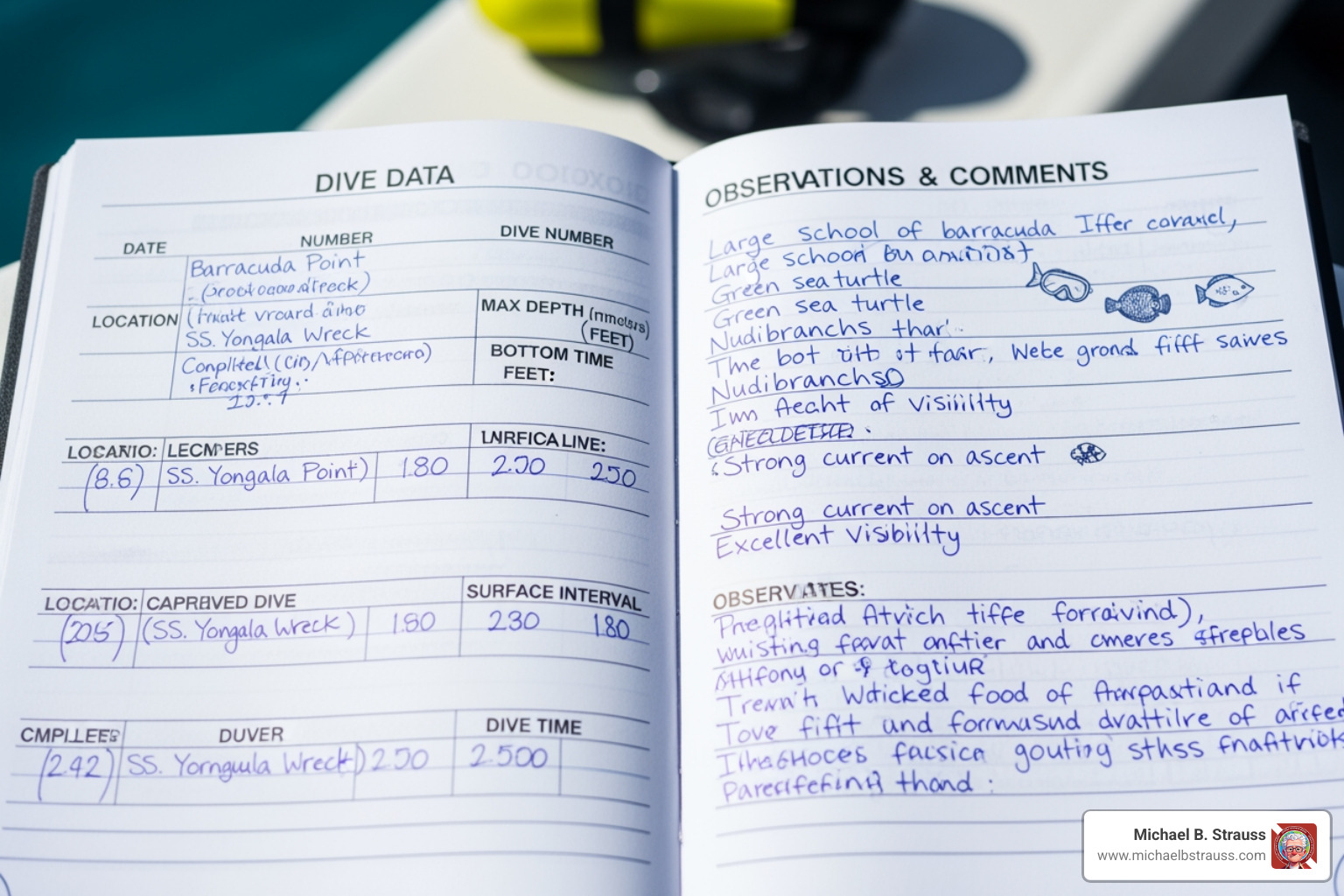
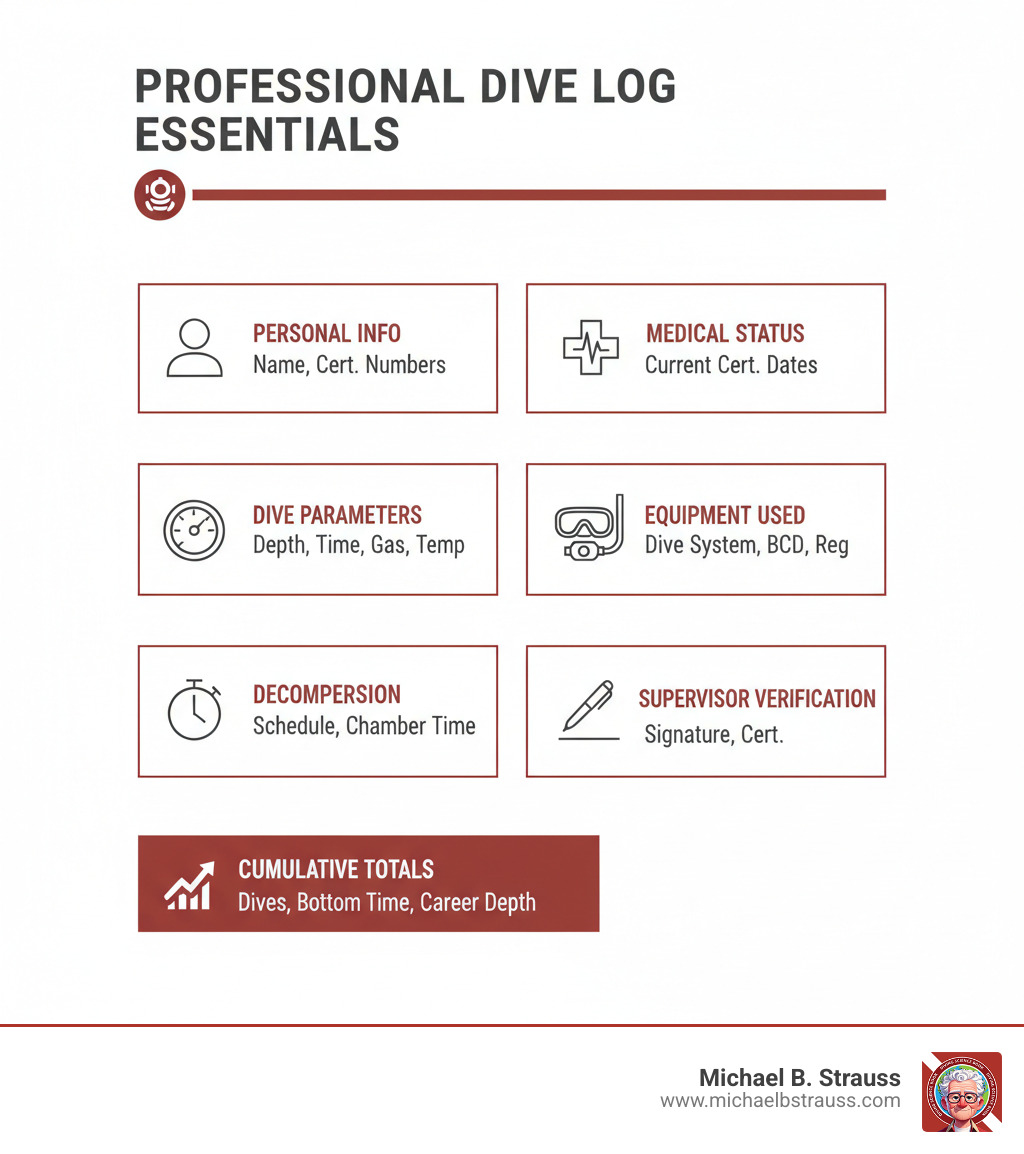
It begins with your personal details (name, contact info, certification numbers) and medical certificates (dates, restrictions, on-the-job incidents) to establish your credentials and fitness for duty. You must also list all relevant qualifications and certifications, including non-diving skills like welding or first aid, with issue and expiry dates.
Each dive requires detailed dive parameters: date, time, location, max depth, bottom time, and dive type (surface-supplied, SCUBA, etc.). You must also document the gas mixture, water temperature, visibility, a description of work performed, and all equipment used.
Decompression schedules must be recorded precisely, noting the tables or algorithms followed and any chamber time. Understanding Decompression Science is key to accurate documentation.
Critically, every entry requires a supervisor's signature, printed name, and certification number. This signature transforms your log into verified, timestamped evidence of your experience. Also include team information, remarks on unusual events, and maintain cumulative totals for dives and bottom time.
Mandatory Data Fields for a Professional Dive Log Entry:
- Date of Dive
- Dive Number
- Dive Location/Site
- Max Depth
- Bottom Time
- Gas Used
- Work Performed
- Equipment Used
- Supervisor's Name & Signature
- Diver's Signature
- Next Decompression Obligation (if applicable)
A comprehensive log, as emphasized by IMCA, should include medical certificates, qualifications, training records, competence assessments, and dive details to ensure no critical information is missed.
The Logbook's Role in Safety and Career Advancement
Your professional dive log is a powerful tool for both safety and career advancement.
For competency assessment, your logbook provides irrefutable, timestamped proof of your skills. A supervisor's signature on a task, like underwater welding or using a specific diving system, becomes verified evidence that is invaluable when applying for jobs or advanced certifications.
For career progression, a well-maintained logbook tells your professional story. It showcases the full breadth of your experience, making it easier to move into roles like diving supervisor or life support technician.
The logbook is also a crucial tool for incident investigation. In the event of an accident, your detailed records on timelines, equipment, procedures, and conditions provide essential evidence. This helps investigators understand what happened, identify root causes, and prevent future incidents. This is particularly relevant for the Evaluation and Management of Pain-Related Medical Problems of Diving.
Finally, dive logs drive continuous improvement. Analyzing data across multiple dives helps identify patterns in equipment performance or procedures, leading to smarter, safer operations. This data-driven approach fosters a culture of constant refinement in the diving industry. Your log is your career record, your safety tool, and your contribution to a safer industry.
Modernizing the Log: Paper vs. Digital Systems
For decades, the paper logbook was the undisputed king of dive record-keeping. Now, digital technology is changing how we manage dive data. The choice between traditional paper and modern digital systems involves weighing functionality, efficiency, and data security. Accurate and accessible dive data, regardless of the method, is crucial for understanding physiological impacts, including conditions like Why and at What Sites Decompression Sickness Can Occur.
Traditional Paper Logs: Pros and Cons
Many professional divers still rely on traditional paper logbooks for their tangible and authentic feel.
Pros of Traditional Paper Logs:
- Durability: High-quality logbooks with stitched pages are robust and can withstand harsh dive site conditions.
- Simplicity: They require only a pen and paper, with no batteries to charge or software to glitch.
- Regulatory Acceptance: Paper logs are universally accepted by bodies like ADCI, IMCA, and WorkSafeBC.
However, they have significant drawbacks:
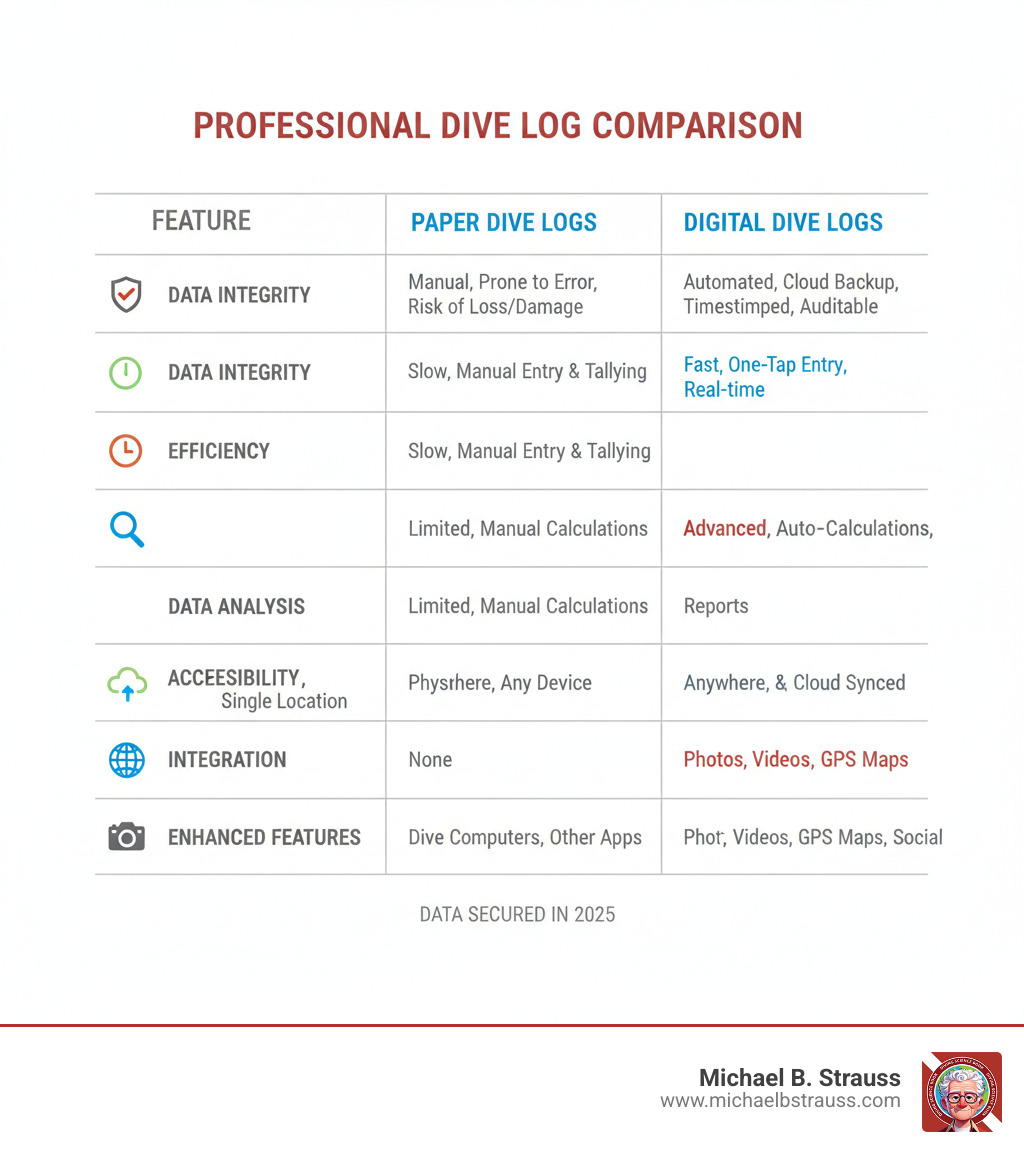
- Risk of Loss or Damage: A single incident can destroy an entire career's worth of records.
- Manual and Error-Prone: Handwriting every detail is time-consuming and susceptible to errors.
- Limited Analysis: Calculating cumulative data or analyzing trends is a difficult manual task.
The Rise of the Digital Professional Dive Log
The professional dive log is going digital, enhancing safety, efficiency, and data integrity for high-stress commercial diving operations.
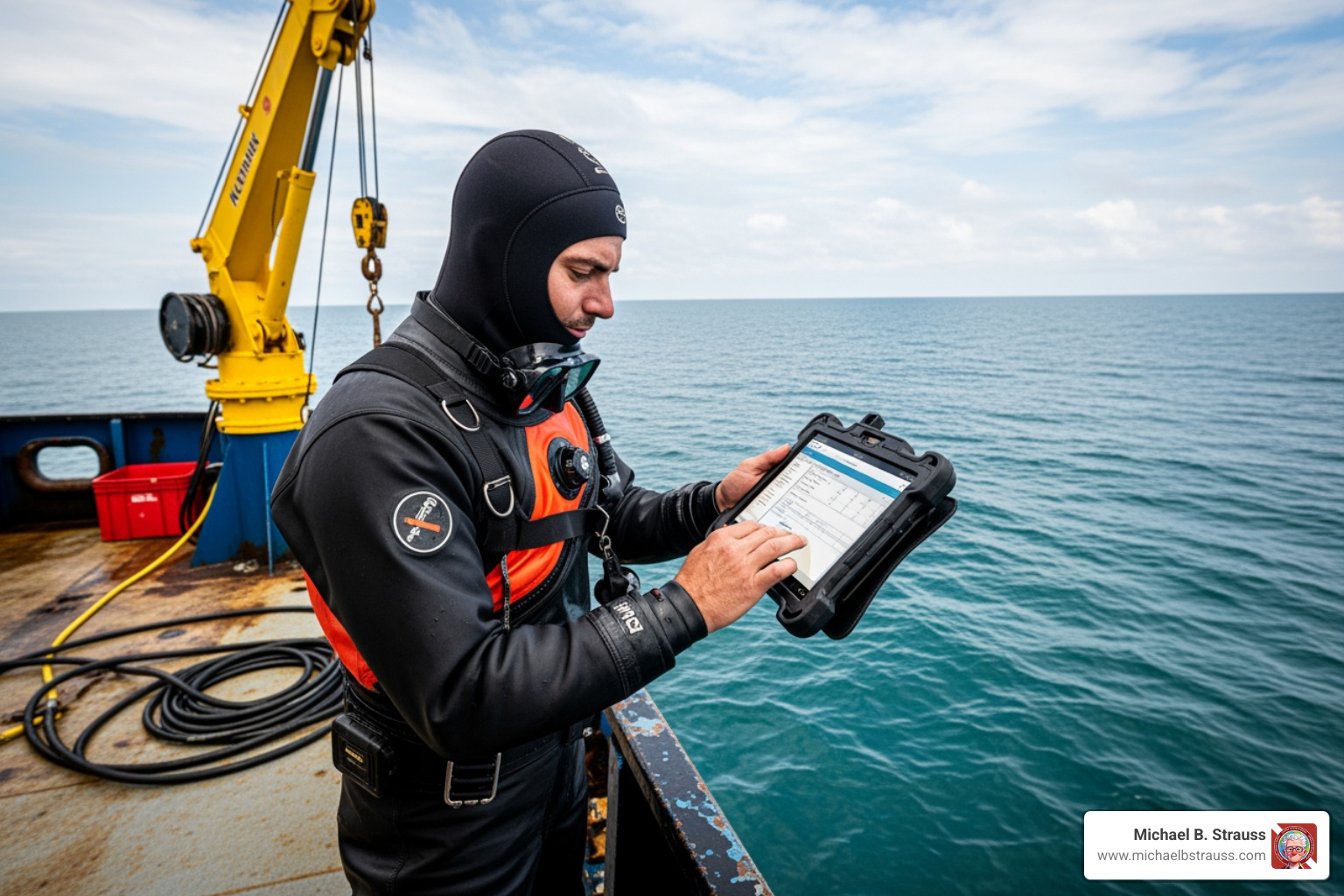
Digital systems are gaining traction for several reasons:
- Efficiency and Real-time Data: Digital logs streamline operations with intuitive, pre-populated inputs. Supervisors can manage live logs on mobile apps, with automated notifications for checks and procedures.
- Cloud Backup and Accessibility: Cloud-based systems automatically sync dives, certifications, and media across all devices. This provides seamless access and protects against data loss.
- Digital Signatures and Timestamped Evidence: Digital signatures create a verifiable, auditable record of experience. Once signed, the log is instantly distributed, ensuring transparency and data integrity with a full change history.
- Data Analytics: Digital platforms can automatically calculate statistics and generate reports. This data-driven approach supports proactive decision-making and continuous improvement in safety, which is critical for understanding issues like Decompression Science.
- Adaptability for High-Stress Environments: Modern digital solutions are designed for complex scenarios, with flexible logic that adapts to different dive types and workflows, such as managing surface decompression or chamber dives across multiple connected devices.
- Integration and Features: Many systems download data directly from a wide range of dive computers. They also offer features like GPS mapping, multimedia integration, and custom reporting tools.
Cloud-based and digitally signed logs provide objective, secure records, fostering a safer and more resilient diving industry.
Choosing the Right Logging System for Your Career
Choosing between a paper or digital professional dive log depends on your needs, regulatory environment, and personal preference. The goal is to find a tool that supports your career and upholds the highest safety standards, a principle deeply valued by Dr. Michael B. Strauss.
When making your choice, consider these key factors:
- Cost: Paper logs are a one-time purchase, while digital solutions may have subscription fees. Weigh this against the long-term value of data security and efficiency.
- Platform Compatibility & Integration: Ensure a digital system works on your devices and integrates with your dive computer for streamlined data transfer.
- Regulatory Compliance: The system must meet the requirements of bodies like ADCI, IMCA, and WorkSafeBC.
- Data Integrity and Security: Professional records demand robust security. Verify the protocols of cloud solutions. Digital signatures offer superior authenticity.
- Offline Functionality: For remote work, ensure your digital log can function without an internet connection and sync later.
The best system is one you will use consistently, that meets all regulations, and that improves your safety and career growth. To deepen your understanding of the science behind safe diving practices, get your copy of Diving Science Revisited today.
DISCLAIMER: Articles are for "EDUCATIONAL PURPOSES ONLY", not to be considered advice or recommendations.


