Why Mastering Proper Weight Belt Use Matters for Every Diver
Proper weight belt use is the foundation of safe scuba diving. It allows you to achieve neutral buoyancy and control your position underwater, but incorrect weighting or placement can lead to poor buoyancy, increased air consumption, and emergency situations.
Quick Guide to Proper Weight Belt Use:
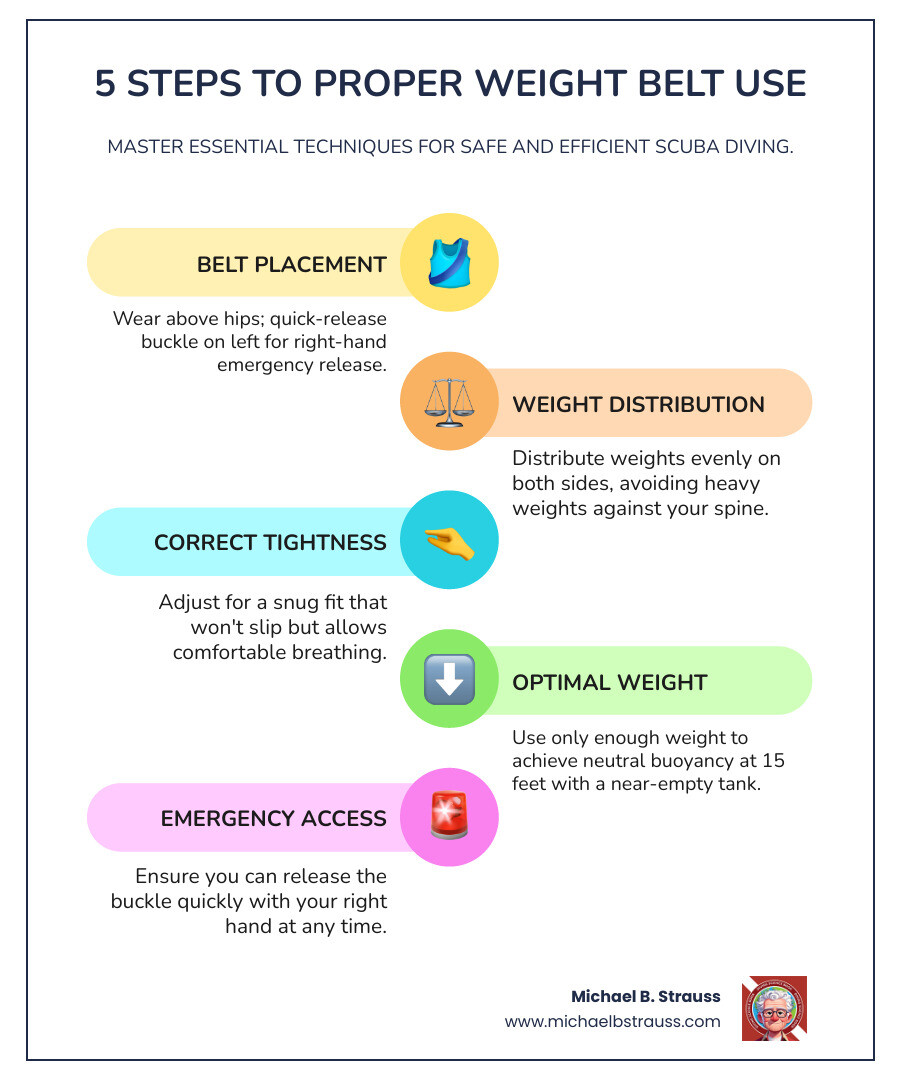
- Position - Wear the belt above your hip bones with the quick-release buckle on your left side for right-hand emergency release.
- Weight Distribution - Distribute weights evenly on both sides, avoiding heavy weights directly against your spine.
- Tightness - Adjust for a snug fit that won't slip but allows comfortable breathing.
- Amount - Use only enough weight to achieve neutral buoyancy at 15 feet with a near-empty tank.
- Emergency Access - Ensure you can release the buckle quickly with your right hand at any time.
Unlike a lifting belt for core support, a scuba weight belt has one critical purpose: counteracting the positive buoyancy of your body and wetsuit to help you achieve neutral buoyancy.
Many divers use weight belts, but not all have mastered their assembly, positioning, or emergency procedures. Whether you're a new diver or have hundreds of dives logged, understanding proper weight belt use directly impacts your safety, air consumption, and overall diving experience.
Simple proper weight belt use word guide:
A Diver's Guide to Proper Weight Belt Use
This section covers the essential principles of selecting, wearing, and using a scuba weight belt for optimal safety and performance.
Choosing and Assembling Your Weight System
Proper weight belt use begins with selecting and assembling the right system. Divers typically use two main types: traditional web-strap belts or modern pocket-style belts.
The classic web-strap belt uses vinyl-coated lead blocks threaded onto durable nylon. Pocket-style belts use soft, lead-shot-filled pouches that conform to the body for improved comfort. While many modern Buoyancy Compensators (BCs) integrate weight pockets, traditional belts remain essential for divers needing more weight or specific distribution.
Regardless of the type, proper weight belt use demands even weight distribution. Aim to place an equal amount of weight on each side of your body. For example, if you need 13 pounds, distribute it as 6 pounds on one side and 7 on the other, rather than placing a large block against your spine. For heavier loads, consider distributing some weight to ankle or tank weights to avoid concentrating it all on your hips.
To assemble a traditional web belt, thread the weights onto the strap. To prevent them from sliding, secure each one by giving the belt a half-twist before threading it through the weight's second slot, "locking" it in place. Retainer clips can also be used. This ensures your weights remain fixed, providing consistent buoyancy.
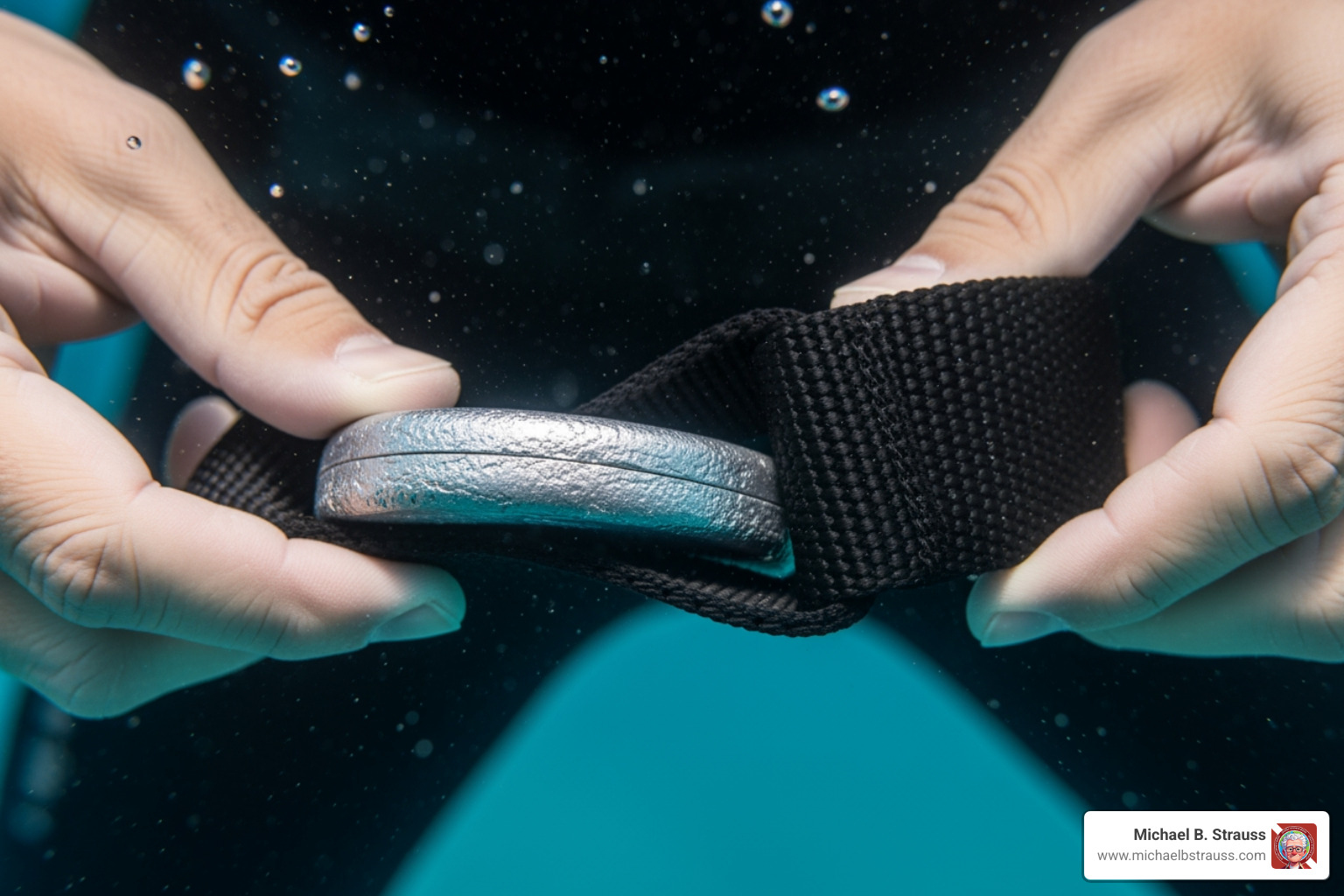
When selecting a belt, focus on the amount of weight it needs to hold, as most are adjustable for waist size.
The Correct Way to Wear and Adjust Your Belt
Wearing and adjusting your belt correctly is critical for safety. To don a heavy belt without straining your back, use the "step-through" method: place the belt on the ground, step into the loop, and pull it up to your waist.
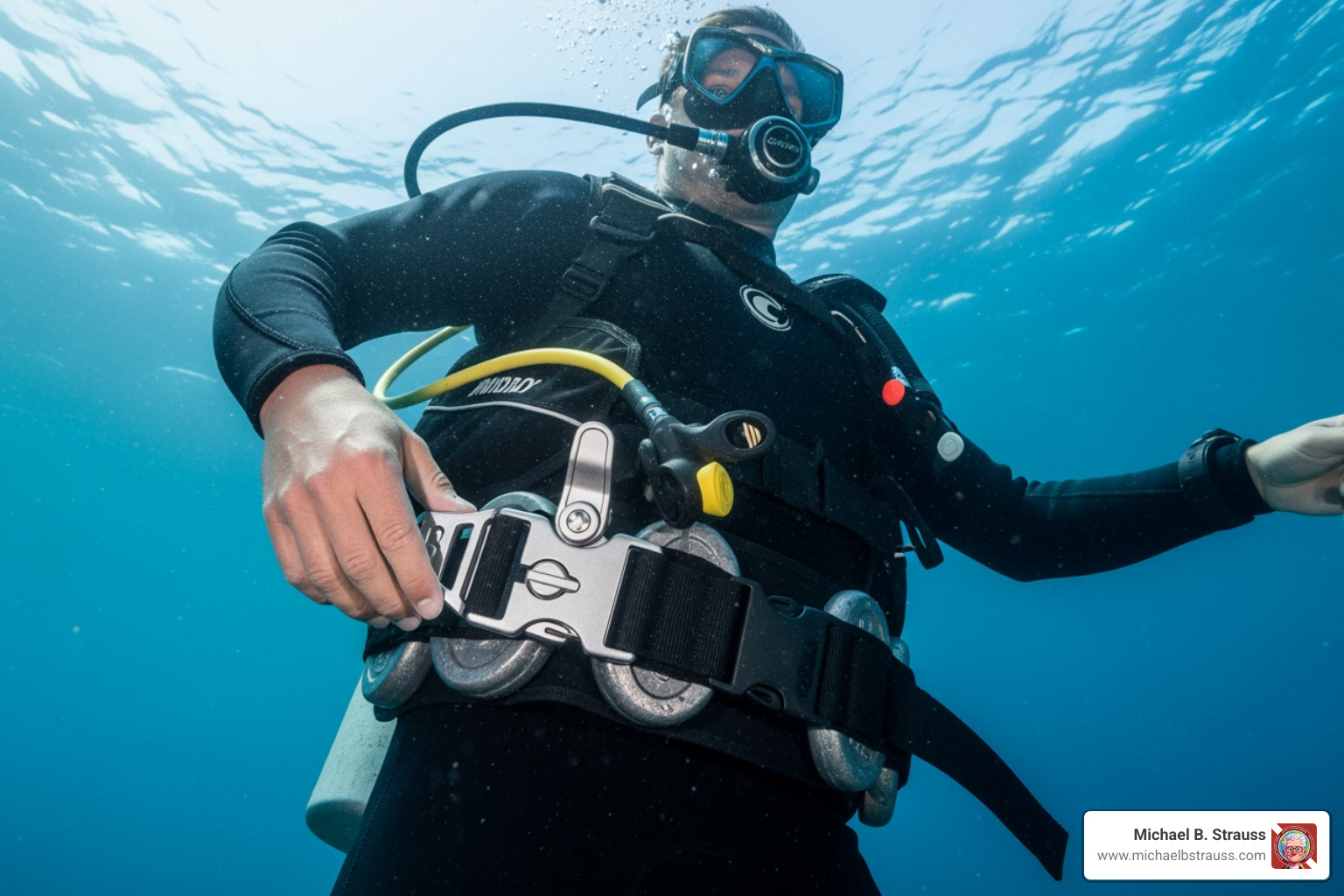
Position the belt just above your hip bones so it rests securely. The most vital aspect of proper weight belt use is the quick-release buckle. It must be on your left side for a standard right-hand release, ensuring you can ditch it quickly in an emergency without fumbling.
The belt should be snug enough to prevent slipping but not so tight that it restricts breathing. Your wetsuit will compress at depth, making the belt feel looser, so a secure fit at the surface is important.
Mastering Buoyancy: The Primary Purpose of a Weight Belt
The core of proper weight belt use is buoyancy control. Our bodies and wetsuits are naturally buoyant, and a weight belt provides the counteracting force needed to achieve neutral buoyancy—the state of being effortlessly suspended in the water. This conserves energy, reduces air consumption, and protects marine life.
Your wetsuit's neoprene compresses as you descend, reducing its buoyancy. This means the right amount of weight is a careful balance. To determine the correct amount, perform a buoyancy check. With a near-empty tank at the surface, you should float at eye level while holding a normal breath. If you sink, you have too much weight; if you float higher, you need more.
Fine-tuning your weight is an ongoing process. Adjust by small increments over several dives to find your perfect balance. This precision improves safety, comfort, and air consumption. For a deeper understanding of the physics and principles at play, Dr. Michael B. Strauss's work on Diving Science offers invaluable insights.
Common Mistakes and Advanced Safety Protocols
Understanding potential pitfalls and emergency procedures is crucial for every diver. Even with the best intentions, mistakes can happen, and knowing how to react is key to a safe dive.
Safety First: Proper Weight Belt Use in Emergencies
A critical part of proper weight belt use is knowing how to handle it in an emergency. Ditching your weight belt is a life-saving skill for emergency ascents. To gain immediate positive buoyancy, open the quick-release buckle with your right hand, hold the belt out to the side, and let it drop.
You may also need to remove your belt for non-emergencies, like handing it to a boat crew. To do this safely, undo the buckle and hold the belt by the end without the buckle to prevent weights from sliding off as you pass it up.
Removing or replacing a belt underwater is a complex skill that should be avoided unless absolutely necessary. It requires excellent buoyancy control and should be practiced in a controlled environment. Mastering all safety protocols is key to minimizing risk, a topic covered extensively in Dr. Michael B. Strauss’s extensive work, including insights into Decompression Science.
Myths and Misconceptions About Weighting
To master proper weight belt use, we must debunk common myths.
A dangerous myth is that "more weight is safer." In reality, over-weighting causes poor buoyancy control and high air consumption. You'll constantly fight to maintain position by adjusting your BC, leading to exhaustion and depleting your air supply faster. This struggle also makes it harder to achieve the stable neutral buoyancy needed to dive safely, a key factor in preventing issues like those explored in Why and at What Sites Decompression Sickness Can Occur.
Another misconception is that belt placement doesn't matter. As covered, incorrect placement can cause discomfort and, more critically, prevent you from finding the quick-release buckle in an emergency.
Finally, a weight belt is a tool, not a magic fix for poor buoyancy. Mastery comes from practice, proper breathing, and skill development—not from adding extra weight. Proper weight belt use is about precision and using the minimum weight necessary, not relying on brute force.
Key Takeaways for Safe and Effective Proper Weight Belt Use
A weight belt is a critical piece of safety equipment. When used correctly, it improves your diving; when misused, it introduces significant risks.
Here are our key takeaways for mastering proper weight belt use:
- Practice Makes Perfect: Regularly practice donning, adjusting, and ditching your weight belt in a controlled environment until it becomes second nature.
- Precision in Weighting: Always perform a buoyancy check. Use only the minimum weight needed to achieve neutral buoyancy with a near-empty tank.
- Optimal Distribution: Distribute weights evenly and secure them to prevent shifting, which improves trim and comfort.
- Accessibility is Key: The quick-release buckle must always be on your left side for a right-hand release in an emergency.
- Pre-Dive and Buddy Checks: Include the weight belt in all pre-dive and buddy checks to confirm it is secure and the release is clear.
- Continuous Learning: Stay informed, review procedures, and consider advanced training to refine your skills.
Dr. Michael B. Strauss, a renowned expert in diving safety, reinforces the importance of understanding our gear. We encourage you to explore the comprehensive guide on Diving Science for a deeper understanding of safe diving principles. Every dive is an opportunity to refine your skills, ensuring each adventure is as safe as it is unforgettable.
Ready to master the principles of safe diving? Get your copy of Diving Science Revisited today!
DISCLAIMER: Articles are for "EDUCATIONAL PURPOSES ONLY", not to be considered advice or recommendations.


