Why the Rescue Diver Course Is a Game-Changer for Scuba Divers

A rescue diver course teaches you to prevent dive emergencies, manage panicked or unresponsive divers, and perform structured rescues — both underwater and at the surface.
Here's what the course covers at a glance:
- Self-rescue — handle your own emergencies before helping others
- Stress recognition — spot early signs of panic in fellow divers
- Panicked diver management — safely approach and control a distressed diver
- Unresponsive diver rescue — bring a diver up from depth and tow them to safety
- Search patterns — locate a missing diver using compass navigation and structured sweeps
- Emergency management — coordinate a response and provide surface first aid
Divers consistently describe this certification as the most challenging — and most rewarding — course they've ever taken. Many say it completely changes how they think underwater.
The shift isn't just about skill. It's about mindset. You stop thinking only about your own dive and start scanning for problems around you. That awareness makes you a better buddy, a safer diver, and a stronger candidate for professional training like Divemaster.
One common theme from divers who've completed it: "I wish I'd done this sooner."
Whether you're aiming for professional certification or simply want to be the diver others can count on in an emergency, this guide walks you through everything you need to know.
Key terms for Rescue diver course:
Mastering the Rescue diver course: Prerequisites and Training
Before we jump into the deep end, let’s talk about what you need to have in your logbook before signing up. The Rescue diver course isn't an entry-level program; it builds on the foundational skills you learned in your initial certifications. Think of it as moving from "learning to drive" to "learning defensive driving and basic EMT skills."

Certification and Age Requirements
To enroll, you generally need to be at least 12 years old (for Junior Rescue Diver) or 15–18 years old for the full adult certification, depending on the agency. You must also hold an Advanced Open Water certification or a PADI Adventure Diver certification (specifically including the Underwater Navigation dive). Most shops also recommend having at least 20 logged dives to ensure your buoyancy is stable enough to handle the "task loading" of the course.
Medical and Administrative Prep
Safety is the priority, so you’ll need to complete a PADI Medical Form. If you answer "Yes" to any health conditions, you must get a doctor’s sign-off before entering the water. Additionally, you'll need to sign a Continuing Education administrative document.
EFR, CPR, and First Aid
You cannot become a Rescue Diver without being trained in CPR and First Aid. Most divers take the Emergency First Response (EFR) course alongside their rescue training. This certification must have been completed within the last 24 months. These "dry" skills are the backbone of what happens once you get a victim back to the boat or shore.
| Requirement | Details |
|---|---|
| Minimum Age | 12 (Junior) or 15–18 (Standard) |
| Prerequisite Cert | Advanced Open Water or equivalent |
| Medical | Completed Medical Statement |
| First Aid/CPR | Current within 24 months |
| Core Skill Focus | Problem prevention and emergency management |
Core Skills Taught in the Rescue diver course
The curriculum is designed to make problem-solving second nature. We don't just want you to know what to do; we want you to do it without hesitation.
- Self-Rescue: This is the most underrated part of the course. You'll learn how to handle leg cramps, air depletion, and vertigo. If you can't save yourself, you can't save anyone else.
- Stress Recognition: We teach you to look for "the look"—that wide-eyed, rapid-breathing stare that signals a diver is about to panic. Catching this early can prevent a full-blown emergency.
- Managing Panicked Divers: A panicked diver is surprisingly strong and can accidentally drown their rescuer. You'll practice "quick releases" and surface approaches that keep you safe while you calm the other person down.
- Unresponsive Diver Scenarios: This is the "heavy lifting" portion. You will practice bringing an unresponsive diver from the bottom to the surface using controlled buoyant lifts. Research such as Recommendations for rescue of a submerged unresponsive compressed-gas diver highlights the importance of immediate, effective action in these high-stakes moments.
- Search Patterns: If a buddy goes missing, you need a plan. You’ll learn U-shaped and expanding square search patterns using your compass and reels.
- Emergency Management: You’ll learn how to take charge of a scene, delegate tasks to bystanders, and use emergency equipment like oxygen units.
Physical Demands and Gear for the Rescue diver course
Let’s be honest: the Rescue diver course is a workout. You will be towing people, dragging "victims" out of the water, and performing rescue breaths while swimming.
Physical Preparation:Experienced divers suggest working on your endurance before the course. You don't need to be an Olympic athlete, but being comfortable swimming a few laps in full gear will make the towing exercises much easier.
Essential Gear:Beyond your standard mask, fins, and BCD, you will need:
- Pocket CPR Mask: A mandatory piece of kit for in-water resuscitation practice.
- Dive Computer: Essential for monitoring your own depth while managing a victim's ascent.
- Compass: You'll be using this for search and recovery drills.
- Cutting Tool: To manage entanglements.
- Surface Signaling Device: Floats or marker buoys to signal the boat.
A Pro Tip on Sun Protection:You will spend a significant amount of time on the surface during drills. Divers often report brutal sunburns on their scalps or the backs of their legs. Wear a hood or a high-collared rash guard, and don't forget reef-safe sunscreen. As one diver joked, after a day in the sun without a hood, they looked like they were "peeling like a cancer patient." Avoid the "dandruff" look—protect your skin!
Advancing Your Scuba Career and Safety Knowledge
Taking the Rescue diver course is often the "lightbulb moment" for many divers. It’s where the sport stops being about looking at pretty fish and starts being about the science of safety. This is where the work of experts like Dr. Michael B. Strauss becomes incredibly relevant. His insights into Diving Science and Safety provide the physiological and physical context that makes these rescue techniques work in the real world.
Professional Progression: The Path to Divemaster
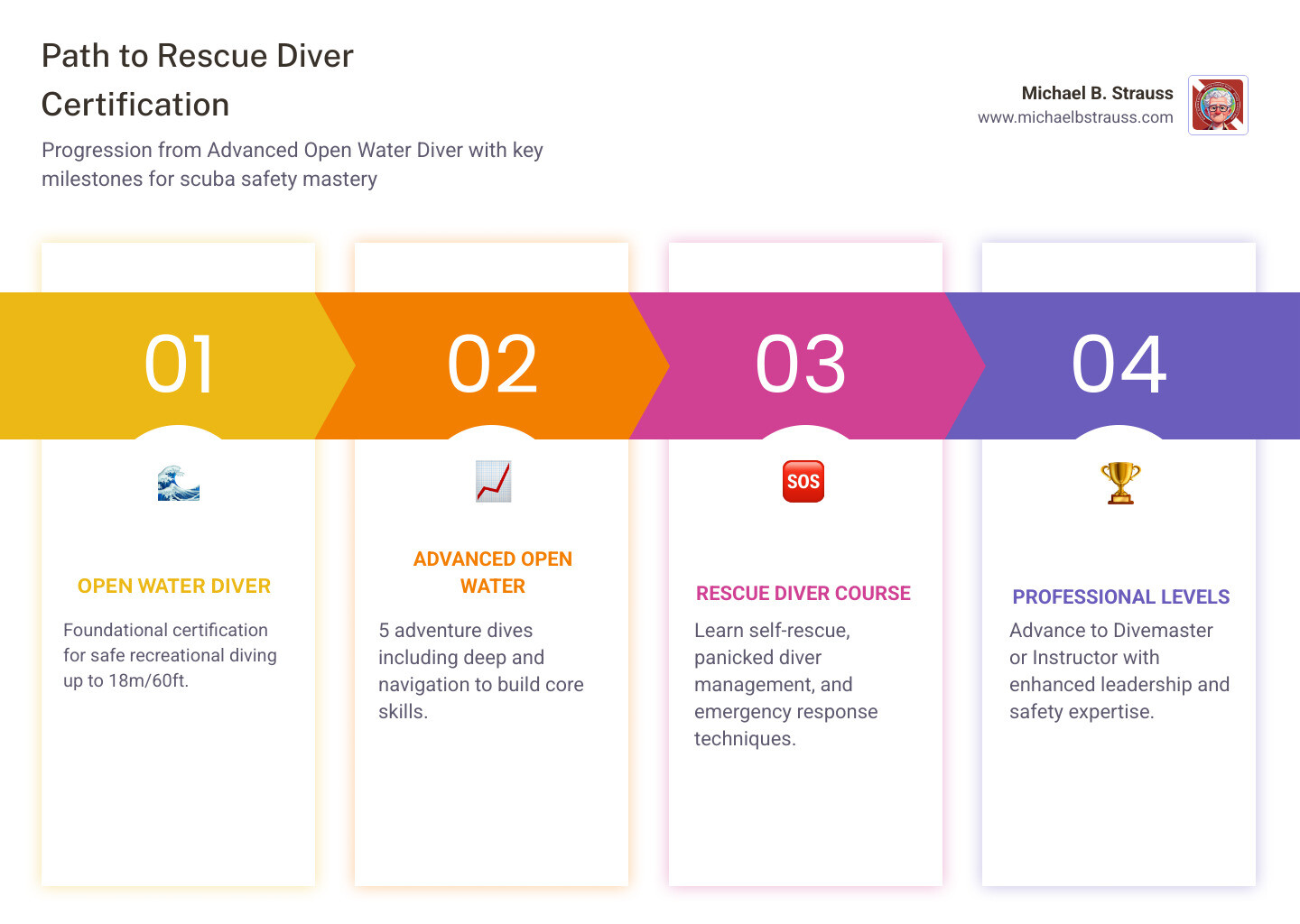
If you have dreams of working in the dive industry, the Rescue certification is your gateway. It is a strict prerequisite for the PADI Divemaster course. Even if you don't want to turn pro, completing this course along with five specialty certifications puts you on the path to becoming a Master Scuba Diver, the highest non-professional rating in recreational diving. You can even Take the Master Scuba Diver Challenge to push your skills to the limit.
Overcoming Challenges in Rescue Training
The biggest hurdle for most students isn't the strength required—it's the "task loading."
- Buoyancy Mastery: You might think your buoyancy is great, but try maintaining a safety stop while holding another diver and removing their gear. Practicing your trim beforehand is a lifesaver.
- Multitasking: You’ll be asked to navigate, check your air, monitor a victim, and signal a boat all at once. The key is "Slow is smooth, smooth is fast." Don't rush; focus on the rhythm of the rescue.
- Team Leadership: In final scenarios, your instructor might step back and let you lead. This requires clear communication. You’ll learn to point at a bystander and say, "You, call 911!" rather than just shouting into the air.
Beyond the Certification: Continuous Skill Practice
A rescue certification isn't a "one and done" deal. These are perishable skills. If you don't practice a victim drag for three years, you probably won't be very good at it when a real emergency happens.
- Oxygen Provider: We highly recommend taking the Emergency Oxygen Provider course. Knowing how to set up an O2 kit is just as important as getting the diver to the surface.
- Community Drills: Many dive clubs run "Rescue Refreshers." Joining these keeps the steps of a rescue fresh in your muscle memory.
- Specialty Courses: To further round out your safety knowledge, you might View the Most Popular PADI Specialty Courses like Search and Recovery or Deep Diver.
Choosing the Right Dive Center for Your Training
While the standards for the Rescue diver course are consistent across agencies like PADI, SSI, or SDI, the experience depends on your instructor.
- Instructor Experience: Look for an instructor who has real-world experience, perhaps as a public safety diver or a medical professional. They often add "extra" scenarios that go beyond the book.
- Ratios: For younger divers (ages 10-15), there is often a maximum instructor-to-diver ratio of 4:1 to ensure safety.
- Flexibility: Some shops offer eLearning, allowing you to finish the "book work" at home so you can spend more time in the water. This is a great way to Ask a Scuba Expert about specific scenarios before you even get wet.
Final Thoughts: The "Serious Fun"
While we talk a lot about emergencies and accidents, the Rescue diver course is actually a blast. There is a lot of laughter during the drills—especially when you’re trying to haul a "victim" who is twice your size onto a boat. You’ll bond with your classmates in a way you didn't during Open Water.
By the end of the weekend, you won't just be a person who dives. You’ll be a guardian of the underwater world, equipped with the confidence to handle the unexpected. As Dr. Strauss emphasizes in his books, a safe diver is a happy diver.
Ready to level up? Contact your local dive center and sign up for the Rescue diver course. It’s the best investment you’ll ever make in your diving career.
To get or buy the book Diving Science Revisited, please visit this link: https://www.bestpub.com/view-all-products/product/diving-science-revisited/category_pathway-48.html
DISCLAIMER: Articles are for "EDUCATIONAL PURPOSES ONLY", not to be considered advice or recommendations.


