Why Every Diver Needs Scuba Diving Insurance

Scuba diving insurance is specialized coverage that protects divers from the high costs of diving-related accidents and medical emergencies — things most standard health insurance plans simply won't cover.
Quick answer: What does scuba diving insurance cover?
- Dive accident insurance — covers decompression sickness (DCS), arterial gas embolism (AGE), hyperbaric chamber treatments, and emergency evacuations
- Travel insurance — covers trip cancellation, lost gear, and non-medical travel disruptions
- Professional liability insurance — covers instructors, divemasters, and dive facilities against third-party claims
Scuba diving is generally a safe sport. But when something goes wrong underwater, the costs can be staggering. A single hyperbaric chamber treatment can run anywhere from $330 to $1,000 per hour — before you add physician fees, medication, or emergency transport.
Real claims tell the story clearly. Divers have faced bills of over $22,000 for temporary paralysis, nearly $20,000 for air evacuations and follow-up treatments, and more than $33,000 for multi-day hyperbaric therapy abroad.
Your regular health insurance likely won't help much. Many policies exclude diving injuries outright, cap international emergency coverage, or leave you with massive out-of-pocket deductibles.
That's exactly why specialized dive insurance exists — and why over 250,000 divers have chosen dedicated dive safety coverage.
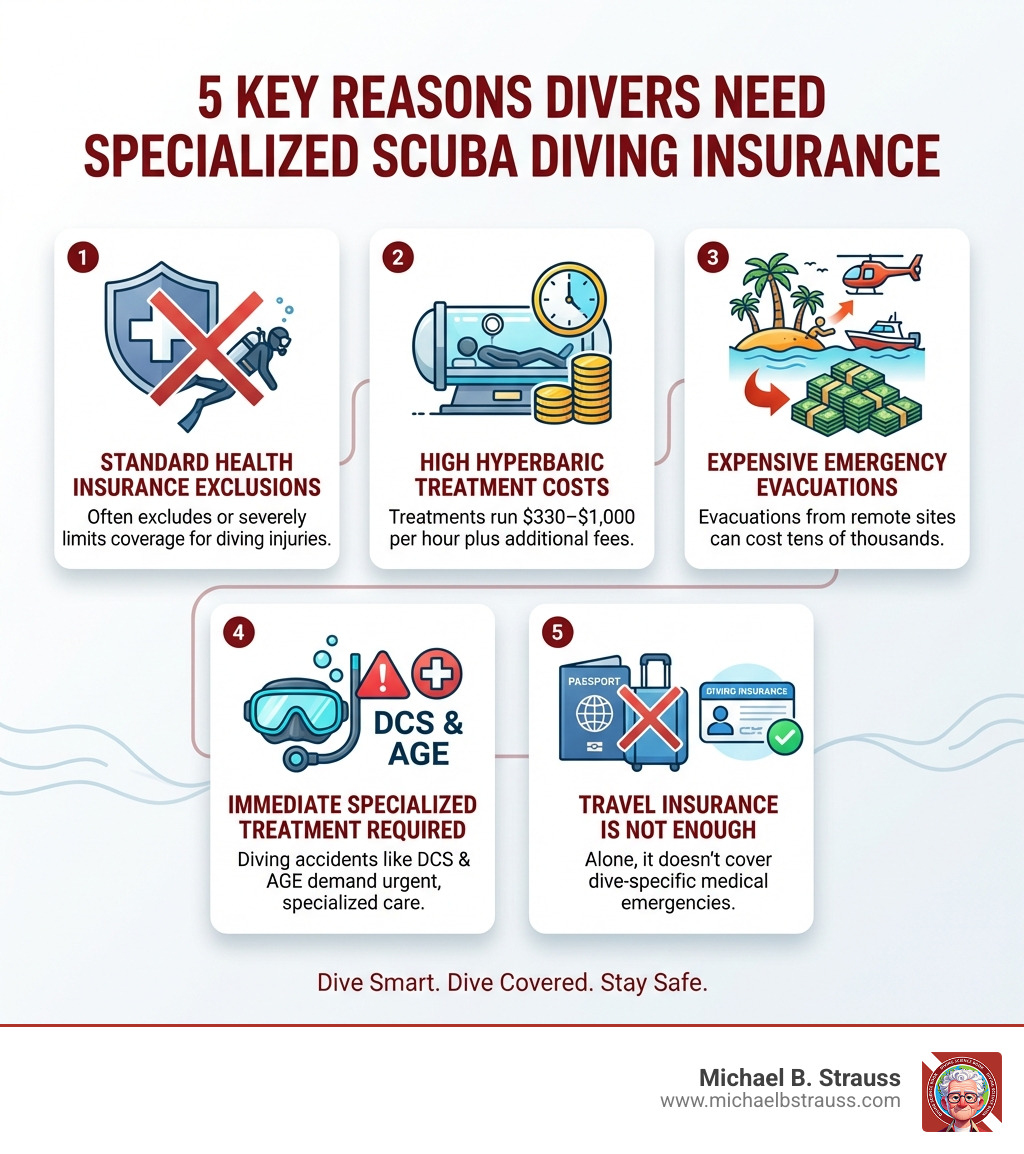
Simple guide to scuba diving insurance terms:
Understanding the Types of scuba diving insurance
When we talk about scuba diving insurance, we are actually looking at a few different "buckets" of protection. It is common for new divers to assume their standard travel policy or their home health insurance has them covered. Unfortunately, the "fine print" in those documents often contains exclusions for "hazardous activities" or "extreme sports," which frequently includes scuba diving.
To navigate this, we need to distinguish between three main types of coverage:
- Dive Accident Insurance: This is the "must-have" for every active diver. It focuses specifically on the medical costs associated with a diving injury, such as hyperbaric oxygen therapy and emergency medical evacuation.
- Travel Insurance: This covers the "topside" risks. If a hurricane cancels your trip to Cozumel, or if the airline loses your expensive regulator bag, travel insurance steps in. While some premium travel plans include basic dive medical coverage, they often lack the high limits and specialized expertise required for serious diving accidents.
- Liability Insurance: This is essential for dive professionals (Instructors and Divemasters) and dive centers. It protects against third-party claims of negligence or injury occurring during training or guided dives.
| Feature | Dive Accident Insurance | General Travel Insurance | Professional Liability |
|---|---|---|---|
| Primary Focus | Diving-related medical emergencies | Trip logistics and non-dive medical | Legal defense and damages |
| Hyperbaric Coverage | High limits (often up to $500k) | Low limits or excluded | N/A |
| Evacuation | Specialized medical transport | Standard emergency transport | N/A |
| Gear Protection | Limited to accident loss | Baggage loss/theft coverage | N/A |
| Worldwide Recognition | High (accepted by chambers) | Moderate | Industry-specific |
The gap in coverage is real. Primary health insurance often provides minimal payments for chamber treatments, which are incredibly resource-intensive. Furthermore, if you are diving in a remote region like the Maldives or Indonesia, your local health plan may not have the infrastructure to coordinate a complex air evacuation. Specialized providers have worldwide recognition, meaning hyperbaric facilities often accept their coverage directly, preventing you from having to pay tens of thousands of dollars out-of-pocket before receiving treatment.
Understanding why and at what sites decompression sickness can occur is a vital part of risk management. Knowing the physiological risks helps us appreciate why specialized insurance isn't just a "nice-to-have"—it's a critical safety tool.
Essential Coverage for scuba diving insurance Plans
A robust scuba diving insurance policy should address the specific physiological and logistical challenges of the underwater environment. Unlike a broken leg on a ski slope, a diving injury often requires highly specialized equipment and long-term care.
- Decompression Sickness (DCS) and Arterial Gas Embolism (AGE): These are the primary concerns for any diver. Treatment involves recompression in a hyperbaric chamber, often for several hours or even days.
- Hyperbaric Chamber Treatments: As mentioned, these can cost upwards of $1,000 per hour. A severe case of DCS might require multiple "tables" (treatment sessions), quickly totaling $30,000 or more.
- Emergency Medical Evacuation: If you are on a liveaboard or a remote island, you may need a pressurized flight to reach the nearest functional chamber. These evacuations are among the most expensive components of a claim.
- Search and Rescue: If a diver is separated from the boat, the cost of a private air or sea search can be astronomical. Quality insurance plans include a benefit to cover these costs.
For those interested in the technical side of why these injuries happen, we recommend learning more info about decompression science. Understanding the "why" behind the bubbles makes the "how" of the insurance coverage much clearer.
Specialized scuba diving insurance for Professionals and Liveaboards
If you have moved beyond recreational diving into the professional realm or have a penchant for week-long liveaboard trips, your insurance needs become even more specific.
Professional Liability and Divemaster CoverageFor those teaching or guiding, professional liability is non-negotiable. It provides coverage for legal fees and settlements if a student or client is injured. In Canada and the USA, these policies often offer $1M per occurrence and up to $2M in aggregate coverage. Some programs even offer "vouchers" for dive centers to cover their staff for short-term events.
Liveaboard and Adventure SpecificsLiveaboard trips represent a significant financial investment. If you get a "fit to dive" issue—like a severe ear squeeze or even a non-diving illness—on day one of a ten-day trip, you lose the entire investment. Specialized "Dive & Travel" policies include trip interruption benefits specifically for these scenarios.
Furthermore, certain activities like shark cage diving or technical diving (beyond 40 meters) may require "Explorer" or "Guardian" level plans to ensure you aren't diving outside your policy's limits. For more on training standards that influence these policies, check out PADI Dive Safety Resources.
How to Choose and Use Your Policy

Choosing a policy isn't just about finding the lowest price; it's about matching the coverage to your diving habits. If you dive once a year in your home state, a basic plan might suffice. If you travel internationally three times a year, an annual travel-plus-dive plan is far more economical.
Policy Exclusions: What to Watch For
No insurance policy covers everything. Common exclusions include:
- Depth Limits: Many standard policies cap coverage at 30 or 40 meters. If you are a deep diver, ensure your plan covers your certification level.
- Solo Diving: Unless you are certified as a solo diver and following specific protocols, many insurers will deny claims resulting from solo dives.
- Pre-existing Conditions: Just like standard health insurance, diving insurers may look closely at your medical history if a condition contributed to an accident.
- Commercial Diving: Recreational policies almost never cover commercial work (underwater welding, hull cleaning for hire, etc.).
The Claims Filing Process
In the event of an accident, the first step is always to call local emergency services (EMS). Once the diver is stabilized, call your insurance provider's 24/7 emergency hotline. This is crucial because many insurers must arrange the medical transportation themselves for the costs to be fully covered.
When filing a claim later, you will typically need:
- A completed claim form.
- Medical records from the treating physician and hyperbaric facility.
- Itemized bills and receipts for all expenses.
- A copy of your dive logs and certification card.
Coverage for Older Divers and Families
Age should not be a barrier to exploring the ocean, but it does change the insurance landscape. Fortunately, specialized providers offer coverage for divers age 70 and over, particularly in the USA and Canada. These plans often maintain the same high limits (up to $500,000 for medical expenses) to ensure older divers have access to the same quality of care.
For families, many providers offer "Family Account" plans. This simplifies the process by putting everyone under one membership, though it is important to check if each family member needs their own individual insurance add-on to the main membership.
We also see an increase in specialized coverage for:
- Freediving: Coverage for competitive or recreational breath-hold diving.
- Technical Diving: Coverage for mixed gases (Trimix), rebreathers, and overhead environments like caves.
Comparing Industry Providers and Membership Benefits
When comparing specialized insurance providers, look beyond just the medical limits. Consider the "Membership Perks" that come with the policy.
For example, many specialized memberships provide access to a 24/7 Emergency Hotline, a Medical Information Line for non-emergency questions (the "Ask A Medic" service), and a Physician Referral Network. These resources are invaluable for getting a "fit to dive" opinion after a minor illness or injury.
Other specialized providers focus on direct payments to service providers. This means they work to pay the hospital or chamber directly, so you aren't stuck trying to put a $20,000 charge on your personal credit card while in a foreign country.
Real-Life Claims and Payout Statistics
To understand the true value of scuba diving insurance, we only need to look at the data. The costs associated with diving accidents are rarely "minor."
- The Maldives DCS Claim: Two divers required several days of hyperbaric treatment. The total payout reached $33,697.
- The Honduras Barotrauma Case: A diver suffering from severe barotrauma and DCS had $14,713 in medical expenses covered.
- The Caribbean Paralysis Claim: A diver suffered temporary paralysis after a dive. The medical expenses exceeded $22,000, all covered by a "Preferred" level plan.
- Air Evacuation Costs: A single air evacuation from a remote site followed by chamber treatments resulted in a $19,787 claim.
Common Claim Types Include:
- Decompression Sickness (The "Bends")
- Arterial Gas Embolism (AGE)
- Ear and Sinus Barotrauma
- Marine Life Stings (e.g., Stonefish or Lionfish)
- Equipment loss during a covered accident
- Trip cancellation due to "fit to dive" medical issues
Conclusion: Prioritizing Safety with Michael B. Strauss
At the end of the day, scuba diving insurance is about peace of mind. It allows us to focus on the beauty of the reef and the thrill of the wreck, knowing that if the unexpected happens, we have a global network of experts ready to assist us — both medically and financially.
As Dr. Michael B. Strauss emphasizes in his work, safety is a combination of proper training, physical fitness, and being prepared for the "what ifs." By choosing a comprehensive insurance plan, you are taking a professional approach to your hobby.
For those looking to deepen their understanding of diving medicine and safety, we highly recommend exploring the Evaluation and Management of Pain-Related Medical Problems of Diving. It provides a clinical perspective on the very issues these insurance policies are designed to handle.
Dive safe, stay covered, and explore more diving safety resources to ensure your next underwater adventure is a secure one.
To further your knowledge on the science behind diving safety, get your copy of Diving Science Revisited here: https://www.bestpub.com/view-all-products/product/diving-science-revisited/category_pathway-48.html
DISCLAIMER: Articles are for "EDUCATIONAL PURPOSES ONLY", not to be considered advice or recommendations.


