Why Every Diver Needs a Scuba Diving Logbook
A scuba diving logbook is your official record of underwater experience, tracking essential dive data and serving as proof of certification progress. Choosing the right logbook format is crucial for both safety and skill development.
Quick Answer: What to Look for in a Scuba Diving Logbook
- Essential fields: dive number, date, location, depth, bottom time, gas mix, buddy signature
- Format options: waterproof paper binders, digital apps, or dive computer integration
- Key features: space for notes, marine life tracking, certification stamps, and data analysis
- Durability: waterproof or water-resistant materials for real-world dive conditions
- Compatibility: ability to import from dive computers or sync across devices
Beyond simple record-keeping, your logbook serves three critical purposes. First, it provides proof of experience for advanced certifications and dive operator requirements, as many agencies require verified dive counts to progress to technical or instructor levels.
Second, it acts as a safety tool. Tracking dive profiles, gas consumption, and environmental conditions helps you identify patterns, refine your technique, and prevent incidents like decompression sickness.
Third, it preserves memories and learning. Recording marine life sightings, equipment configurations, and personal observations creates a diving journal you'll treasure for years. The choice between traditional paper logs and modern digital platforms ultimately depends on your personal diving style and preferences.
The Modern Scuba Diving Logbook: From Paper to Pixels
What are the Essential Features of a Good Scuba Diving Logbook?
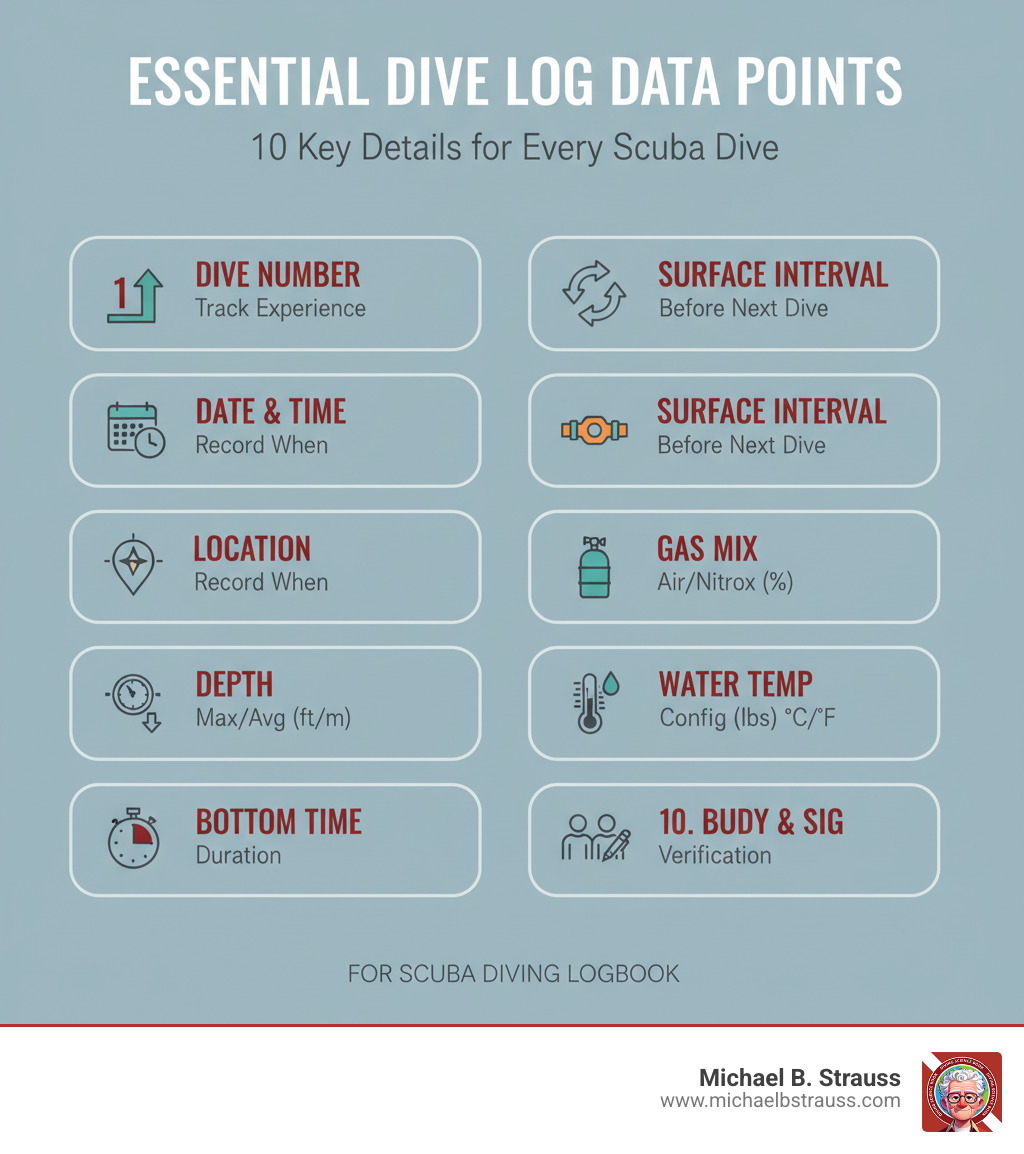
A good scuba diving logbook supports safety, helps us grow as divers, and preserves our underwater memories. It starts with the basics: a dive number for sequential tracking and the date, which is crucial for planning multiple dive days and managing nitrogen loading.
Location details, including the specific dive site name, bring dives back to life years later. Key safety data includes maximum and average depth, bottom time, and the surface interval, which directly affect decompression calculations. Recording your gas mix—whether standard air or a specific nitrox percentage—is critical for correct dive computer settings.
Many divers overlook logging the weight used, but this detail is invaluable for fine-tuning buoyancy across different suits and conditions. Similarly, water temperature affects comfort and gas consumption. A buddy's name and signature provides verification, especially for training, while a space for verification stamps adds the official proof required by many agencies.
Perhaps the most personal feature is the notes section. This is where a logbook becomes a journal for recording marine life, visibility, equipment notes, or personal feelings. A well-designed logbook provides ample space for these details, helping you become a safer, more skilled, and more reflective diver.
Physical vs. Digital: Which Logbook is Right for You?
Choosing between a physical scuba diving logbook and a digital app is a key decision. Both have dedicated fans for good reason.
Traditional paper logbooks offer the tangible satisfaction of writing down dive details and collecting real signatures and stamps. They are simple, reliable, and work without batteries or an internet connection. While water damage was once a major concern, modern waterproof options use durable synthetic paper that resists splashes and even full submersion, making them highly practical for marine environments.
Digital logbooks offer unparalleled convenience, with your entire dive history in your pocket and backed up to the cloud. Many apps sync directly with dive computers, automatically importing profiles, times, and temperatures, which eliminates manual data entry. The analytical power is a major draw, allowing you to track trends in air consumption, average depth, and more. Some platforms also offer social features for sharing logs and photos with a global dive community.
However, digital logging isn't without drawbacks, such as screen glare in bright sun and reliance on battery life. There's no single right answer. Many experienced divers use a hybrid approach, syncing data digitally while keeping a paper log for signatures and quick notes. The best format is the one you will use consistently, making logging an enjoyable ritual rather than a chore.
The Evolution and Types of Dive Logbooks
The scuba diving logbook has evolved from simple paper notes to sophisticated digital tools. The advent of dive computers, which automatically record detailed profiles, spurred the development of apps that can download a complete dive history. This progression reflects a desire for greater accuracy, easier analysis, and better ways to preserve memories.
Different types of diving require different logbooks:
- Recreational dive logs are the most common, focusing on core data like location, depth, time, and gas mix. They include generous space for notes on marine life and personal observations.
- Technical diving logs are far more detailed. They must track multiple gas mixes, gas switch depths, complex decompression schedules, and oxygen exposure, as they are critical safety documents for high-risk dives.
- Scientific diving logs function as research tools, with fields for specific objectives, sampling data, and detailed environmental conditions required for academic or conservation work.
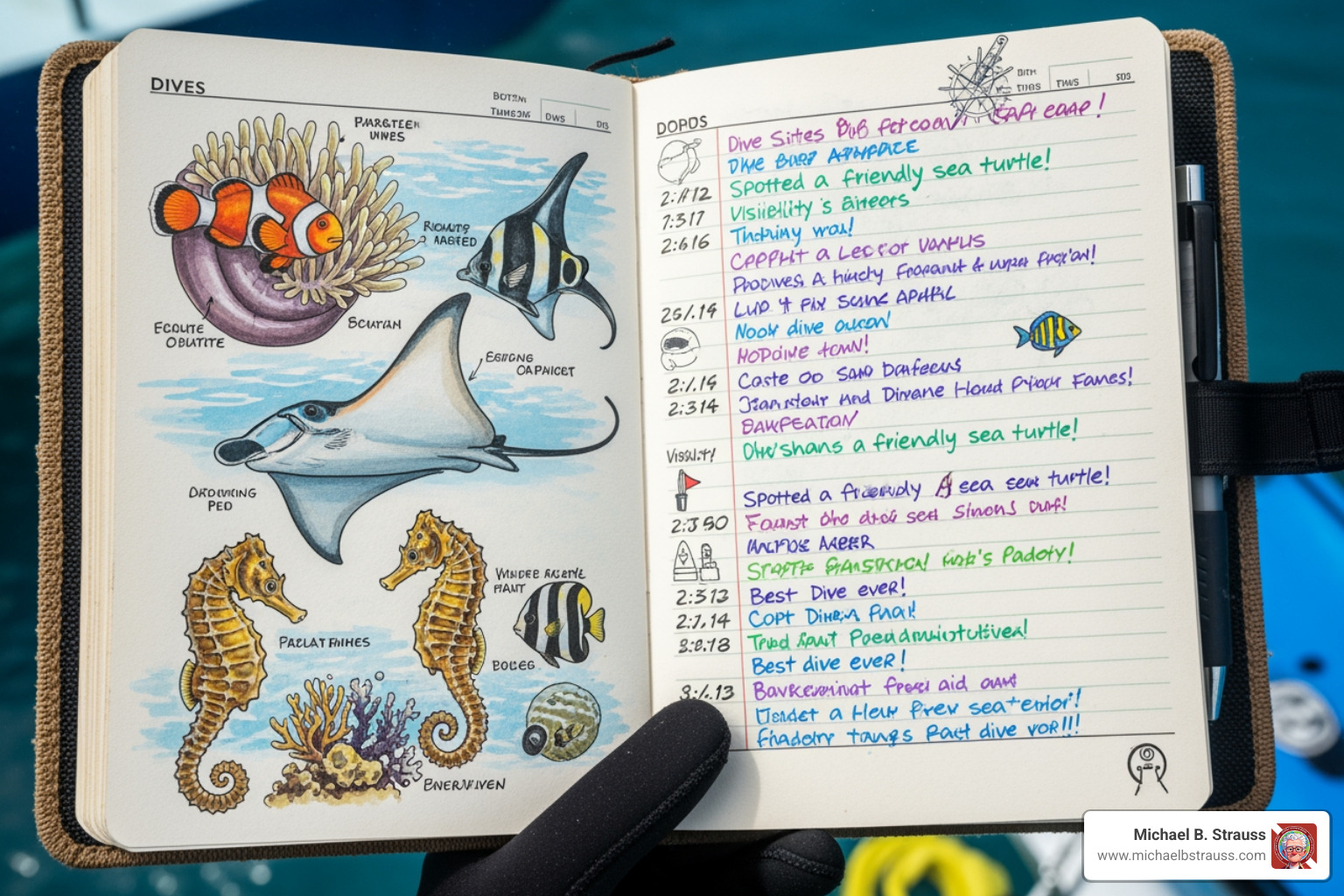
Personalization is a key feature of modern logbooks. Digital platforms allow users to add photos and videos, while even physical logbooks offer space for sketches and custom stamps, turning a simple record into a rich, personal story of your underwater journey.
Beyond Recording Dives: Open uping Advanced Benefits
Your scuba diving logbook has potential far beyond being a simple dive counter. When we use it thoughtfully, it becomes a powerful tool for personal growth, skill development, and deeper connection with the underwater world.

By consistently recording your weight configuration, you can fine-tune your buoyancy control. Monitoring your air consumption, often calculated as a Surface Air Consumption (SAC) rate in digital logs, provides concrete evidence of improved breathing control and efficiency.
Your logbook also becomes an invaluable trip planning resource. Notes on water temperature, visibility, currents, and marine life sightings help you anticipate conditions for future dives.
Beyond the data, the notes section serves as a personal journal to capture feelings, memorable moments, and reflections. This qualitative information brings your dive statistics to life.
Perhaps most importantly, a well-maintained scuba diving logbook deepens your understanding of diving science and physiology. By tracking your profiles, you're actively engaging with decompression theory in real-world contexts. This practical application improves your safety awareness and reinforces why conservative diving practices matter. To learn more about the science, explore resources on diving science and the physiological risks like decompression sickness. This transforms your logbook from a simple record into a dynamic tool for lifelong learning.
Understanding 'Waterproof' and Eco-Friendly Materials
When choosing a physical scuba diving logbook, it's important to understand the terminology and materials. Water-resistant means it can handle splashes, while waterproof implies it can be fully submerged without damage.
Modern logbooks achieve true waterproofing with synthetic paper technology. Made from polymers instead of wood pulp, these pages don't absorb water, so ink won't smudge and the paper won't tear when wet. This material is also highly durable, resisting stains and deterioration from salt and humidity.
Environmental considerations are also important to many divers. Fortunately, many synthetic paper logbooks align with these values. They are often made from tree-free, recyclable materials using manufacturing processes that consume little water and produce no harmful emissions. These non-toxic polymers can be safely disposed of or even incinerated. Choosing a logbook made with these materials allows you to document your adventures while staying true to your commitment to protecting the ocean.
Conclusion: Your Dive Log as a Lifelong Companion
As we've explored throughout this guide, a scuba diving logbook is more than a record; it's an essential companion for every diver. Consistent logging builds proof of experience for advanced certifications, creates a personal safety record to refine your technique, and documents your growth as a diver.
But perhaps most importantly, our logbook tells the story of our personal underwater journey. Each entry captures a unique memory—the thrill of that first glimpse of a manta ray, the peaceful weightlessness of hovering over a coral garden, the camaraderie shared with a dive buddy exploring a new site together. These memories, preserved alongside the technical data, create a narrative that we'll treasure for a lifetime.
Whether we choose a durable physical logbook or a feature-rich digital app, the key is to make logging a consistent habit. Our scuba diving logbook is where our past experiences inform our future dives, turning passion into wisdom.
Of course, keeping a thorough logbook is just one part of being a well-informed, safety-conscious diver. Understanding the science behind diving, recognizing potential risks, and continuously expanding our knowledge are equally vital. To deepen your understanding of diving science, get your copy of the book Diving Science, Revisited today.
DISCLAIMER: Articles are for "EDUCATIONAL PURPOSES ONLY", not to be considered advice or recommendations.


