Read story

Why Scuba Diving Underwater Navigation is Essential for Every Diver
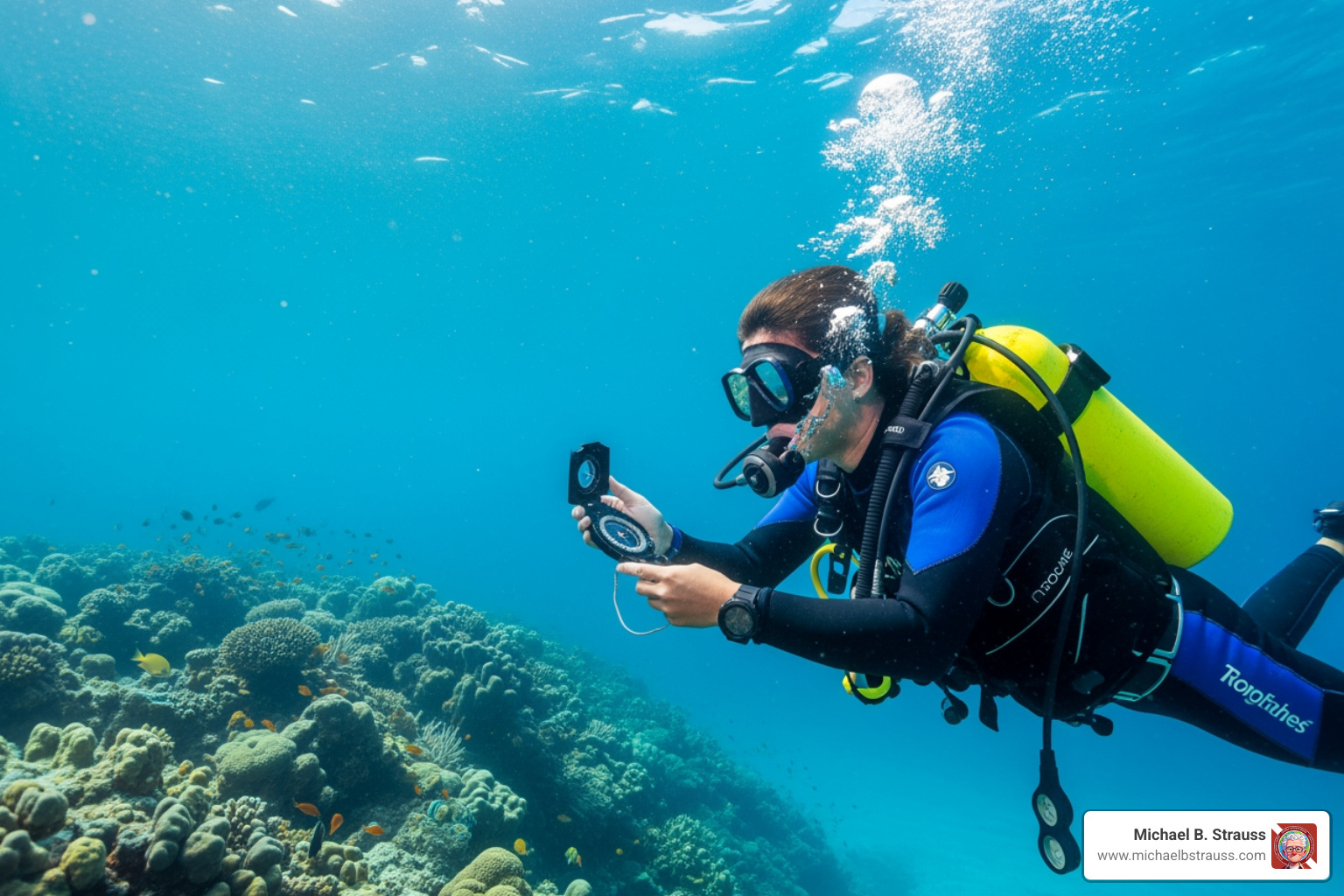
scuba diver with compass underwater - Scuba diving underwater navigation

Scuba diving underwater navigation is the skill that transforms you from a follower into a confident, independent diver.

Quick Answer: Essential Navigation Skills

  1. Natural Navigation: Using sunlight, depth, bottom features, and water movement.
  2. Compass Navigation: Using a compass to set headings and calculate return routes.
  3. Distance Estimation: Counting kick cycles or timing your swim.
  4. Dive Planning: Creating a route, managing air, and coordinating with your buddy.

It's a common scenario: two divers, interested in the dive, suddenly realize they don't know the way back to the boat. This happens more often than you'd think.

Good underwater navigation matters because it directly impacts your safety and enjoyment. Confident navigation helps you conserve energy, reduce air consumption by avoiding stress, and maximize your bottom time exploring. It also prevents risky, repeated surfacings to get your bearings.

While basic navigation is part of Open Water certification, it's often just an introduction. An advanced open water diver course includes underwater navigation as a mandatory skill for good reason—it's that fundamental.

Effective navigation combines two approaches: natural navigation (using environmental cues like sunlight, sand ripples, and coral formations) and compass navigation (using an instrument for precise headings). Together, they ensure you can always find your way.

Mastering navigation builds confidence, saves energy, and improves dive planning. As noted by diving medicine expert Dr. Michael B. Strauss, these skills open up new possibilities for independent and more complex underwater exploration.
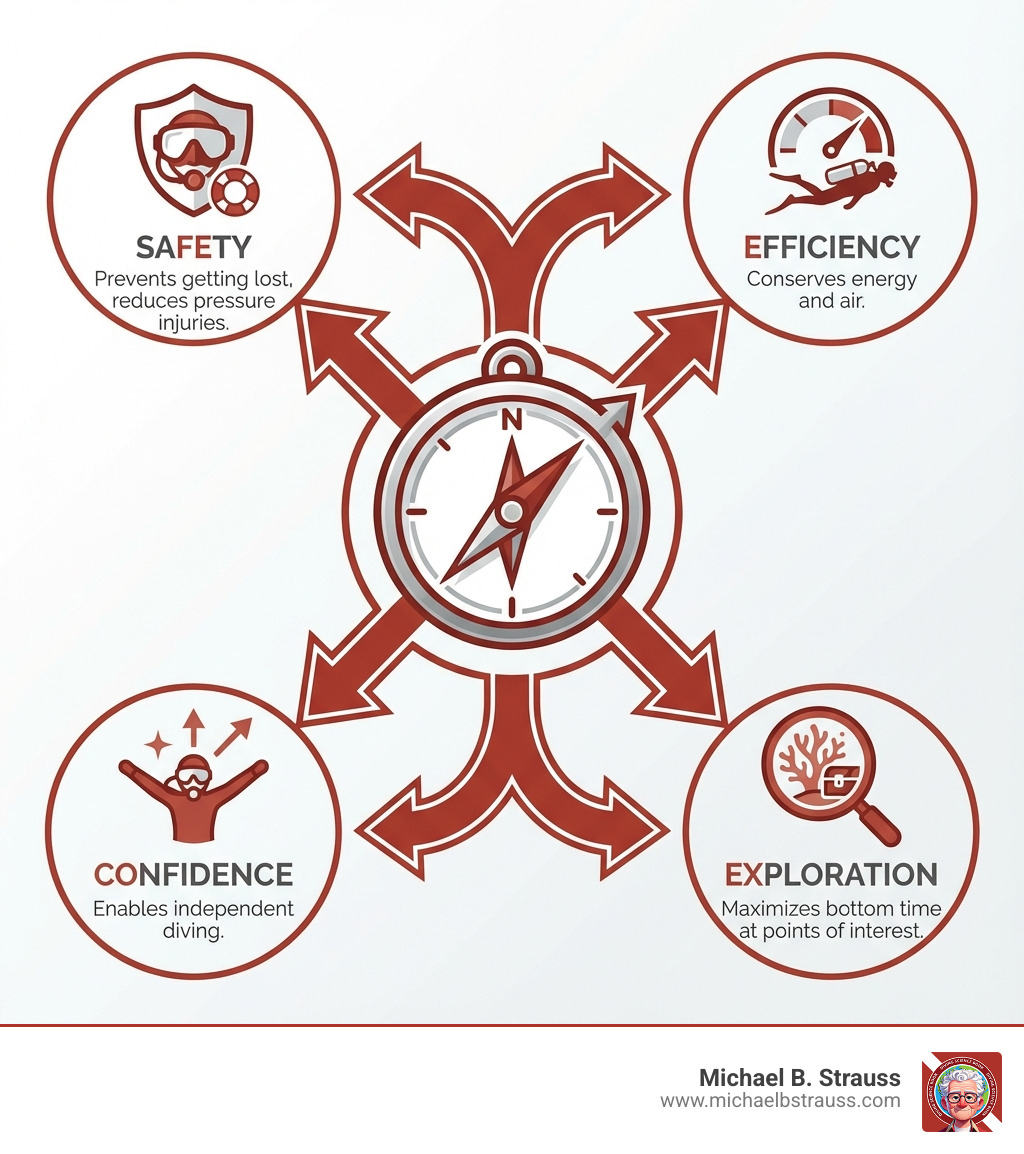
infographic showing the benefits of good underwater navigation: a compass icon with arrows pointing to four outcomes - Safety (prevents getting lost and reduces pressure injuries), Efficiency (conserves energy and air), Confidence (enables independent diving), and Exploration (maximizes bottom time at points of interest) - Scuba diving underwater navigation infographic

The Core Techniques of Scuba Diving Underwater Navigation
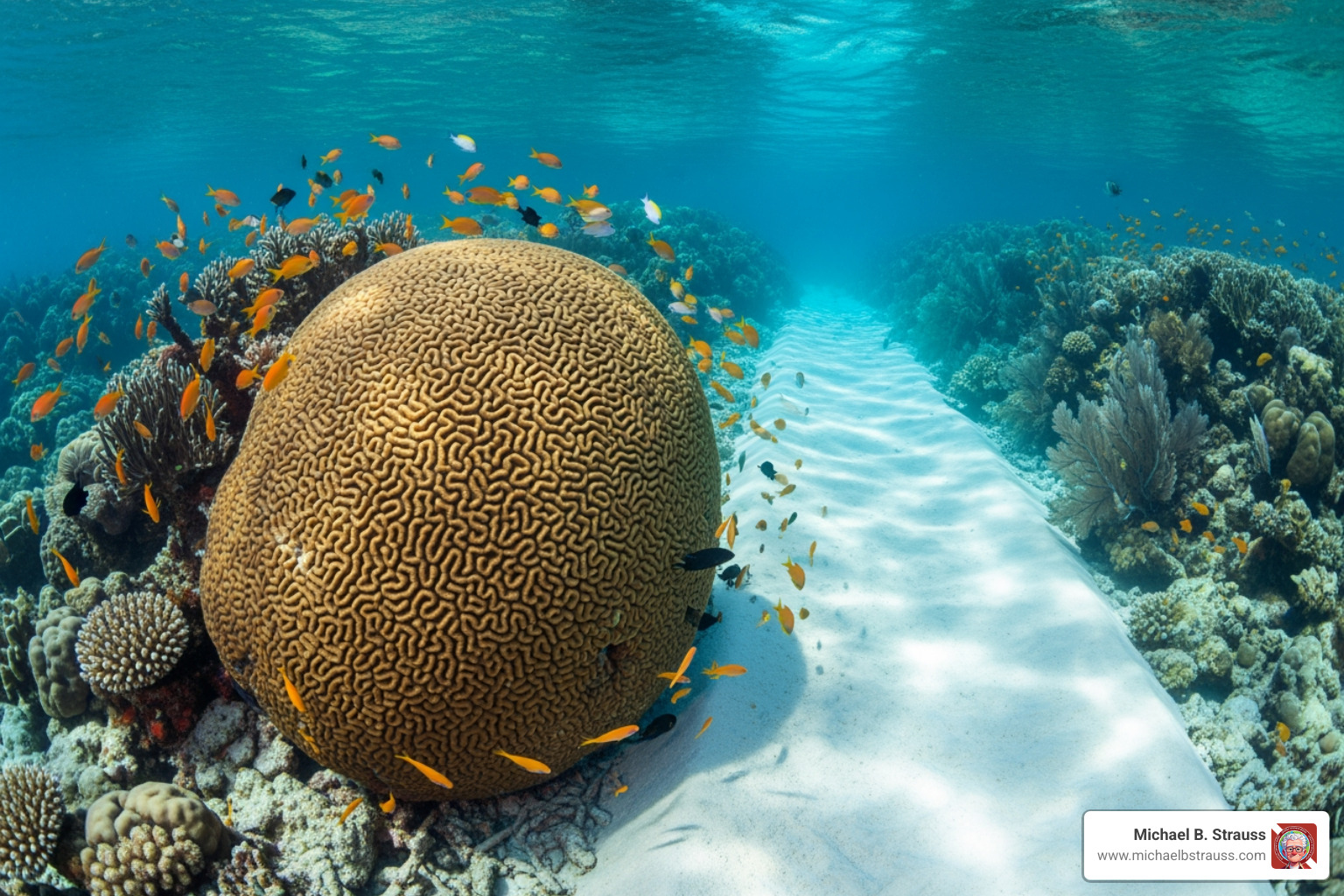
A vibrant coral reef with clear landmarks like a large brain coral and a sand channel - Scuba diving underwater navigation

Navigating underwater is a unique challenge without GPS. Mastering scuba diving underwater navigation is crucial for safety and efficiency. It involves blending keen observation of your environment with precise instrument use to create a complete navigational toolkit.

Mastering Natural Navigation: Using Your Environment as a Guide

Natural navigation, or pilotage, means using the environment to build a mental map. When combined with a compass, it's a powerful way to stay oriented.

Here’s how to use your surroundings:

  • Landmarks: Use distinctive features like large coral heads, rocks, or sand channels as signposts. Before diving, study a site map. During the dive, look back at landmarks after passing them to see how they'll appear on your return.
  • Depth and Contours: The slope of the seafloor is a reliable guide. Following a specific depth contour (e.g., keeping a reef wall on your right) can lead you back to your starting point.
  • Sunlight and Water Movement: The sun's angle provides a general direction in shallower water. Currents, surge, and sand ripples (which often run parallel to shore) also offer directional clues.
  • Other Environmental Cues: Notice changes in bottom composition (sand to rubble) and the orientation of marine life like sea fans, which can indicate prevailing currents.

Developing this "aquatic savoir-faire," as diving safety expert Dr. Michael B. Strauss calls it, improves your intuitive connection to the underwater world. More info about aquatic savoir-faire.

The Diver's Compass: Your Instrument for Accuracy
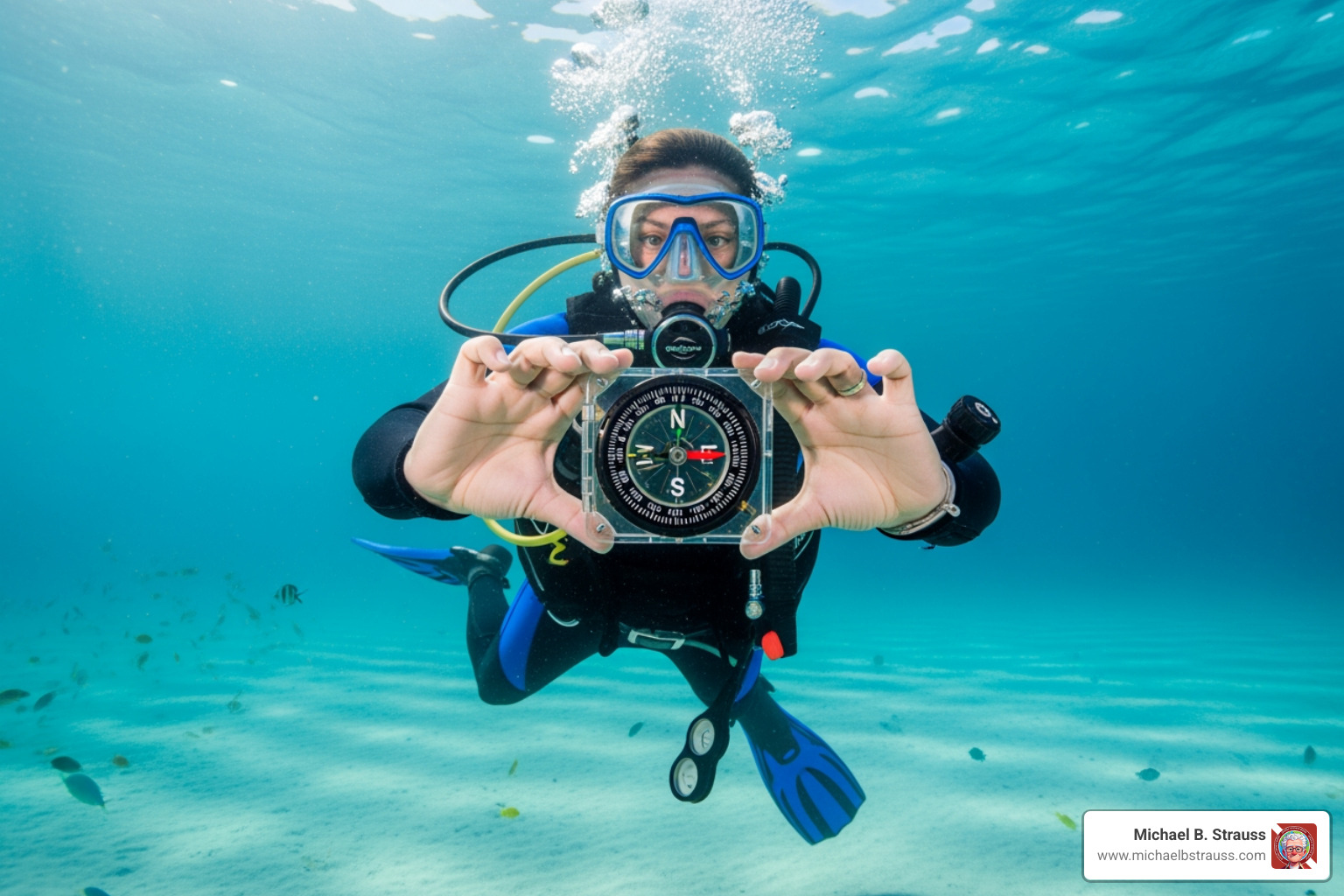
A diver holding a compass level with both hands - Scuba diving underwater navigation

A compass provides precision, especially in low visibility or open water where natural cues are scarce.

  • How to Use a Compass: Hold the compass level and point the lubber line (the fixed line on the compass) in your direction of travel. Rotate the bezel until its index marks align with the north-pointing needle. This sets your heading.
  • Maintaining Your Course: To follow your heading, look up and swim toward a distant landmark aligned with your lubber line. Glance at the compass periodically to ensure the needle stays within the bezel marks, but avoid fixating on it. Good buoyancy is key to swimming a straight line.
  • Setting a Return Course: To return, you can rotate the bezel 180 degrees to set a reciprocal heading (e.g., 90° becomes 270°).
  • Avoiding Inaccuracy: Keep your compass away from metal objects like dive knives or steel tanks, as they can cause magnetic deviation and give false readings.

For dedicated training, consider an underwater navigator specialty course.

Integrating Techniques for Successful Scuba Diving Underwater Navigation

The most effective navigation combines natural and compass techniques. Continuously cross-reference your instrument with environmental cues to stay on course.

  • Estimating Distance: Knowing your distance traveled is as important as direction. The two primary methods are counting kick cycles (the number of kicks over a known distance) or timing your swim. Calibrate these methods for better accuracy.
  • Managing Time and Air: Proper dive planning is essential. Always follow the Rule of Thirds for air management: use one-third of your air for the outbound journey, one-third for the return, and keep one-third in reserve for safety and contingencies.
  • Using the Buddy System: Navigation is a team effort. Before the dive, agree on the route, turn-around points, and communication signals. One diver can lead navigation while the other monitors time, depth, and air, but both should be actively aware of the plan. This teamwork keeps buddies together and improves safety.

Understanding Diving Science helps you make better-informed navigational decisions based on the physics and physiology of the underwater environment.

Even with solid foundational skills, the underwater world can present unique challenges. This section addresses common problems, critical safety procedures, and how to continue developing your skills.

Common Mistakes and How to Avoid Them

Recognizing common pitfalls is the first step to avoiding them:

  • Fixating on the Compass: Don't get tunnel vision. Use your compass for quick checks, then look up to find a visual reference to swim towards.
  • Poor Buoyancy Control: Unstable buoyancy makes it nearly impossible to swim a straight line. Master neutral buoyancy first.
  • Ignoring Currents: Always account for currents. Plan to swim into the current at the start of your dive so the return trip is easier.
  • Lack of a Dive Plan: Always create a clear plan with your buddy, including the route, turn-around points, and emergency procedures.
  • Buddy Miscommunication: Agree on who is navigating and what hand signals to use before you get in the water.

Challenges in Different Environments:

  • Open Water: With few natural landmarks, you must rely heavily on your compass.
  • Limited Visibility: Natural cues disappear, making your compass and practiced distance estimation essential. Trust your instruments and training.
  • Overhead Environments (Caves, Wrecks): These require specialized training and certification. Never enter without it. The cardinal rule is to always maintain a continuous guideline to an open-water exit. Be aware that metal in wrecks can affect your compass.

What to Do If You Become Lost or Disoriented

Even experienced divers can get lost. If it happens, react calmly and methodically to avoid panic, which wastes air and clouds judgment.

Follow this plan:

  • STOP: Stop swimming to conserve air and prevent getting more lost.
  • THINK: Assess the situation. What was your last known position or heading? What natural cues are available?
  • BREATHE: Take slow, deep breaths to remain calm.
  • ACT:
    • Check Air and Communicate: Check your air supply and signal your buddy that you are disoriented. Work together.
    • Reorient: Look for natural cues (sunlight, slope, current) and consult your compass. Try a reciprocal heading if you remember your outbound course.
    • Ascend Safely if Needed: If you cannot find your way and are low on air, perform a slow, controlled ascent with a safety stop. Surfacing repeatedly to get bearings increases the risk of pressure-related injuries.
    • Signal at the Surface: Once surfaced, inflate your SMB, use a whistle, and listen for boats.

Understanding the risks of uncontrolled ascents, like those detailed in Why and at What Sites Decompression Sickness Can Occur, highlights the importance of staying calm and in control.

Advancing Your Scuba Diving Underwater Navigation Skills

Proficient navigation requires continuous practice. As Dr. Michael B. Strauss emphasizes, mastery comes from consistent application.

  • Practice Drills: On every dive, practice skills like maintaining buoyancy, monitoring air, and communicating with your buddy. Try simple out-and-back swims or more complex patterns like squares (four 90° turns) to hone your compass work.
  • Specialty Courses: To advance beyond the basics, consider a formal course. An advanced open water diver certification includes navigation as a mandatory skill. For more in-depth training, an underwater navigator specialty course focuses entirely on refining these techniques. Formal training provides expert feedback in a controlled environment, building confidence and competence.

Mastering scuba diving underwater navigation is a cornerstone of safe, enjoyable diving. It empowers you to become an active, independent explorer. Continue learning and Explore more diving resources to improve your expertise.

Ready to dive deeper into the science behind safe diving? Get your copy of Diving Science, Revisited today! Buy the book

DISCLAIMER: Articles are for "EDUCATIONAL PURPOSES ONLY", not to be considered advice or recommendations.

Download Full PDF
Tags:

Why Scuba Diving Underwater Navigation is Essential for Every Diver

scuba diver with compass underwater - Scuba diving underwater navigation

Scuba diving underwater navigation is the skill that transforms you from a follower into a confident, independent diver.

Quick Answer: Essential Navigation Skills

  1. Natural Navigation: Using sunlight, depth, bottom features, and water movement.
  2. Compass Navigation: Using a compass to set headings and calculate return routes.
  3. Distance Estimation: Counting kick cycles or timing your swim.
  4. Dive Planning: Creating a route, managing air, and coordinating with your buddy.

It's a common scenario: two divers, interested in the dive, suddenly realize they don't know the way back to the boat. This happens more often than you'd think.

Good underwater navigation matters because it directly impacts your safety and enjoyment. Confident navigation helps you conserve energy, reduce air consumption by avoiding stress, and maximize your bottom time exploring. It also prevents risky, repeated surfacings to get your bearings.

While basic navigation is part of Open Water certification, it's often just an introduction. An advanced open water diver course includes underwater navigation as a mandatory skill for good reason—it's that fundamental.

Effective navigation combines two approaches: natural navigation (using environmental cues like sunlight, sand ripples, and coral formations) and compass navigation (using an instrument for precise headings). Together, they ensure you can always find your way.

Mastering navigation builds confidence, saves energy, and improves dive planning. As noted by diving medicine expert Dr. Michael B. Strauss, these skills open up new possibilities for independent and more complex underwater exploration.

infographic showing the benefits of good underwater navigation: a compass icon with arrows pointing to four outcomes - Safety (prevents getting lost and reduces pressure injuries), Efficiency (conserves energy and air), Confidence (enables independent diving), and Exploration (maximizes bottom time at points of interest) - Scuba diving underwater navigation infographic

The Core Techniques of Scuba Diving Underwater Navigation

A vibrant coral reef with clear landmarks like a large brain coral and a sand channel - Scuba diving underwater navigation

Navigating underwater is a unique challenge without GPS. Mastering scuba diving underwater navigation is crucial for safety and efficiency. It involves blending keen observation of your environment with precise instrument use to create a complete navigational toolkit.

Mastering Natural Navigation: Using Your Environment as a Guide

Natural navigation, or pilotage, means using the environment to build a mental map. When combined with a compass, it's a powerful way to stay oriented.

Here’s how to use your surroundings:

  • Landmarks: Use distinctive features like large coral heads, rocks, or sand channels as signposts. Before diving, study a site map. During the dive, look back at landmarks after passing them to see how they'll appear on your return.
  • Depth and Contours: The slope of the seafloor is a reliable guide. Following a specific depth contour (e.g., keeping a reef wall on your right) can lead you back to your starting point.
  • Sunlight and Water Movement: The sun's angle provides a general direction in shallower water. Currents, surge, and sand ripples (which often run parallel to shore) also offer directional clues.
  • Other Environmental Cues: Notice changes in bottom composition (sand to rubble) and the orientation of marine life like sea fans, which can indicate prevailing currents.

Developing this "aquatic savoir-faire," as diving safety expert Dr. Michael B. Strauss calls it, improves your intuitive connection to the underwater world. More info about aquatic savoir-faire.

The Diver's Compass: Your Instrument for Accuracy

A diver holding a compass level with both hands - Scuba diving underwater navigation

A compass provides precision, especially in low visibility or open water where natural cues are scarce.

  • How to Use a Compass: Hold the compass level and point the lubber line (the fixed line on the compass) in your direction of travel. Rotate the bezel until its index marks align with the north-pointing needle. This sets your heading.
  • Maintaining Your Course: To follow your heading, look up and swim toward a distant landmark aligned with your lubber line. Glance at the compass periodically to ensure the needle stays within the bezel marks, but avoid fixating on it. Good buoyancy is key to swimming a straight line.
  • Setting a Return Course: To return, you can rotate the bezel 180 degrees to set a reciprocal heading (e.g., 90° becomes 270°).
  • Avoiding Inaccuracy: Keep your compass away from metal objects like dive knives or steel tanks, as they can cause magnetic deviation and give false readings.

For dedicated training, consider an underwater navigator specialty course.

Integrating Techniques for Successful Scuba Diving Underwater Navigation

The most effective navigation combines natural and compass techniques. Continuously cross-reference your instrument with environmental cues to stay on course.

  • Estimating Distance: Knowing your distance traveled is as important as direction. The two primary methods are counting kick cycles (the number of kicks over a known distance) or timing your swim. Calibrate these methods for better accuracy.
  • Managing Time and Air: Proper dive planning is essential. Always follow the Rule of Thirds for air management: use one-third of your air for the outbound journey, one-third for the return, and keep one-third in reserve for safety and contingencies.
  • Using the Buddy System: Navigation is a team effort. Before the dive, agree on the route, turn-around points, and communication signals. One diver can lead navigation while the other monitors time, depth, and air, but both should be actively aware of the plan. This teamwork keeps buddies together and improves safety.

Understanding Diving Science helps you make better-informed navigational decisions based on the physics and physiology of the underwater environment.

Even with solid foundational skills, the underwater world can present unique challenges. This section addresses common problems, critical safety procedures, and how to continue developing your skills.

Common Mistakes and How to Avoid Them

Recognizing common pitfalls is the first step to avoiding them:

  • Fixating on the Compass: Don't get tunnel vision. Use your compass for quick checks, then look up to find a visual reference to swim towards.
  • Poor Buoyancy Control: Unstable buoyancy makes it nearly impossible to swim a straight line. Master neutral buoyancy first.
  • Ignoring Currents: Always account for currents. Plan to swim into the current at the start of your dive so the return trip is easier.
  • Lack of a Dive Plan: Always create a clear plan with your buddy, including the route, turn-around points, and emergency procedures.
  • Buddy Miscommunication: Agree on who is navigating and what hand signals to use before you get in the water.

Challenges in Different Environments:

  • Open Water: With few natural landmarks, you must rely heavily on your compass.
  • Limited Visibility: Natural cues disappear, making your compass and practiced distance estimation essential. Trust your instruments and training.
  • Overhead Environments (Caves, Wrecks): These require specialized training and certification. Never enter without it. The cardinal rule is to always maintain a continuous guideline to an open-water exit. Be aware that metal in wrecks can affect your compass.

What to Do If You Become Lost or Disoriented

Even experienced divers can get lost. If it happens, react calmly and methodically to avoid panic, which wastes air and clouds judgment.

Follow this plan:

  • STOP: Stop swimming to conserve air and prevent getting more lost.
  • THINK: Assess the situation. What was your last known position or heading? What natural cues are available?
  • BREATHE: Take slow, deep breaths to remain calm.
  • ACT:
    • Check Air and Communicate: Check your air supply and signal your buddy that you are disoriented. Work together.
    • Reorient: Look for natural cues (sunlight, slope, current) and consult your compass. Try a reciprocal heading if you remember your outbound course.
    • Ascend Safely if Needed: If you cannot find your way and are low on air, perform a slow, controlled ascent with a safety stop. Surfacing repeatedly to get bearings increases the risk of pressure-related injuries.
    • Signal at the Surface: Once surfaced, inflate your SMB, use a whistle, and listen for boats.

Understanding the risks of uncontrolled ascents, like those detailed in Why and at What Sites Decompression Sickness Can Occur, highlights the importance of staying calm and in control.

Advancing Your Scuba Diving Underwater Navigation Skills

Proficient navigation requires continuous practice. As Dr. Michael B. Strauss emphasizes, mastery comes from consistent application.

  • Practice Drills: On every dive, practice skills like maintaining buoyancy, monitoring air, and communicating with your buddy. Try simple out-and-back swims or more complex patterns like squares (four 90° turns) to hone your compass work.
  • Specialty Courses: To advance beyond the basics, consider a formal course. An advanced open water diver certification includes navigation as a mandatory skill. For more in-depth training, an underwater navigator specialty course focuses entirely on refining these techniques. Formal training provides expert feedback in a controlled environment, building confidence and competence.

Mastering scuba diving underwater navigation is a cornerstone of safe, enjoyable diving. It empowers you to become an active, independent explorer. Continue learning and Explore more diving resources to improve your expertise.

Ready to dive deeper into the science behind safe diving? Get your copy of Diving Science, Revisited today! Buy the book

DISCLAIMER: Articles are for "EDUCATIONAL PURPOSES ONLY", not to be considered advice or recommendations.