What Are Underwater Communication Systems?

Underwater communication systems are technologies that allow divers, submarines, and underwater vehicles to send and receive information beneath the surface.
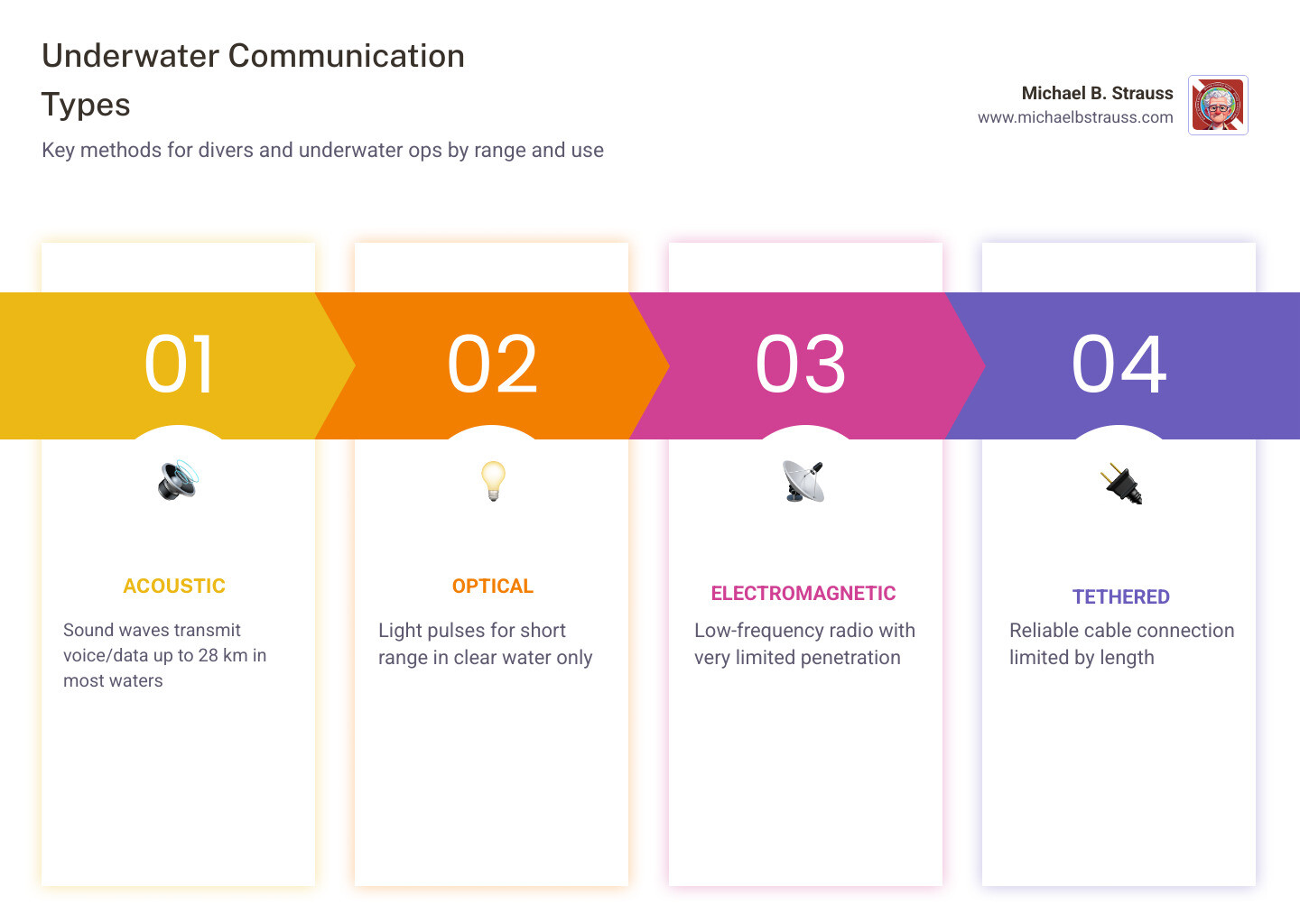
Here is a quick overview of the most common types:
| Type | How It Works | Typical Range |
|---|---|---|
| Acoustic (sound-based) | Converts data or voice to sound waves | Up to 28 km |
| Optical | Uses light pulses through water | Short range, clear water only |
| Electromagnetic | Low-frequency radio waves | Very limited in water |
| Tethered (hardwired) | Physical cable connection | Limited by cable length |
| App-based (e.g., smartphone) | Acoustic signals via device speaker/mic | Up to ~100 m |
For most scuba divers, acoustic systems are the practical go-to — they work in murky water, require no line of sight, and range from simple diver-to-diver voice units to full surface communication setups.
If you have ever tried to tell your dive buddy something important underwater — and ended up waving your arms like a confused sea lion — you already understand the problem that underwater communication systems solve.
Sound travels roughly four times faster in water than in air. But the underwater environment is harsh for signals. Radio waves die almost immediately. Light scatels. That leaves sound as the primary vehicle for underwater communication, and the technology built around it is more sophisticated than most divers realize.
From the early submarine bells of the 1900s to today's NATO-standardized digital protocols like JANUS — which operates across frequencies from 900 Hz to 60 kHz and reaches distances of up to 28 kilometres — the field has evolved dramatically. Even smartphones can now be used for acoustic underwater messaging at distances up to 100 metres.
Whether you are a recreational diver, a commercial operator, or a diving medicine professional, understanding how these systems work can directly improve safety, coordination, and situational awareness on every dive.
Underwater communication systems definitions:
The Evolution and Mechanics of Underwater Communication Systems
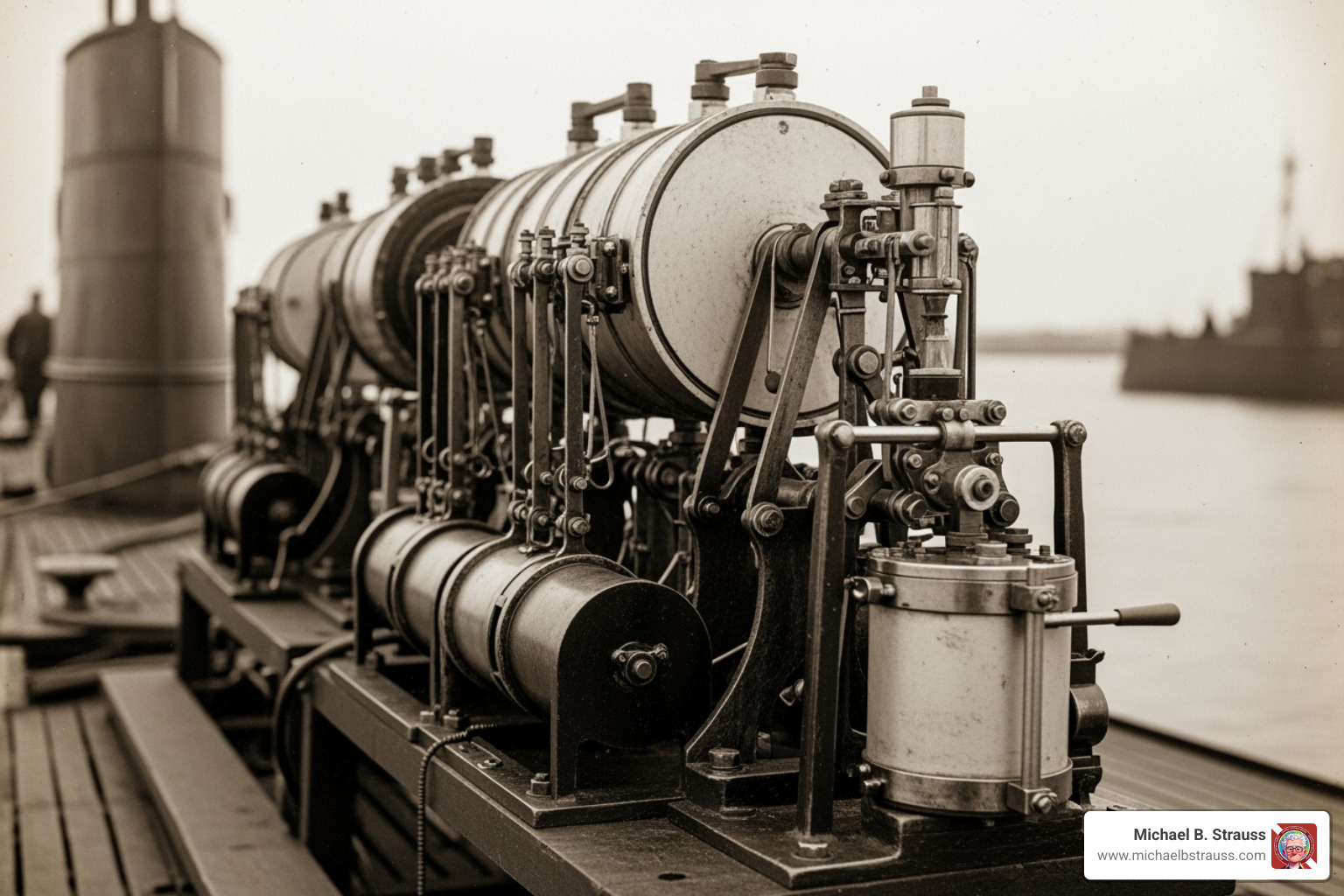
The story of how we talk to each other beneath the waves is one of overcoming physics. In the early 20th century, ships relied on primitive submarine bells to navigate in fog. This evolved into the Fessenden oscillator, a device that could both create and receive underwater sounds, used by submarines for basic signaling. These early tools were the ancestors of the modern underwater communication systems we use today.
However, the ocean is a noisy, difficult place for signals. When we try to send data or voice through water, we face three major hurdles:
- Signal Attenuation: High-frequency sounds are absorbed by water much faster than low-frequency ones. This is why long-range sonar and communication systems often use lower, deeper tones.
- Multipath Propagation: Sound doesn't just travel in a straight line; it bounces off the surface and the sea floor. The receiver often gets the same message multiple times with slight delays, creating a "ghosting" effect that can scramble digital data.
- Limited Bandwidth: Compared to the massive amounts of data we send over Wi-Fi on land, the "pipe" for underwater sound is very narrow. We have to be very efficient with how we pack information into those sound waves.
For a deeper dive into these physics, you can explore how sound is used to communicate underwater.
How Underwater Communication Systems Differ from Terrestrial Radio
On land, we are spoiled by electromagnetic waves (radio, Wi-Fi, LTE). These waves travel at the speed of light. In the ocean, saltwater is a conductor that absorbs these waves almost instantly. Unless you are using Extremely Low Frequency (ELF) waves with antennas miles long, radio isn't an option.
Instead, we use acoustic waves. While sound in water is fast (about 1,500 meters per second), it is still a million times slower than light. This leads to a noticeable signal delay. If you are communicating over a few kilometers, you might have to wait several seconds for a response—much like the delay on an old satellite phone call. Furthermore, denoising underwater signals is a constant challenge for engineers trying to separate a diver's voice from the crackle of snapping shrimp or the drone of a boat engine.
Modulation Techniques: FSK, PSK, and OFDM
To send digital information via sound, we use "modulation"—basically, a way of changing the sound wave to represent ones and zeros.
- FSK (Frequency Shift Keying): This is the simplest method. It uses two different pitches to represent data. It's robust and works well in harsh conditions but is relatively slow.
- PSK (Phase Shift Keying): This method changes the "phase" or timing of the wave. it allows for higher data rates but is more sensitive to the movement of the diver (the Doppler effect).
- OFDM (Orthogonal Frequency Division Multiplexing): This is the heavy hitter. It breaks the data into many small chunks and sends them simultaneously over different frequencies. It is highly resilient against the "multipath" echoes mentioned earlier.
- CPM (Continuous Phase Modulation): This technique helps keep the signal "smooth," which reduces interference with other frequencies and improves efficiency in the limited bandwidth of the ocean.
The JANUS Protocol and Digital Interoperability
For a long time, different manufacturers made systems that couldn't talk to each other. In 2017, NATO approved JANUS, the first international standardized protocol for underwater digital communication.
Documented as STANAG 4748, JANUS allows different devices to "handshake" and exchange basic info. It uses frequencies between 900 Hz and 60 kHz. Think of it as the "Wi-Fi standard" for the ocean. It’s designed to be simple and robust, allowing for emergency location, underwater "chat," and even an underwater version of AIS (Automatic Identification System) to help submarines and divers avoid collisions.
Practical Applications and Safety in Modern Diving
While the military uses these systems for stealth and coordination, the rest of us use them to make diving safer and more social. In recreational diving, being able to say "Look at that turtle!" is fun, but being able to say "I'm low on air" or "I have a cramp" is a game-changer for safety.
Diver-to-Diver and Surface-to-Diver Underwater Communication Systems
Modern systems generally fall into three categories:
- Wireless Transceivers: Most recreational systems are wireless. They use a transducer (a waterproof speaker/mic) to send acoustic signals through the water. Most use a "Push-to-Talk" (PTT) system similar to a walkie-talkie.
- Surface-to-Diver (B2D): These units allow a boat captain to talk to everyone in the water. Some systems, like the "Boat 2 Diver" recall units, are used primarily for safety to tell divers to return to the boat immediately.
- Hardwired Systems: Used mostly in commercial and military diving, these involve a physical cable (an umbilical) running from the surface to the diver. These offer crystal-clear voice quality and unlimited "battery" life but restrict the diver's movement.
For tech-savvy divers, there are even emerging technologies like ultrasonic pings for simple "I'm OK" signals and smartphone apps that use the phone's built-in speaker and mic (inside a waterproof housing) to send text messages over short distances.
Essential Hardware and Acoustic Modem Ranges
To use a voice-based system, you usually need a full-face mask (FFM). This provides an air pocket that allows you to move your jaw and speak clearly. Without an FFM, you’d have to use a "mouthpiece" microphone, which can be difficult to use and less clear.
Other essential hardware includes:
- Bone Conduction Headphones: These sit against your temple and vibrate your skull to let you "hear" the sound, leaving your ears open to hear the ambient environment.
- Transducers: The heart of the system, these convert electrical signals into sound waves.
- Directional Sensors: Advanced systems use vector sensors to determine exactly where a signal is coming from, helping you locate your buddy in low visibility.
Typical Ranges and Rates:
Enhancing Dive Safety with Michael B. Strauss
At the end of the day, all the technology in the world is just a tool. The real goal is a safe return to the surface. Dr. Michael B. Strauss has dedicated his career to the science of diving safety and diving-science.
In his extensive series of books for scuba divers, Dr. Strauss emphasizes that communication is the bedrock of operational efficiency. Whether you are managing a complex decompression-science schedule or just navigating a reef, the ability to communicate clearly reduces stress and prevents minor issues from turning into emergencies.
By integrating modern underwater communication systems with the safety protocols outlined in Dr. Strauss’s research, divers can significantly enhance their enjoyment of the underwater world. Safety isn't just about having the right gear; it's about having the right information at the right time.
For more information on dive safety and professional insights, we encourage you to explore our resources and ensure your next adventure is as safe as it is thrilling.
Learn more about Michael B. Strauss's Diving Science services
To get or buy the book "Diving Science Revisited," please visit: https://www.bestpub.com/view-all-products/product/diving-science-revisited/category_pathway-48.html
DISCLAIMER: Articles are for "EDUCATIONAL PURPOSES ONLY", not to be considered advice or recommendations.


