Read story

The Ocean Is 80% Unexplored — Underwater Robotics Research Is Changing That
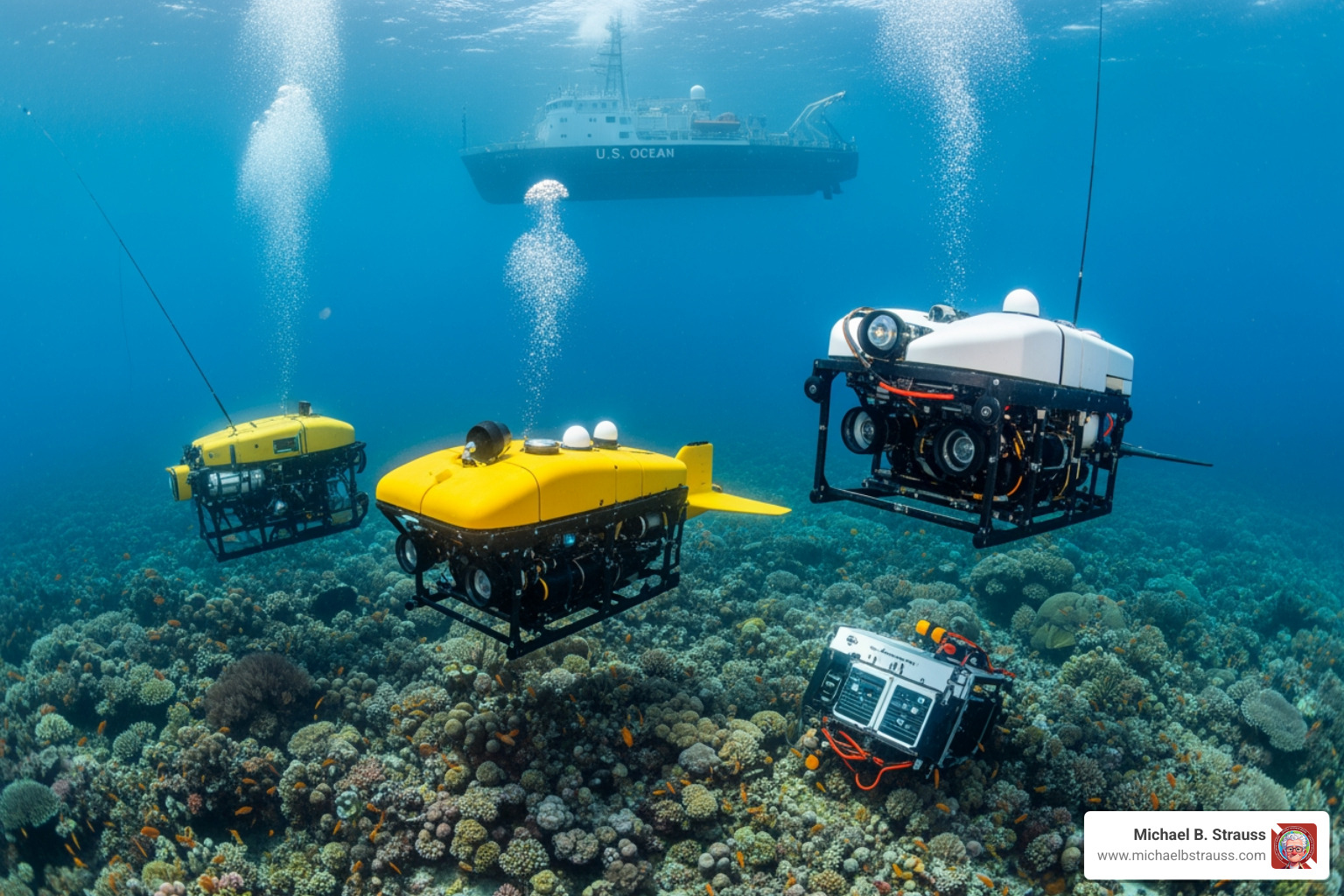
underwater robotics research

Underwater robotics research is the study and development of robotic systems designed to operate beneath the ocean's surface — including remotely operated vehicles (ROVs), autonomous underwater vehicles (AUVs), and emerging humanoid robots.

Here's a quick overview of what this field covers:

  • What it is: Engineering and science focused on building robots that can explore, monitor, and work underwater
  • Key vehicle types: ROVs (tether-controlled), AUVs (fully autonomous), and intervention AUVs (capable of manipulation tasks)
  • Main applications: Ocean science, oil and gas inspection, military operations, search and rescue, and deep-sea archaeology
  • Why it matters: About 80% of the ocean remains unexplored, and robotic systems are the primary tool for changing that
  • Market size: The global underwater robotics market was valued at $2.685 billion in 2020 and is projected to reach $6.719 billion by 2028, growing at a 12.15% CAGR

Think about this for a moment. The deep ocean is the largest habitat on Earth — and we've mapped more of the surface of Mars than our own ocean floor. That's not a small gap. It's a massive one.

Underwater robots are filling it.

These machines let scientists observe chemical, biological, and physical ocean processes over longer periods and across wider areas than any ship-based method could achieve. They go where humans simply can't — under Arctic ice, through hurricane-force currents, and down to depths where the pressure would crush a submarine.

The field is advancing fast. New algorithms help robots survive extreme weather. Acoustic navigation is getting cheaper and more reliable. Humanoid robots are now capable of picking up 2,000-year-old artifacts from the seafloor. And fleets of autonomous vehicles are beginning to monitor entire ocean ecosystems with minimal human oversight.

This guide breaks down the technology, the challenges, the key research players, and where the field is headed next.
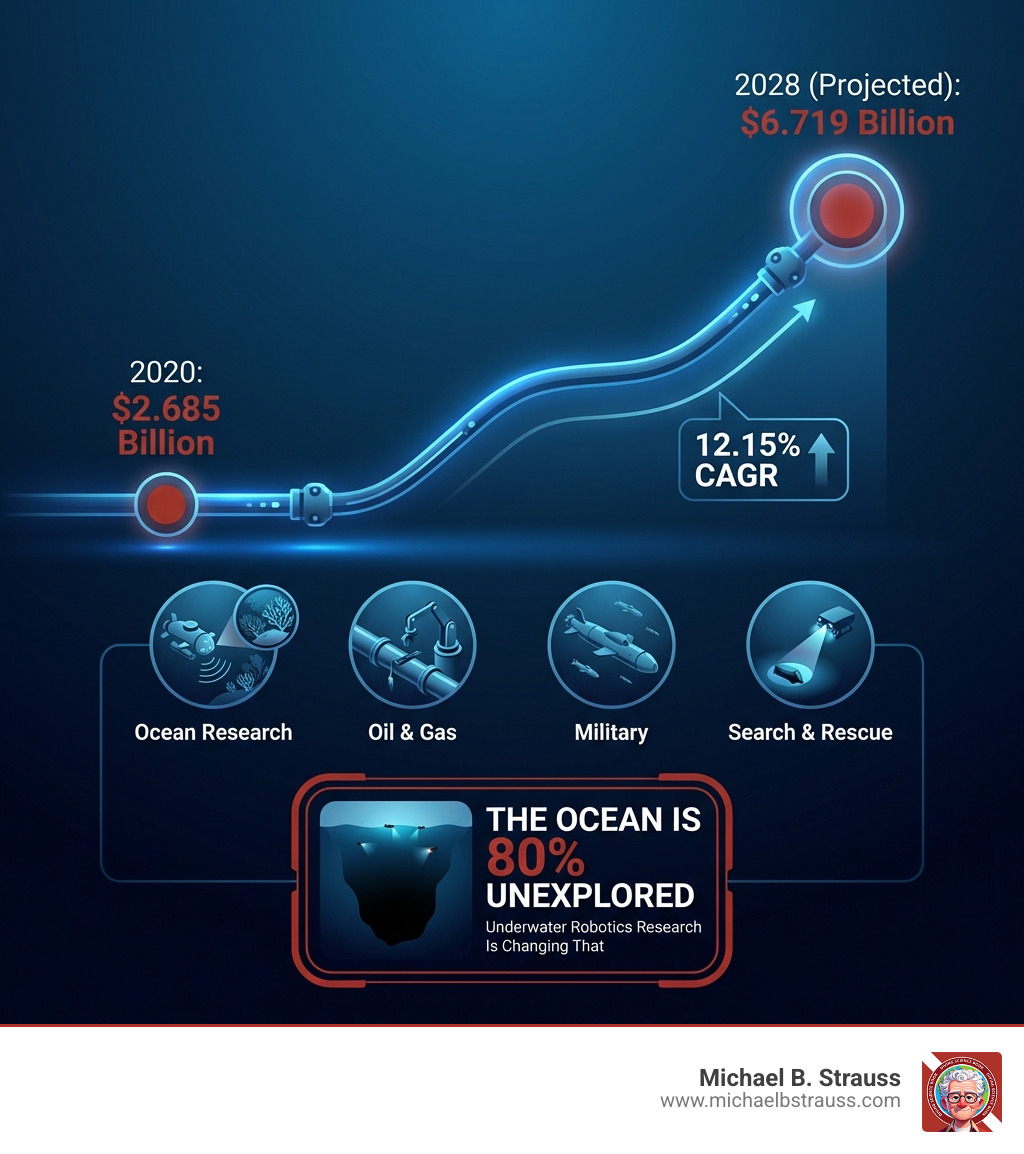
Infographic showing the global underwater robotics market growth from $2.685 billion in 2020 to a projected $6.719 billion in 2028 at a 12.15% CAGR, with icons representing key application areas including ocean research, oil and gas, military, search and rescue, and a callout that 80% of the ocean remains unexplored - underwater robotics research infographic

Essential underwater robotics research terms:

The Evolution of Underwater Robotics Research and Technology
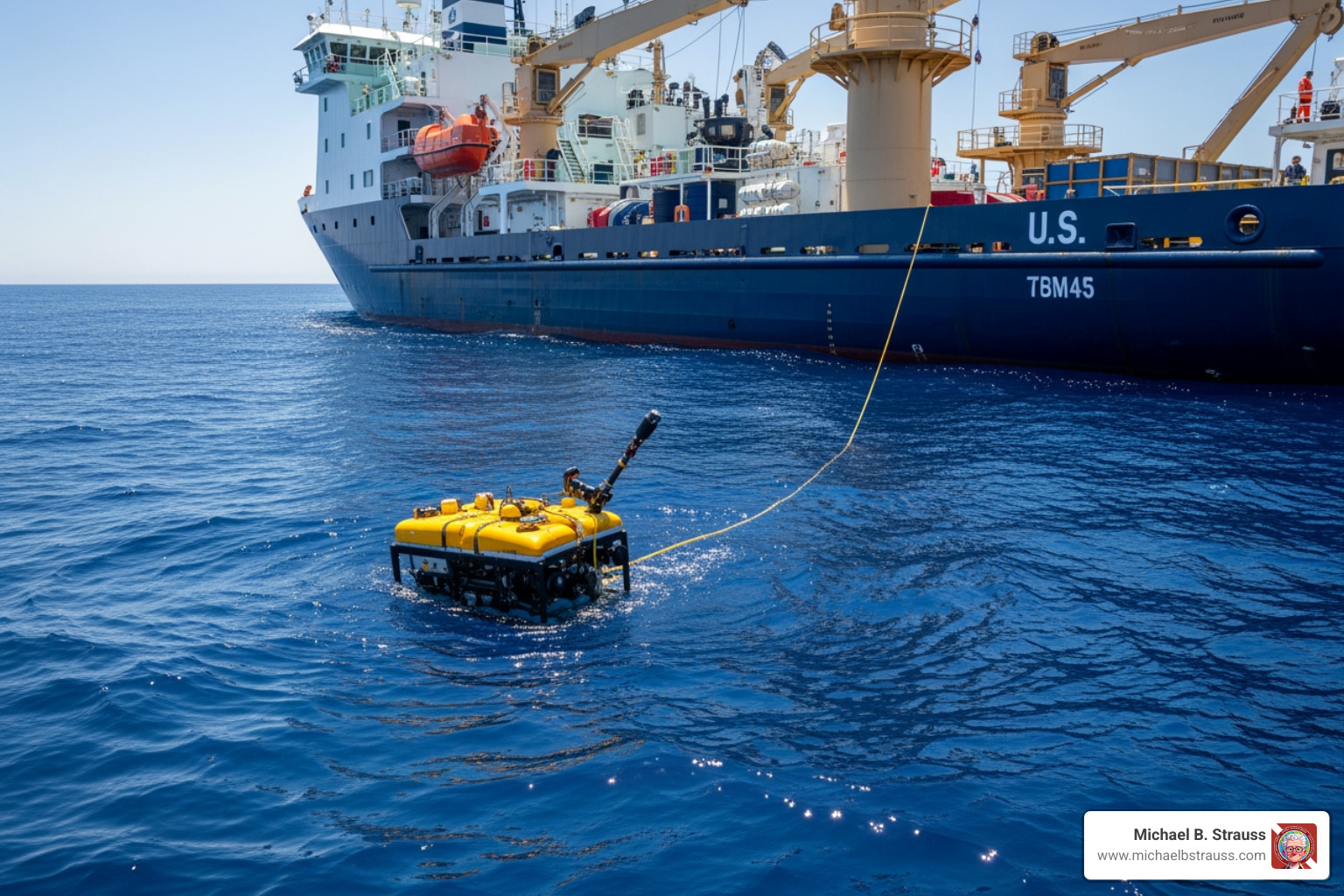
a remotely operated vehicle tethered to a research vessel - underwater robotics research

The journey of underwater robotics research began with a simple need: to see what lies beneath the waves without putting human lives at risk. Historically, the military and the offshore oil and gas industry drove the early stages of this technology. Today, nearly 30 percent of global oil and gas production comes from offshore sources, which has necessitated the development of highly reliable robotic platforms.

In the early days, we relied almost exclusively on Remotely Operated Vehicles (ROVs). These are tethered robots controlled by a pilot on a ship. While ROVs are incredibly powerful and provide real-time high-definition video, they are limited by the length of their "leash."

The field has since evolved toward Autonomous Underwater Vehicles (AUVs). These robots are the "self-driving cars" of the ocean. They are pre-programmed with a mission and can stay submerged for days or even weeks. Recent scientific research on autonomous sampling has even shown how AUVs can collect environmental DNA (eDNA) to track marine life, expanding our ability to monitor biodiversity across vast spatial and temporal scales.

We are also seeing the rise of Intervention AUVs (I-AUVs), which combine the autonomy of an AUV with the mechanical arms (manipulators) of an ROV. Even more exciting is the development of Underwater Humanoid Robots (UHRs), which mimic human form and dexterity to perform delicate tasks like archaeological recovery.

FeatureROVs (Remotely Operated)AUVs (Autonomous)UHRs (Humanoid)
ControlReal-time human pilotPre-programmed/AIHaptic/Telepresence
ConnectionPhysical tether (cable)UntetheredUsually untethered
Best UseHeavy construction, repairLarge-scale mapping, dataDelicate manipulation
PowerUnlimited (via tether)Battery-limitedBattery-limited

Sensing and Perception in Underwater Robotics Research

For a robot to be useful, it needs to "see" and "feel" its environment. However, the ocean is a nightmare for standard sensors. Light doesn't travel far, and the water is often murky. This is why underwater robotics research focuses heavily on multimodal sensor fusion—combining different types of "eyes" to build a complete picture.

  1. Sonar (Acoustic Sensing): Since sound travels much better than light in water, sonar is the primary tool for long-range navigation. Forward-Looking Sonar (FLS) can provide millimeter resolution at close ranges, helping robots avoid obstacles.
  2. Optical Cameras: These are used for close-up inspections and creating 3D photomosaics of the seafloor. The challenge is that they require powerful lights and are limited by water turbidity.
  3. Chemical and Biological Sensors: Modern robots carry "lab-on-a-chip" technology to measure oxygen levels, pH, and even detect specific chemical plumes from deep-sea vents.
  4. Acoustic Navigation: Much like GPS uses satellites, underwater robots use acoustic beacons to find their position. This has historically been expensive, but recent scientific research on acoustic navigation algorithms has developed software that guarantees accurate positioning even with cheaper, less reliable sensors. This breakthrough could lower the cost of high-precision missions from $500,000 to just $10,000.

Overcoming Environmental Challenges in Underwater Robotics Research

Working underwater is like working on another planet. The pressure is immense, the temperature is near freezing, and communication is incredibly slow. In underwater robotics research, we face several "brick wall" challenges that require clever engineering to bypass.

Communication Latency: Water blocks radio waves. This means we can't use Wi-Fi or standard GPS. Communication happens through acoustic modems, which are slow and prone to lag. To solve this, projects like DexROV use "cognitive engines" to predict what the robot should do next, helping onshore pilots manage deep-sea tasks despite a several-second delay.

Motion Stability: Ocean currents are unpredictable. A robot trying to turn a valve or take a photo needs to stay perfectly still. Researchers use bio-inspired designs—mimicking the fins of a fish or the movements of a jellyfish—to create more stable, agile vehicles.

Extreme Weather: Hurricanes are the ultimate test. While traditional robots might be lost in such turbulence, researchers are now using Tech Tank simulations to test "hurricane-resistant" algorithms. These algorithms use information theory to provide mathematical guarantees that a robot will survive and return home, even in the worst-case scenarios.

Terrain-Based Navigation: When a robot is deep in a trench, it can't "call home" for a position fix. Instead, it uses SLAM (Simultaneous Localization and Mapping) to recognize seafloor features—like a specific rock formation or a shipwreck—to figure out where it is.

Leading Institutions and Real-World Projects

The heavy lifting in this field is often done by dedicated research institutions. Organizations like MBARI (Monterey Bay Aquarium Research Institute) are pioneers in developing "onboard intelligence." Their Long-range AUVs (LRAUVs) can spend weeks at sea, docking at underwater stations to recharge and upload data without ever needing a human crew to pull them out of the water.

In Europe, groups like Girona Underwater Vision and Robotics have spent over 20 years becoming a benchmark for AUV design. They specialize in creating high-quality 2D and 3D photomosaics, which are essential for mapping the seafloor and monitoring coral reefs.

One of the most impressive feats of recent years is the OceanOneK project. This humanoid robot was designed to reach depths of 1,000 meters. During its missions, it successfully recovered a 2,000-year-old Roman oil lamp from a shipwreck. What makes it special is the haptic feedback—the pilot on the surface can actually "feel" the weight and texture of the objects the robot touches.

To help the public and other researchers understand these deep-sea environments, MBARI provides the Deep-Sea Guide, an interactive tool that catalogs decades of deep-sea observations.

Future Frontiers and Industry Applications

As underwater robotics research matures, the applications are expanding far beyond just "looking at fish." We are entering an era of "resident robotics," where robots live permanently on the seafloor to maintain infrastructure or monitor the environment.

  • Oil and Gas: Robots are used for autonomous pipeline inspection and valve manipulation, reducing the need for dangerous human dives.
  • Military: The US Navy has invested heavily (over $1.7 billion in a single year) in unmanned underwater vehicles for mine countermeasures and surveillance.
  • Search and Rescue: Robots like the Bluefin-21 (used in the search for MH370) can scan vast areas of the seafloor that are inaccessible to divers.
  • Climate Research: Robots are being deployed under Arctic ice to measure melting glaciers, providing critical data for predicting sea-level rise.
  • AI and Machine Learning: Using AI to automatically identify species or detect structural cracks in real-time.
  • Cooperative Multi-Robot Systems: "Swarms" of small, cheap robots working together to map a large area faster than one expensive robot could.
  • Bio-inspired Sensing: Developing "robotic skins" with gel-based sensors that can feel pressure and strain just like biological organisms.
  • Sustainable Exploration: Using wave-gliders and solar-powered surface vessels to provide long-term power to submerged robotic fleets.

Advancing Safety and Exploration with Michael B. Strauss

While robots are taking over many of the most dangerous tasks, the human element remains vital, especially in scientific diving and complex underwater interventions. Understanding the intersection of technology and human physiology is where the work of Dr. Michael B. Strauss becomes essential.

Whether you are a researcher operating a humanoid robot via a haptic interface or a diver working alongside an AUV, safety is the foundation of every successful mission. Dr. Strauss, a renowned expert in diving safety, provides the necessary framework for understanding how we can safely push the boundaries of ocean exploration. His books are essential reads for anyone interested in diving science, offering insights that bridge the gap between traditional diving and the high-tech future of underwater work.

As we continue to develop smarter, more resilient robots, our goal remains the same: to unlock the secrets of the 80% of our planet that remains hidden beneath the waves. By combining cutting-edge underwater robotics research with a rigorous commitment to safety and education, we are finally moving toward a truly sustainable and comprehensive understanding of our oceans.

To further explore the intersection of human capability and underwater technology, you can buy the book "Diving Science Revisited" here: https://www.bestpub.com/view-all-products/product/diving-science-revisited/category_pathway-48.html

DISCLAIMER: Articles are for "EDUCATIONAL PURPOSES ONLY", not to be considered advice or recommendations.

Download Full PDF
Tags:

The Ocean Is 80% Unexplored — Underwater Robotics Research Is Changing That

underwater robotics research

Underwater robotics research is the study and development of robotic systems designed to operate beneath the ocean's surface — including remotely operated vehicles (ROVs), autonomous underwater vehicles (AUVs), and emerging humanoid robots.

Here's a quick overview of what this field covers:

  • What it is: Engineering and science focused on building robots that can explore, monitor, and work underwater
  • Key vehicle types: ROVs (tether-controlled), AUVs (fully autonomous), and intervention AUVs (capable of manipulation tasks)
  • Main applications: Ocean science, oil and gas inspection, military operations, search and rescue, and deep-sea archaeology
  • Why it matters: About 80% of the ocean remains unexplored, and robotic systems are the primary tool for changing that
  • Market size: The global underwater robotics market was valued at $2.685 billion in 2020 and is projected to reach $6.719 billion by 2028, growing at a 12.15% CAGR

Think about this for a moment. The deep ocean is the largest habitat on Earth — and we've mapped more of the surface of Mars than our own ocean floor. That's not a small gap. It's a massive one.

Underwater robots are filling it.

These machines let scientists observe chemical, biological, and physical ocean processes over longer periods and across wider areas than any ship-based method could achieve. They go where humans simply can't — under Arctic ice, through hurricane-force currents, and down to depths where the pressure would crush a submarine.

The field is advancing fast. New algorithms help robots survive extreme weather. Acoustic navigation is getting cheaper and more reliable. Humanoid robots are now capable of picking up 2,000-year-old artifacts from the seafloor. And fleets of autonomous vehicles are beginning to monitor entire ocean ecosystems with minimal human oversight.

This guide breaks down the technology, the challenges, the key research players, and where the field is headed next.

Infographic showing the global underwater robotics market growth from $2.685 billion in 2020 to a projected $6.719 billion in 2028 at a 12.15% CAGR, with icons representing key application areas including ocean research, oil and gas, military, search and rescue, and a callout that 80% of the ocean remains unexplored - underwater robotics research infographic

Essential underwater robotics research terms:

The Evolution of Underwater Robotics Research and Technology

a remotely operated vehicle tethered to a research vessel - underwater robotics research

The journey of underwater robotics research began with a simple need: to see what lies beneath the waves without putting human lives at risk. Historically, the military and the offshore oil and gas industry drove the early stages of this technology. Today, nearly 30 percent of global oil and gas production comes from offshore sources, which has necessitated the development of highly reliable robotic platforms.

In the early days, we relied almost exclusively on Remotely Operated Vehicles (ROVs). These are tethered robots controlled by a pilot on a ship. While ROVs are incredibly powerful and provide real-time high-definition video, they are limited by the length of their "leash."

The field has since evolved toward Autonomous Underwater Vehicles (AUVs). These robots are the "self-driving cars" of the ocean. They are pre-programmed with a mission and can stay submerged for days or even weeks. Recent scientific research on autonomous sampling has even shown how AUVs can collect environmental DNA (eDNA) to track marine life, expanding our ability to monitor biodiversity across vast spatial and temporal scales.

We are also seeing the rise of Intervention AUVs (I-AUVs), which combine the autonomy of an AUV with the mechanical arms (manipulators) of an ROV. Even more exciting is the development of Underwater Humanoid Robots (UHRs), which mimic human form and dexterity to perform delicate tasks like archaeological recovery.

FeatureROVs (Remotely Operated)AUVs (Autonomous)UHRs (Humanoid)
ControlReal-time human pilotPre-programmed/AIHaptic/Telepresence
ConnectionPhysical tether (cable)UntetheredUsually untethered
Best UseHeavy construction, repairLarge-scale mapping, dataDelicate manipulation
PowerUnlimited (via tether)Battery-limitedBattery-limited

Sensing and Perception in Underwater Robotics Research

For a robot to be useful, it needs to "see" and "feel" its environment. However, the ocean is a nightmare for standard sensors. Light doesn't travel far, and the water is often murky. This is why underwater robotics research focuses heavily on multimodal sensor fusion—combining different types of "eyes" to build a complete picture.

  1. Sonar (Acoustic Sensing): Since sound travels much better than light in water, sonar is the primary tool for long-range navigation. Forward-Looking Sonar (FLS) can provide millimeter resolution at close ranges, helping robots avoid obstacles.
  2. Optical Cameras: These are used for close-up inspections and creating 3D photomosaics of the seafloor. The challenge is that they require powerful lights and are limited by water turbidity.
  3. Chemical and Biological Sensors: Modern robots carry "lab-on-a-chip" technology to measure oxygen levels, pH, and even detect specific chemical plumes from deep-sea vents.
  4. Acoustic Navigation: Much like GPS uses satellites, underwater robots use acoustic beacons to find their position. This has historically been expensive, but recent scientific research on acoustic navigation algorithms has developed software that guarantees accurate positioning even with cheaper, less reliable sensors. This breakthrough could lower the cost of high-precision missions from $500,000 to just $10,000.

Overcoming Environmental Challenges in Underwater Robotics Research

Working underwater is like working on another planet. The pressure is immense, the temperature is near freezing, and communication is incredibly slow. In underwater robotics research, we face several "brick wall" challenges that require clever engineering to bypass.

Communication Latency: Water blocks radio waves. This means we can't use Wi-Fi or standard GPS. Communication happens through acoustic modems, which are slow and prone to lag. To solve this, projects like DexROV use "cognitive engines" to predict what the robot should do next, helping onshore pilots manage deep-sea tasks despite a several-second delay.

Motion Stability: Ocean currents are unpredictable. A robot trying to turn a valve or take a photo needs to stay perfectly still. Researchers use bio-inspired designs—mimicking the fins of a fish or the movements of a jellyfish—to create more stable, agile vehicles.

Extreme Weather: Hurricanes are the ultimate test. While traditional robots might be lost in such turbulence, researchers are now using Tech Tank simulations to test "hurricane-resistant" algorithms. These algorithms use information theory to provide mathematical guarantees that a robot will survive and return home, even in the worst-case scenarios.

Terrain-Based Navigation: When a robot is deep in a trench, it can't "call home" for a position fix. Instead, it uses SLAM (Simultaneous Localization and Mapping) to recognize seafloor features—like a specific rock formation or a shipwreck—to figure out where it is.

Leading Institutions and Real-World Projects

The heavy lifting in this field is often done by dedicated research institutions. Organizations like MBARI (Monterey Bay Aquarium Research Institute) are pioneers in developing "onboard intelligence." Their Long-range AUVs (LRAUVs) can spend weeks at sea, docking at underwater stations to recharge and upload data without ever needing a human crew to pull them out of the water.

In Europe, groups like Girona Underwater Vision and Robotics have spent over 20 years becoming a benchmark for AUV design. They specialize in creating high-quality 2D and 3D photomosaics, which are essential for mapping the seafloor and monitoring coral reefs.

One of the most impressive feats of recent years is the OceanOneK project. This humanoid robot was designed to reach depths of 1,000 meters. During its missions, it successfully recovered a 2,000-year-old Roman oil lamp from a shipwreck. What makes it special is the haptic feedback—the pilot on the surface can actually "feel" the weight and texture of the objects the robot touches.

To help the public and other researchers understand these deep-sea environments, MBARI provides the Deep-Sea Guide, an interactive tool that catalogs decades of deep-sea observations.

Future Frontiers and Industry Applications

As underwater robotics research matures, the applications are expanding far beyond just "looking at fish." We are entering an era of "resident robotics," where robots live permanently on the seafloor to maintain infrastructure or monitor the environment.

  • Oil and Gas: Robots are used for autonomous pipeline inspection and valve manipulation, reducing the need for dangerous human dives.
  • Military: The US Navy has invested heavily (over $1.7 billion in a single year) in unmanned underwater vehicles for mine countermeasures and surveillance.
  • Search and Rescue: Robots like the Bluefin-21 (used in the search for MH370) can scan vast areas of the seafloor that are inaccessible to divers.
  • Climate Research: Robots are being deployed under Arctic ice to measure melting glaciers, providing critical data for predicting sea-level rise.
  • AI and Machine Learning: Using AI to automatically identify species or detect structural cracks in real-time.
  • Cooperative Multi-Robot Systems: "Swarms" of small, cheap robots working together to map a large area faster than one expensive robot could.
  • Bio-inspired Sensing: Developing "robotic skins" with gel-based sensors that can feel pressure and strain just like biological organisms.
  • Sustainable Exploration: Using wave-gliders and solar-powered surface vessels to provide long-term power to submerged robotic fleets.

Advancing Safety and Exploration with Michael B. Strauss

While robots are taking over many of the most dangerous tasks, the human element remains vital, especially in scientific diving and complex underwater interventions. Understanding the intersection of technology and human physiology is where the work of Dr. Michael B. Strauss becomes essential.

Whether you are a researcher operating a humanoid robot via a haptic interface or a diver working alongside an AUV, safety is the foundation of every successful mission. Dr. Strauss, a renowned expert in diving safety, provides the necessary framework for understanding how we can safely push the boundaries of ocean exploration. His books are essential reads for anyone interested in diving science, offering insights that bridge the gap between traditional diving and the high-tech future of underwater work.

As we continue to develop smarter, more resilient robots, our goal remains the same: to unlock the secrets of the 80% of our planet that remains hidden beneath the waves. By combining cutting-edge underwater robotics research with a rigorous commitment to safety and education, we are finally moving toward a truly sustainable and comprehensive understanding of our oceans.

To further explore the intersection of human capability and underwater technology, you can buy the book "Diving Science Revisited" here: https://www.bestpub.com/view-all-products/product/diving-science-revisited/category_pathway-48.html

DISCLAIMER: Articles are for "EDUCATIONAL PURPOSES ONLY", not to be considered advice or recommendations.